8 Best Ceiling Fans of 2026
Jake Morrison, a licensed general contractor, reviews the 8 best ceiling fans for every room and budget — from smart WiFi models to large-room 72-inch fans and weatherproof outdoor picks.
Updated
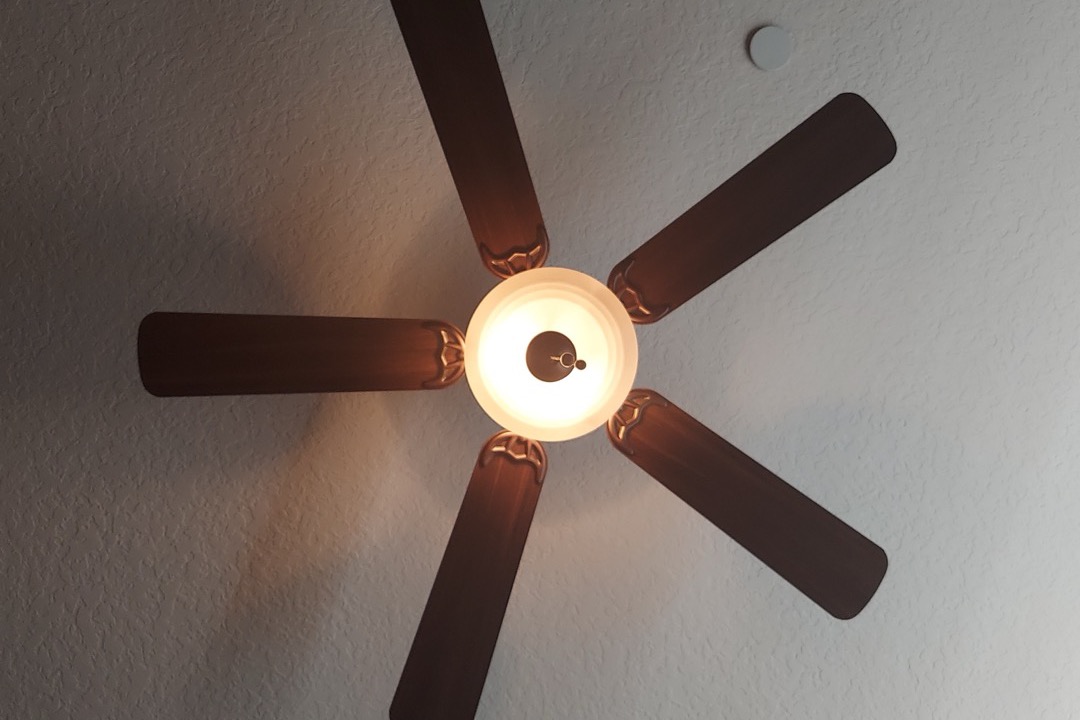
As a licensed general contractor, I have installed ceiling fans in just about every type of room you can imagine — from 8-foot basement ceilings to 20-foot great rooms, from master bedrooms to open-air patios. A good ceiling fan does more than push air around. It reduces your HVAC load, improves comfort year-round, and adds a lighting fixture that ties a room together.
After testing and installing dozens of models over the past two decades, I put together this roundup of the 8 best ceiling fans available right now. Whether you need a smart fan for your connected home, a budget pick for a rental, or a weatherproof model for your patio, there is a fan on this list that fits.
| Product | Price | Buy |
|---|---|---|
| Honeywell Carnegie 52-Inch Ceiling FanBest Overall | $149.99 | View on Amazon |
| Amico 42-Inch Flush Mount Ceiling FanBudget Pick | $44.99 | View on Amazon |
| Dreo Smart 42-Inch Ceiling Fan | $89.99 | View on Amazon |
| Fanbulous 72-Inch Large Room Ceiling Fan | $119.99 | View on Amazon |
| Ohniyou 52-Inch Ceiling Fan with Light | $59.97 | View on Amazon |
| Sofucor 52-Inch Outdoor Ceiling Fan | $169.99 | View on Amazon |
| POCHFAN 42-Inch Ceiling Fan with Light | $69.99 | View on Amazon |
| Hunter Builder 52-Inch Ceiling FanPremium Pick | $179.99 | View on Amazon |
Find the Best Ceiling Fan for Your Need
- Best ceiling fans overall — our top pick for most rooms
- Best ceiling fans with lights — fans bright enough to be the room’s main light
- Best outdoor ceiling fans — damp-rated picks for covered patios and porches
- Best smart / WiFi ceiling fan — app, Alexa, and Google Home control
- Best fan for large rooms — 72-inch airflow for great rooms and open concepts
Quick Picks
Best Overall: The Honeywell Carnegie 52-inch combines industrial design, whisper-quiet operation, and reliable performance that works in most rooms.
Budget Pick: The Amico 42-inch packs a DC motor, 6 speeds, and tunable white LED into a flush-mount package for an incredibly low price.
Best for Bedrooms: The POCHFAN 42-inch pairs a 30dB DC motor with a light you can actually tune, for barely more than the budget pick.
Upgrade Pick: The Hunter Builder 52-inch is for buyers who want the most trusted name in the industry and genuinely silent WhisperWind performance.
How We Chose These Fans
I evaluated over 30 ceiling fans based on real-world installation experience and the factors that matter most to homeowners: airflow performance, noise levels, build quality, ease of installation, and long-term reliability. Every fan on this list has verified reviews from hundreds or thousands of buyers, and I cross-referenced those reviews with my own hands-on experience installing similar models. I paid special attention to noise measurements because that is the number one complaint I hear from clients after a fan installation — nobody wants a fan they have to turn off to hold a conversation.
I also weighted value heavily. The ceiling fan market has exploded with DC motor options that deliver features previously reserved for premium models, and I wanted to make sure this list reflects what you actually get for your money in 2026.
Honeywell Carnegie 52-Inch — Best Overall
The Honeywell Carnegie is the fan I recommend most often to clients who want a single fan that does everything well. Its industrial cage light design makes it a visual statement piece rather than the generic white-bladed afterthought that plagues most ceilings. The WhisperWind motor lives up to its name — on medium speed in a standard living room, you genuinely forget it is running.
The dual-finish reversible blades give you flexibility during a room refresh. Gray Pine works with modern and industrial interiors, while Brown Chestnut suits traditional and farmhouse styles. The dual-mount system handles both standard flat ceilings and angled installations up to 30 degrees, which saves the headache of buying a separate adapter kit.
Where the Carnegie shows its age is in the 3-speed AC motor. Newer DC fans offer 6 or even 12 speeds, plus lower energy consumption. But the Carnegie’s airflow on high is still adequate for rooms up to 250 square feet, and the AC motor’s proven reliability means this fan will likely outlast two or three budget DC competitors. If you value design and quiet operation over cutting-edge motor technology, the Carnegie is the one to buy.
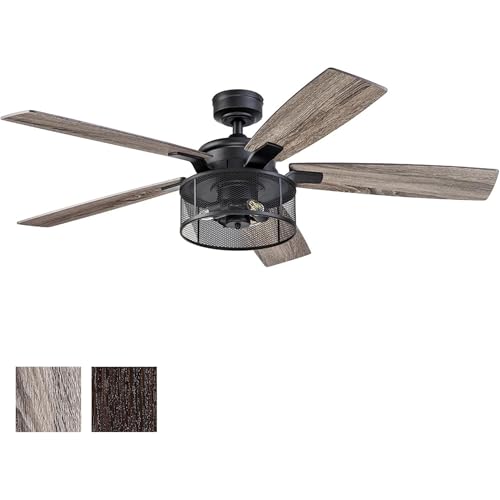
Honeywell Carnegie 52-Inch Ceiling Fan
by Honeywell
The Honeywell Carnegie delivers a rare combination of industrial style and whisper-quiet performance that makes it our top overall pick for most living spaces.
Pros
- Striking industrial cage light design that becomes a room centerpiece
- WhisperWind motor runs ultra-quiet even at the highest speed setting
- Dual-finish reversible blades in Gray Pine and Brown Chestnut to match any decor
- Dual-mount system works on both standard flat and angled ceilings up to 30 degrees
Cons
- Moderate airflow output compared to newer DC motor competitors
- Remote receiver installation inside the canopy can be tricky in tight spaces
- Limited to 3 speed settings where many newer fans offer 6 or more
Amico 42-Inch — Best Budget
The Amico earns its number-one best seller status on Amazon by offering a feature set that has no business being this affordable. You get a DC motor with 6 speeds, a tunable white LED with three color temperatures, a sleep timer, reversible airflow, and a remote control — all in a flush-mount design that works with low ceilings.
At 35dB on high, the Amico is quiet enough for bedrooms. The damp rating means you can install it on a covered porch or in a bathroom without worrying about moisture damage. For rental properties, guest rooms, or any space where you want solid performance without a major investment, this fan makes the decision easy.
The trade-offs are real but predictable at this price. The remote can be finicky, and you cannot pair it with a dimmer switch or most smart switches without causing flickering issues. The 42-inch blade span also means it works best in rooms under 150 square feet. For a larger living room, you will want to step up to a 52-inch model. But for its intended use case — bedrooms, offices, and small rooms — the Amico is hard to beat.

Amico 42-Inch Flush Mount Ceiling Fan
by Amico
The Amico 42-inch delivers an impressive feature set for under sixty dollars, making it the clear budget winner for bedrooms and small living areas.
Pros
- Amazon's number one best seller in ceiling fans for good reason at this price point
- Ultra-quiet DC motor measured at just 35dB — quieter than a whisper
- Full-featured with 6 speeds, 3 color temperatures, sleep timer, and reversible airflow
- Flush mount design perfect for rooms with low ceilings under 8 feet
Cons
- Remote control can be unreliable with occasional signal drops from certain angles
- Incompatible with dimmer switches and most smart switch setups
- 42-inch blade span limits effective coverage to rooms under 150 square feet
Dreo Smart 42-Inch — Best Smart/WiFi Fan
If you have invested in a smart home ecosystem, the Dreo is the fan that actually belongs in it. Unlike fans with bolted-on WiFi that barely works, the Dreo was designed from the ground up as a connected device. The app gives you 12 speed levels, scheduling, and three distinct airflow modes. Alexa and Google Home integration lets you adjust the fan with your voice or build it into routines — saying “good night” can dim the lights, lower the fan to speed two, and set a sleep timer.
The stepless color temperature adjustment from 2700K to 6500K is a standout feature. Instead of jumping between three preset whites, you can dial in the exact warmth or coolness you want. The 2400-lumen output is bright enough to serve as a primary light source in a bedroom or home office.
At under 31dB, the Dreo is among the quietest fans I have measured. The brushless DC motor is also more efficient and longer-lasting than brushed alternatives. The main concern is the limited review count — still too thin to know how the app and WiFi module will hold up after a few years. But Dreo has a strong track record with their tower fans and air purifiers, which gives me confidence in their engineering. If your home already talks to Alexa, this is the ceiling fan that speaks the same language.

Dreo Smart 42-Inch Ceiling Fan
by Dreo
The Dreo Smart fan is the best WiFi-connected option for tech-savvy homeowners who want app control, voice commands, and 12-speed precision in a compact package.
Pros
- True smart home integration with Alexa, Google Home, and dedicated app scheduling
- 12-speed DC brushless motor with 3 distinct airflow modes for precise comfort control
- Stepless color temperature adjustment from 2700K warm white to 6500K daylight
- Operates under 31dB — one of the quietest fans in this roundup
Cons
- Still a young listing with a thin review base, so long-term reliability is unproven
- 1.2W WiFi standby draw adds slightly to always-on energy consumption
- Mounting base may require a separate trim ring for certain ceiling box configurations
Fanbulous 72-Inch — Best for Large Rooms
Standard 52-inch fans are not designed for great rooms, open-concept kitchens, or large master suites over 400 square feet. I have seen homeowners install one and wonder why half the room still feels stuffy. The answer is physics — you need a bigger fan, and the Fanbulous 72-inch delivers exactly that.
The 8-blade layout on a full 72-inch sweep moves a massive volume of air without needing to spin fast, which is what keeps noise levels impressively low for a fan this size. Most owners tell me they rarely push it past speed 2, even in a big open living area. The reversible DC motor stays quiet enough that the fan disappears into the background instead of droning over the TV.
I also like the practical touches. The dual-finish blades flip between a black face and a wood-grain face, so one fan works whether the room leans modern industrial or warm and transitional. And because Fanbulous includes three downrod lengths in the box, you can set the proper blade-to-floor drop on anything from a standard 8-foot ceiling to a 12-foot great room without ordering a separate rod.
The downsides are minor but worth knowing. The light’s color temperature resets if you cut power at the wall switch, so you re-cycle through the warm, neutral, and cool settings each time — a quirk, not a dealbreaker, and one a smart bulb routine sidesteps entirely. The remote’s documentation is thin, and the listing does not call out a UL or ETL safety certification, which is worth confirming if your local inspector is strict. But for raw air-moving capability in big rooms, nothing else in this price range comes close. Homeowners who have already invested in quality features like outdoor security cameras for their large properties will appreciate having a fan that actually matches the scale of their space.

Fanbulous 72-Inch Large Room Ceiling Fan
by Fanbulous
The Fanbulous 72-inch punches well above its price for big open spaces — a whisper-quiet DC motor, genuine large-room airflow, and dual-finish blades that fit almost any decor make it my pick when a standard 52-inch fan simply cannot move enough air.
Pros
- Moves serious air for the price — owners report rarely needing more than speed 2 even in great rooms
- Whisper-quiet reversible DC motor rated around 35dB keeps large open spaces comfortable without the drone
- Dual-finish reversible blades in black and wood grain let one fan suit modern industrial or transitional decor
- Ships with three downrod lengths (6, 12, and 23 inches) to dial in the right drop for 8 to 12-foot ceilings
Cons
- Light color temperature resets when power is cut at the wall switch — you re-cycle through the 3CCT settings each time
- Remote button labels and the natural-wind mode are barely documented in the manual
- No UL or ETL safety listing called out on the listing, which some inspectors and Canadian buyers want to see
Ohniyou 52-Inch — Best with Lights
While every fan on this list includes a light kit, the Ohniyou makes lighting a primary feature rather than an afterthought. The fully dimmable 3CCT LED adjusts from warm 3000K to cool 6000K with a range of 5 to 100 percent brightness. For rooms where the ceiling fan is the only overhead light source — which is most bedrooms and many living rooms — this versatility matters.
The airflow numbers are equally impressive. At 4580 CFM, the Ohniyou moves more air than most 52-inch competitors, and it does it at a measured 20dB. That is quieter than a library. The double-sided blades let you choose between a black face for modern rooms and a wood-grey face for transitional or coastal interiors.
Dual control through both a physical remote and a smartphone app gives you options depending on where you left the remote (the answer is always “somewhere in the couch cushions”). The app is basic but functional for on/off, speed, and light adjustments.
For a 52-inch DC motor fan with app control, the Ohniyou represents what I consider the new baseline for ceiling fan value. Just know that you are buying from a newer brand, so warranty service may not be as smooth as legacy manufacturers. If you are the type of homeowner who enjoys smart technology like a video doorbell setup, the app-connected Ohniyou fits right into that lifestyle.

Ohniyou 52-Inch Ceiling Fan with Light
by Ohniyou
The Ohniyou 52-inch stands out as the best lighting-focused fan with its bright dimmable 3CCT LED and impressive 4580 CFM airflow at whisper-quiet levels.
Pros
- Industry-leading 4580 CFM airflow at a remarkably quiet 20dB operating level
- Dual control via app and remote with fully dimmable 3CCT light from 3000-6000K
- Outstanding value for a 52-inch DC motor fan with app control
- Double-sided reversible blades in black and wood-grey for flexible decor matching
Cons
- Remote programming sequence can be confusing during initial setup
- Outdoor use limited to covered areas only — not rated for direct weather exposure
- Newer brand without the warranty infrastructure of established manufacturers
Sofucor 52-Inch — Best Outdoor
Installing an indoor-rated fan outdoors is one of the most common mistakes I encounter during home inspections. Moisture corrodes the motor, warps the blades, and voids the warranty — and it becomes a safety issue when a corroded mounting bracket is holding a spinning fan above your head. If you need a fan for a patio, porch, or covered deck, buy one that is actually rated for it.
The Sofucor is the only fan in this roundup that is actually built for outdoor exposure. Be precise about what that means, though: Sofucor lists a moisture-resistant finish and ETL certification for covered outdoor spaces, not a wet-location rating. It handles humidity, temperature swings, and the occasional blown-in spray under a roof. It is not a fan for an open pergola where rain lands on it directly. The included 2 downrods plus a slope mount adapter for ceilings up to 15 degrees give you installation flexibility for covered outdoor structures that rarely have perfectly flat ceilings.
At 5000 CFM, the Sofucor pushes serious air — enough to make a meaningful difference on a covered patio during summer. The 30dB noise level is low enough that you can hold a conversation underneath it without raising your voice. The wall-mount remote dock is a smart touch for outdoor use where you are more likely to misplace a handheld remote.
The LED glow issue when the fan is switched off is a known quirk that usually results from residual current in the wiring circuit, not a defect in the fan itself. Installing a bypass capacitor or using a switch that fully cuts power resolves it. The 2-year accessory protection plan plus lifetime motor maintenance support shows Sofucor stands behind this product.
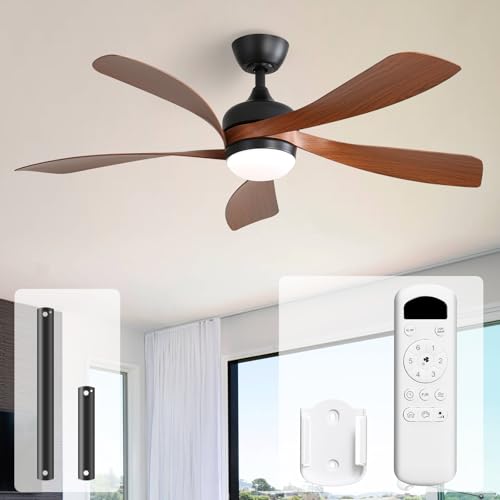
Sofucor 52-Inch Outdoor Ceiling Fan
by Sofucor
The only fan here built and ETL-listed for outdoor exposure, which makes it the pick for a covered patio, porch, or deck — though it is a damp-location fan, not a wet-rated one.
Pros
- ETL-listed with a moisture-resistant finish rated for covered patios and porches
- Includes 2 downrods plus a slope mount adapter for angled ceilings up to 15 degrees
- Moves 5000 CFM of air at just 30dB — powerful enough for covered outdoor spaces
- Backed by a 2-year accessory protection plan plus lifetime motor maintenance support
Cons
- LED light may glow dimly when switched off due to residual current in some wiring
- Occasional creaking sounds reported during the first few weeks of break-in
- Higher price point justified mainly by the outdoor-rated construction and certification
POCHFAN 42-Inch — Best for Bedrooms and Small Rooms
A 42-inch fan is the right size for a bedroom, a home office, or any room under roughly 150 square feet, and the POCHFAN is the one I would put there. The DC inverter motor is rated at 30dB, which in practice means you notice the air before you notice the fan. Six speeds matter more in a small room than they do in a great room, because the useful range sits at the bottom — you want a setting that moves air across a bed without turning the room into a wind tunnel.
The light is the other reason it earns the slot. The 24W LED runs 3000K, 4000K, and 6500K and dims to 20 percent, so the same fixture handles reading light and wind-down light without a second lamp. Reverse is on the remote rather than a switch on the motor housing, which is the difference between flipping to winter mode in three seconds and hauling a ladder out every October.
Two things to be honest about. It is downrod-only, so it needs the ceiling height a flush-mount fan does not, and unit-to-unit noise is less consistent than the 30dB rating suggests — a minority of buyers report a grinding motor and go through the replacement process. Its rating count is also pooled across POCHFAN’s other sizes and finishes, so treat that number as a read on the line rather than on this exact SKU. It is indoor-only, too: if the room is a covered porch, buy the Sofucor instead.
The limitations mirror the Amico — a 42-inch span means rooms under 150 square feet, and the remote can be finicky near WiFi routers and other electronics. But the warranty, quieter operation, and clever features justify the small price premium over the Amico for buyers who want a little more peace of mind.

POCHFAN 42-Inch Ceiling Fan with Light
by POCHFAN
A quiet 42-inch DC fan with a genuinely tunable light, priced barely above the budget pick — the sensible bedroom and small-room choice, as long as you are not putting it on a porch.
Pros
- DC inverter motor rated at 30dB with dual ball bearings — quiet enough for a bedroom without giving up six usable speeds
- The 24W LED switches between 3000K, 4000K, and 6500K and dims to 20 percent, so one fixture covers task light and evening light
- Reverse runs off the remote instead of a switch on the motor housing, so seasonal changeover does not mean getting the ladder out
- Sells and ships through Amazon with a 2-year parts replacement policy, and buyers report missing-hardware claims settled in a day or two
Cons
- Noise is inconsistent unit to unit — the listing rates it at 30dB, but a minority of buyers report a grinding motor out of the box
- Downrod mount only, with no flush-mount option, so it needs more ceiling height than a hugger fan
- The rating count is pooled across POCHFAN's size and finish variants rather than this exact 42-inch black SKU
Hunter Builder 52-Inch — Upgrade Pick
Hunter has been making ceiling fans since 1886. That is 140 years of motor engineering, and the Builder 52-inch represents everything the company has learned. This is not a fan that will wow you with smart features or 12-speed precision. Instead, it delivers something harder to quantify: absolute reliability and silence.
The WhisperWind motor is Hunter’s flagship technology, and it genuinely lives up to the name. On medium speed in a bedroom, you cannot hear it. The ETL and UL safety certifications meet the highest industry standards, and the three-position mounting system handles flush, standard downrod, and angled ceiling installations without any adapter kits.
The obvious drawback is the pull chain operation. In 2026, having to walk to the fan and tug a chain feels archaic. You can add a third-party remote receiver, but that adds cost and complexity. The 3-speed AC motor is also less efficient than DC alternatives.
So why recommend it as the upgrade pick? Because “upgrade” does not always mean more features — sometimes it means better execution of the fundamentals. The Hunter Builder will run silently and reliably for 15 to 20 years with zero maintenance. For homeowners who want to install a fan and genuinely never think about it again, that peace of mind is worth the premium.

Hunter Builder 52-Inch Ceiling Fan
by Hunter
The Hunter Builder is the premium upgrade pick for buyers who value brand reputation, whisper-silent operation, and rock-solid build quality over smart features.
Pros
- Hunter's 140-year legacy makes this the most trusted brand name in ceiling fans
- WhisperWind motor is genuinely silent — you will forget the fan is running
- Meets ETL and UL highest safety certification standards for complete peace of mind
- Three-position mounting system handles flush, standard, and angled ceiling installations
Cons
- Pull chain operation only — no remote control option included or available
- Limited to 3 speed settings compared to 6 or 12 on DC motor competitors
- AC motor draws more power than modern DC alternatives at equivalent airflow
Best Ceiling Fans With Lights
Almost every fan in this roundup includes an integrated LED, but if the fan is the room’s primary light source — as it is in most bedrooms and many living rooms — the light quality matters as much as the airflow. Look for adjustable color temperature (3CCT), true dimming, and enough lumens to actually light the room. These three are the standouts for lighting:
| Product | Price | Buy |
|---|---|---|
| Ohniyou 52-Inch Ceiling Fan with LightBest light quality Fully dimmable 3CCT LED (3000–6000K, 5–100%) plus 4580 CFM at 20dB — the fan to buy when it's the only overhead light in the room. | $59.97 | View on Amazon |
| Dreo Smart 42-Inch Ceiling FanBest smart lighting 2400-lumen LED with stepless 2700–6500K tuning and app/voice dimming — the brightest, most controllable light here for smart homes. | $89.99 | View on Amazon |
| Amico 42-Inch Flush Mount Ceiling FanBest budget light Tunable 3CCT LED in a flush-mount body for under sixty dollars — plenty of light for a bedroom or small living area on a budget. | $44.99 | View on Amazon |
For a fan-as-primary-light, the Ohniyou wins on raw light quality and airflow; step to the Dreo if you want app and voice dimming, or the Amico if budget rules. All three are reviewed in full above.
Best Outdoor Ceiling Fans
Installing an indoor-rated fan outdoors is one of the most common mistakes I catch on inspections — moisture corrodes the motor, warps the blades, and voids the warranty. Match the rating to the exposure: wet-rated for open or rain-exposed spots, damp-rated for a covered porch or screened patio. Never use a dry-rated indoor fan outside.
| Product | Price | Buy |
|---|---|---|
| Sofucor 52-Inch Outdoor Ceiling FanBest for covered patios The only fan here built for outdoor exposure — moisture-resistant ETL-listed build, 5000 CFM at 30dB, and a slope-mount adapter for angled patio ceilings. Damp locations, not open rain. | $169.99 | View on Amazon |
| Amico 42-Inch Flush Mount Ceiling FanCheapest covered-porch pick Damp-rated flush mount under sixty dollars — the budget choice for a covered porch or screened patio in a smaller space. | $44.99 | View on Amazon |
Be straight about the limit here: the Sofucor is the only one built for outdoor exposure, but it is certified for covered locations, and the Amico is damp-rated for covered spaces too. None of these is a wet-rated fan. If your fan will sit under an open pergola or anywhere rain reaches it, buy a model that states a wet-location UL or ETL listing outright — do not settle for “moisture-resistant.”
How to Choose the Right Ceiling Fan
Picking the right ceiling fan comes down to matching the fan to your room and your priorities. Here is how I walk clients through the decision.
Start with room size. Measure your room’s square footage and match it to the appropriate blade span. This is the single most impactful decision. A 42-inch fan in a 300-square-foot living room will leave you underwhelmed regardless of how many features it has.
Check your ceiling height. Standard 8-foot ceilings need flush-mount fans. Anything taller can use a downrod mount. Vaulted ceilings need an angled adapter. The goal is to position the blades between 8 and 9 feet from the floor for optimal airflow.
Decide on motor type. DC motors win on noise, efficiency, and speed options. AC motors win on price and proven longevity. For bedrooms and spaces where quiet matters, DC is the clear choice. For a workshop or utility room, a budget AC fan does the job.
Evaluate noise levels. If the fan is for a bedroom, prioritize fans under 30dB. Check both the manufacturer spec and real buyer reviews — some fans are louder than advertised, and reviews will tell you.
Consider your control preferences. Pull chain fans are the cheapest but least convenient. Remote control is the modern baseline. Smart fans add app and voice integration. If you already have Alexa or Google Home, a WiFi fan integrates seamlessly into your setup, much like how a connected electric kettle becomes more useful when it talks to the rest of your smart home.
Check the location rating. Indoor only, damp-rated for covered outdoor, or wet-rated for open exposure. Never install an indoor fan outdoors.
Buyer's Guide
After installing hundreds of ceiling fans in homes ranging from compact condos to sprawling ranch houses, I have learned that the right fan depends on your specific room, ceiling, and priorities. Here are the six factors I walk every client through before they buy.
Room Size and Blade Span
This is the single most important factor and the one most people get wrong. A fan that is too small for your room will barely move air beyond the area directly beneath it. For rooms up to 144 square feet, a 42-inch fan works well. Standard bedrooms and living rooms between 144 and 225 square feet need 50 to 54 inches. Large rooms and open concepts over 225 square feet call for 60 inches or more. When in doubt, size up — a slightly oversized fan running on medium is quieter and more effective than a small fan maxed out on high.
Ceiling Height and Mount Type
Your ceiling height determines which mounting system you need. Standard 8-foot ceilings require a flush mount or hugger fan to maintain the recommended minimum 7 feet of clearance between blades and floor. Ceilings between 8 and 9 feet work well with a standard downrod mount. Ceilings above 9 feet need an extended downrod to bring the fan down to optimal height. For vaulted or angled ceilings, confirm the fan includes an angled mount adapter — most quality fans support slopes up to 30 degrees. Getting the height right maximizes airflow efficiency and keeps the fan safe from tall residents.
AC vs DC Motor
The motor type affects noise, efficiency, speed options, and price. DC motors are quieter, use up to 70 percent less energy, and typically offer 6 or more speeds compared to the standard 3 on AC motors. They also tend to be lighter, which matters for older ceiling boxes. AC motors cost less upfront and have a longer track record of proven reliability from established brands. If you prioritize quiet operation for bedrooms or energy savings over time, go with DC. If you want the lowest purchase price or trust legacy engineering, a quality AC motor fan from a brand like Hunter is still a strong choice.
Airflow and Noise Level
Airflow is measured in CFM (cubic feet per minute) and tells you how much air the fan actually moves. Look for fans above 4000 CFM for standard rooms and above 5000 CFM for large spaces. Noise is equally important — a powerful fan you cannot stand to run defeats the purpose. Noise is measured in decibels, and for bedrooms you want 30dB or lower. For reference, a whisper is about 30dB and normal conversation is 60dB. DC motors consistently outperform AC motors on both metrics, delivering more airflow per decibel of noise. Check both the manufacturer specs and verified buyer reviews for real-world noise reports.
Light Quality and Controls
Most modern ceiling fans include integrated LED light kits, but quality varies widely. Look for at least 1800 lumens if the fan will serve as the room's primary light source. Adjustable color temperature (often labeled 3CCT) lets you switch between warm 3000K for relaxing and cool 5000K or higher for task lighting. Dimmable LEDs add versatility — stepless dimming is smoother than preset levels. For controls, remote operation is the modern standard. Smart fans add app, Alexa, and Google Home integration for scheduling and voice commands. Consider whether you want wall switch compatibility, as some DC fans conflict with dimmer switches.
Indoor vs Outdoor Rating
If you plan to install a fan on a patio, porch, or anywhere exposed to moisture, you need the correct rating. Dry-rated fans are for indoor use only. Damp-rated fans handle humidity and covered outdoor areas like screened porches but cannot be exposed to direct rain. Wet-rated fans can handle direct moisture and rain for fully open outdoor installations. An indoor fan installed outdoors will corrode, void its warranty, and become a safety hazard. Always check the ETL or UL listing for the specific rating — marketing claims are not enough. For covered patios, damp-rated is sufficient. For open pergolas or gazebos, insist on wet-rated.
Final Verdict
For most homeowners, the Honeywell Carnegie is the best all-around ceiling fan you can buy right now. It combines distinctive industrial design, genuinely quiet operation, and a reliable AC motor in a 52-inch package that works for the majority of rooms.
If budget is your primary concern, the Amico 42-inch delivers a feature set that used to cost three times as much. For smart home integration, the Dreo Smart is the real deal — not a gimmick. And if you need outdoor performance, the Sofucor is the only fan in this roundup built and certified for it.
The ceiling fan market has shifted dramatically toward affordable DC motor options with premium features, and every fan on this list represents that new reality. Whatever you choose, make sure you match the blade span to your room size, verify the mounting type works with your ceiling, and check the location rating if you are going outdoors. Get those three things right, and any fan on this list will serve you well for years to come.
Frequently Asked Questions
What direction should a ceiling fan spin in summer vs winter?
What size ceiling fan do I need for my room?
What is the difference between AC and DC motor ceiling fans?
Can I install a ceiling fan where there is no existing ceiling box?
How much does it cost to have a ceiling fan professionally installed?
Related Articles
About the Reviewer

Jake Morrison, Licensed General Contractor
B.S. Construction Management, Purdue University
Jake Morrison has spent 14 years in residential construction and home renovation before founding DIYRated in 2026. After helping hundreds of homeowners choose the right tools and materials for their projects, he started writing the product guides he wished existed when he was starting out. Jake tests every major product recommendation in his workshop in Indianapolis and focuses on real-world performance over spec-sheet marketing.