7 Best Electric Pressure Washers of 2026
Jake Morrison reviews the best electric pressure washers of 2026. Compare PSI, motor type, hose length, and portability to find the right machine for your project.
Updated
I have been on job sites long enough to know that choosing the wrong pressure washer usually comes down to one of two mistakes: buying too little machine for the job, or buying a gas unit when an electric pressure washer would have handled the work cleaner and with far less hassle. In 2026, the best electric pressure washers have closed the gap on gas machines for everything short of commercial concrete stripping — and they start without a pull cord, store without fuel, and weigh a fraction of what a comparable gas unit does. If your work is residential — driveways, decks, siding, vehicles, patio furniture — an electric machine is almost certainly the right tool.
I reviewed seven electric pressure washers for this roundup, covering everything from a 14 lb foam-cannon-included budget machine to a 50 lb contractor-grade brushless unit with CSA-certified 3000 PSI output. I tested performance claims against certified spec data, read through thousands of owner reviews looking for real-world failure patterns, and applied the same evaluation framework I use when recommending equipment on renovation projects. The result is a list built around what actually works in the field, not just which machines photograph best in a product studio.
For a quick comparison of all seven picks, the summary table above lays out pricing, ratings, and key specs side by side.
Find the Best Electric Pressure Washer for Your Project
Jump straight to the machine that matches your work — every pick below is fully reviewed once in the lineup, then compared again where it fits a specific job.
- Overall best electric pressure washers
- Best for driveways & concrete
- Best for cars
- Best portable / lightweight
- Best for commercial & business use
- More use cases: decks, boats & siding
If you specifically want a machine sized and priced for everyday household jobs, my dedicated best pressure washers for home use guide narrows the field further.
How We Chose These Electric Pressure Washers
I evaluated each machine against six criteria: certified PSI and GPM output (not just marketing claims), motor type and expected duty cycle, hose and cord length relative to typical residential use cases, total weight and portability form factor, nozzle and accessory kit completeness, and warranty terms. I cross-referenced Amazon review data — paying particular attention to negative reviews reporting pump failures, hose fitting leaks, and TSS malfunction — against manufacturer specs and third-party certifications from PWMA and CSA where available. No machine with unverified PSI claims made the final cut without a note in the review.
| Product | Price | Buy |
|---|---|---|
| Westinghouse ePX3500 Electric Pressure WasherBest Overall | $169.00 | View on Amazon |
| Westinghouse ePX3050 Electric Pressure WasherBudget Pick | $109.00 | View on Amazon |
| Westinghouse ePX3100v Electric Pressure WasherRunner-Up | $129.00 | View on Amazon |
| CRAFTSMAN CMEPW1900 Electric Pressure WasherRunner-Up | $189.00 | View on Amazon |
| LWQ 2000 PSI Electric Pressure WasherRunner-Up | $119.99 | View on Amazon |
| Westinghouse WPX3000e Electric Pressure WasherPremium Pick | $279.00 | View on Amazon |
| Greenworks Pro 3000 PSI Electric Pressure WasherRunner-Up | $349.98 | View on Amazon |
Best Electric Pressure Washers Overall
These are the seven machines I would put in front of any homeowner or light-duty contractor asking for one electric pressure washer to own. Each is reviewed in full below — start here if you want the all-around best, then use the use-case sections underneath to fine-tune the choice for your specific surface or workflow.
Westinghouse ePX3500 Electric Pressure Washer
The ePX3500 is the machine I recommend to most homeowners asking for a single electric pressure washer that handles everything. With 2500 Max PSI and 1.76 Max GPM, it delivers 4,400 cleaning units — enough to strip mildew from composite decking, blast caked-on road grime off brick, and clean a two-car concrete driveway in a single session. The anti-tipping caster base is a detail that sounds minor until you have watched a machine tip over mid-job and snap the lance fitting. The 35 ft GFCI cord covers most residential driveways and deck setups without requiring an extension cord.
The Total Stop System (TSS) is the feature I specifically look for in any electric pressure washer. When you release the trigger, TSS shuts down the pump instead of letting it idle under load — this is the single biggest driver of pump longevity on machines used seasonally. Universal motors generate more heat than induction alternatives, and letting a universal motor run against a closed circuit accelerates wear faster than almost anything else. TSS addresses this directly, which is part of why the ePX3500 has sustained 4.6 stars across the deepest review base in this roundup, over multiple seasons.
The one real limitation is the lack of a carry handle — 19 lbs is light enough that most users manage fine, but if you frequently move the machine between a second-floor deck, a boat dock, or a truck bed, the ePX3100v’s integrated carry handle may be worth the slightly lower PSI.

Westinghouse ePX3500 Electric Pressure Washer
by Westinghouse
The best all-around electric pressure washer — the deepest review record here, 2500 Max PSI, TSS pump protection, and an anti-tipping caster base make the ePX3500 the top choice for homeowners and light-duty contractors.
Pros
- 2500 Max PSI with 1.76 Max GPM delivers 4,400 cleaning units — enough muscle for concrete driveways, wood decks, vinyl siding, and caked-on patio furniture in a single pass
- 13-Amp universal motor with Total Stop System (TSS) automatically shuts off the pump when the trigger is released — extends pump life and reduces electricity draw between bursts
- Anti-tipping caster base with 35 ft GFCI power cord covers most standard two-car driveways without repositioning the machine or hunting for an extension outlet
- 9,282 Amazon reviews at 4.6 stars is by far the largest review pool in this roundup — years of real-world feedback surfaces every edge case and failure mode
Cons
- Universal motor runs louder than induction-motor alternatives — noticeable in quiet residential neighborhoods or early morning use
- 19 lb weight with no handle makes moving it between jobs slightly awkward compared to machines with integrated carry handles
Westinghouse ePX3050 Electric Pressure Washer
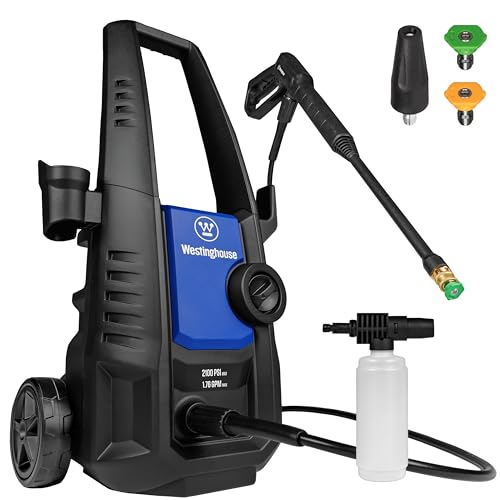
At 14 lbs with a foam cannon included, the ePX3050 is the pick for buyers who want a capable residential pressure washer without the bulk. The foam cannon is the differentiating feature at this price point — most machines in this range ship with quick-connect nozzles only, and a foam cannon adds a genuine cleaning capability upgrade for vehicle washing and surface prep. The turbo nozzle is also included, which is the attachment you want for cleaning larger flat concrete areas faster than a standard 15° or 25° tip allows.
The 2100 Max PSI output is honest and consistent with the Westinghouse platform’s reputation for not inflating specifications. For the work most residential buyers actually do — cars, boats, patio furniture, fences, and light concrete maintenance — 2100 PSI at 1.76 GPM is the right balance of power and portability. Where the ePX3050 gives up ground versus the ePX3500 is hose length: the 20 ft hose requires repositioning on a full two-car driveway, and there is no anti-tipping caster base.
If your primary cleaning tasks are vehicles and portable outdoor gear rather than large fixed surfaces, the ePX3050 is the right call — lighter, cheaper, and better-accessorized than the ePX3500 for those specific jobs. For driveway and deck work at scale, step up.
Westinghouse ePX3050 Electric Pressure Washer
by Westinghouse
The best value electric pressure washer — lightest machine in the roundup, foam cannon included, and 4.5-star Westinghouse reliability at the lowest price point.
Pros
- Foam cannon included in the box alongside 3 nozzles and a turbo nozzle — four cleaning accessories at a price point where most competitors ship with nozzles only
- 14 lb total weight makes it the lightest machine in this roundup — genuinely portable for cleaning vehicles, boats, patio furniture, and second-story trim from a ladder
- 2100 Max PSI is sufficient for all light-to-medium residential tasks including cars, fences, outdoor furniture, and moderately soiled concrete
- A 4.5-star average confirms Westinghouse quality at the entry price — not a spec-padded budget brand
Cons
- 20 ft hose is 5 ft shorter than the ePX3500 — may require repositioning on longer driveways or larger deck surfaces
- No anti-tipping caster base — the upright form factor tips more easily on uneven surfaces, which matters when you are moving around a job
Westinghouse ePX3100v Electric Pressure Washer
The ePX3100v shares the highest rating in this entire roundup with the WPX3000e — 4.7 stars across 4,846 reviews is a harder number to hold than a 4.6 with twice as many reviews. The core differentiation from the ePX3050 is the integrated carry handle built into the frame. This sounds like a minor ergonomic point until you are carrying a pressure washer up a flight of stairs to a second-story deck or loading it into a truck cab without a hitch-mounted cargo carrier. The handle makes it genuinely one-hand portable.
The handheld form factor (no wheels, carry handle instead) is a design choice that works better for some use cases than others. For vehicle detailing, boat cleaning, cleaning gutters from a ladder, and moving between tight spaces, the ePX3100v is more practical than any wheeled machine. For a long driveway or a large deck where you want to set the machine down and drag the hose, the wheeled ePX3500 is more comfortable. The foam cannon inclusion mirrors the ePX3050 — full kit out of the box.
Both the ePX3050 and ePX3100v share the same 2100 PSI / 1.76 GPM output spec. The choice between them comes down to form factor: handle-carry portability (ePX3100v) vs. slightly lighter weight and lower price (ePX3050).

Westinghouse ePX3100v Electric Pressure Washer
by Westinghouse
Tied for the highest-rated machine in this roundup — 4.7 stars across 4,846 reviews and a true handheld carry handle make the ePX3100v the top pick for vehicle detailing and portable cleaning tasks.
Pros
- Tied for the highest customer rating in the roundup at 4.7 stars across 4,846 reviews — a hard score to hold over a sample that size
- Handheld carry handle integrated into the frame makes it the most portable wheeled-style machine for moving between vehicles, boats, and patio areas
- Foam cannon included alongside 3 nozzles — full cleaning kit out of the box without buying accessories separately
- 17.6 lb weight with no-wheel handheld form factor balances portability and stability for jobs that require frequent repositioning
Cons
- No wheels or rolling caster base — less practical than wheeled machines for large driveways or continuous-coverage jobs over 500 sq ft
- 20 ft hose limits reach on larger properties without an extension hose purchase
CRAFTSMAN CMEPW1900 Electric Pressure Washer
The CMEPW1900 is the pick for the buyer who wants a recognizable, trusted name behind a mid-price machine rather than an Amazon-only house brand. CRAFTSMAN’s 4.4-star average across nearly 2,000 reviews reflects a machine that does the everyday residential jobs — cars, patio furniture, grills, siding, and light concrete — without drama. At 1900 CETA-certified PSI and 1.2 GPM, it is honestly rated (CETA certification means the pressure number is verified, not a peak-flow marketing figure), and for the work most homeowners actually do, that output is plenty.
Where the CMEPW1900 stands out at this price is organization. The T-Rail handle system locks the wand in place during transport, and there is dedicated onboard storage for the hose, cord, and all three nozzles — so the whole kit travels and stores as one unit instead of a pile of loose parts in the garage. The built-in soap tank draws detergent automatically the moment you switch to the soap tip, which is simpler than clipping on and refilling a separate foam bottle.
The honest limitations are output and pump construction. At 1.2 GPM this is not the machine for stripping a large, badly weathered driveway quickly — that is what the induction-motor WPX3000e or the CSA-certified Greenworks Pro are for. And the thermoplastic pump housing, standard at this price, will not take the abuse a metal-pump contractor unit shrugs off. As a value pick for routine residential cleaning from a brand people already trust, though, it earns its spot.

CRAFTSMAN CMEPW1900 Electric Pressure Washer
by CRAFTSMAN
A trusted CRAFTSMAN name with onboard storage and an automatic soap tank — the value pick for cars, patio furniture, and light concrete when brand confidence matters as much as raw numbers.
Pros
- 1,964 verified reviews at 4.4 stars behind a household CRAFTSMAN name — the brand trust that makes buyers comfortable clicking buy on a mid-price machine
- T-Rail handle system plus onboard storage for the wand, hose, cord, and all three nozzles keeps the whole kit together instead of scattered across the garage
- Built-in soap tank draws detergent automatically when you switch to the soap tip — no separate foam bottle to attach or refill
- 8-inch wheels and a 35 ft power cord give it real reach and easy maneuvering around a car or across a patio
Cons
- 1900 PSI and 1.2 GPM sit at the lighter end of this roundup — plenty for cars, furniture, and light concrete, but slower on a large stained driveway than the higher-output picks
- Thermoplastic pump housing is standard at this price and less durable under daily contractor use than a metal-pump machine
LWQ 2000 PSI Electric Pressure Washer
The LWQ rounds out the budget tier with the most interesting spec in the lineup: a claimed 2.5 GPM flow rate that, if accurate at working pressure, would give it more cleaning velocity than any other machine in this review. The practical caveat applies here as it does to PSI claims across this category — GPM ratings on lower-cost machines are frequently measured at conditions that do not reflect actual use. That said, the anti-tipping base design, the #2 Best Seller Rank on Amazon, and the 4.3-star rating across more than 4,000 reviews suggest it performs competently for its price.
The LWQ is the right pick for buyers who want an anti-tipping caster-style machine at the lowest possible price and are willing to accept that the brand has fewer years of ownership data behind it than Westinghouse or Sun Joe. For light residential work — car washing, fence rinsing, patio furniture, and spot-cleaning concrete — the 2000 PSI output and lightweight design are appropriate.

LWQ 2000 PSI Electric Pressure Washer
by LWQ
The highest claimed GPM in the roundup — LWQ's anti-tipping base and lightweight build make it a competitive budget pick for buyers who prioritize rinsing speed on large surfaces.
Pros
- 2.5 GPM claimed flow rate is the highest in the roundup by a wide margin — moves more water volume per minute than any other machine here, which speeds up rinsing on large flat surfaces
- Anti-tipping base design mirrors the stability feature found on the Westinghouse ePX3500 — practical for solo operation on uneven driveways and patios
- 16.58 lb lightweight build combined with #2 Best Seller Rank confirms strong demand and consistent availability on Amazon
- 4-nozzle kit covers the standard spray angles for general-purpose residential cleaning at a budget-friendly price point
Cons
- LWQ is a newer brand with limited long-term reliability data — fewer years of ownership reviews compared to Westinghouse or Sun Joe platforms
- GPM claims in this price tier are frequently overstated — real-world flow at rated working pressure is typically lower than the specification sheet number
Westinghouse WPX3000e Electric Pressure Washer
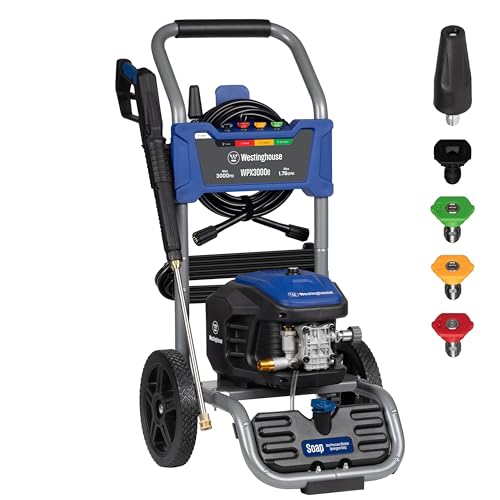
The WPX3000e is the machine I recommend when someone asks for an electric pressure washer they can run for a full day on a job site without babying it. The induction motor is the defining upgrade over every other machine in this roundup: no brushes to wear, lower operating temperature, quieter at distance, and a performance curve that holds up better over multi-hour runs than a universal motor can sustain. The 3000 Max PSI / 1.76 GPM combination (5,280 cleaning units) handles concrete oil stain removal, stripping old deck sealant, and cleaning brick that would stall a lighter machine.
The never-flat wheels are a genuine quality-of-life upgrade on a job site. Standard wheels on residential pressure washers are small-diameter, air-filled, and flat-prone on rough concrete — the kind of failure that stops a job in progress. Never-flat solid wheels keep moving. The super-flex hose behaves noticeably differently than standard hose material at outdoor temperatures below 50°F — it coils and uncoils without the stiffness and kinking that makes standard hoses frustrating in early spring or fall.
The 3-year warranty is the longest in the roundup and reflects real manufacturer confidence in the induction motor platform. At 36.8 lbs, the WPX3000e is not a machine you carry upstairs — but for a homeowner with a long concrete driveway, a large deck, or a fence to strip and restain, the upgrade from the ePX3500 is worth the additional investment. If you want to understand how an induction-motor machine fits into a broader outdoor power tool strategy, the best washer and dryer article covers a related set of motor technology trade-offs for indoor appliances.
Westinghouse WPX3000e Electric Pressure Washer
by Westinghouse
The premium choice for serious cleaning — induction motor, 3000 Max PSI, never-flat wheels, and a 3-year warranty make the WPX3000e the right pick for contractors and power users.
Pros
- Induction motor runs significantly quieter and cooler than universal motor alternatives — better suited for extended-duration jobs and early morning use in residential neighborhoods
- 3000 Max PSI with 1.76 GPM delivers 5,280 cleaning units — the highest cleaning output in this roundup, capable of removing oil stains from concrete and stripping old deck sealant
- Never-flat wheels and super-flex 25 ft hose are genuine durability upgrades over standard models — less friction coiling and uncoiling on repeated job days
- 3-year warranty is the longest coverage in the roundup — Westinghouse backs induction-motor machines more aggressively because they last longer under sustained use
Cons
- 36.8 lb weight is the heaviest in the roundup — moving it between jobs or loading into a truck bed requires more effort than lightweight universal-motor models
- Premium price is only justified if you are regularly cleaning concrete, stripping wood, or running the machine for hours at a stretch — overkill for occasional car washing or light deck cleaning
Greenworks Pro 3000 PSI Electric Pressure Washer
The Greenworks Pro is in a category by itself in this roundup: it is the only machine here with a brushless motor, CSA certification on its output specs, and a steel frame — a combination that describes contractor-grade equipment, not a homeowner machine. The TruBrushless 14-Amp motor eliminates brushes as a wear component entirely, which means longer service intervals and more consistent pressure output over the motor’s lifespan compared to either universal or induction brushed alternatives. The CSA-certified 3000 PSI / 2.0 GPM combination delivers 6,000 cleaning units — the highest certified output in this roundup by a meaningful margin.
The steel frame is the design choice that sets the Greenworks Pro apart from a durability standpoint. Thermoplastic frames — standard on residential machines — are adequate for garage and shed storage. On a job site where equipment gets loaded into truck beds, slides around cargo areas, and gets set down hard on rough surfaces, steel frame construction is the difference between a machine that lasts five seasons and one that cracks a housing on year two. Bob Vila designated this the top pick in his roundup for exactly this reason.
The honest trade-off is weight: approximately 50 lbs is a two-person lift for most people, and the vertical storage orientation, while space-efficient in a shop, is not something you want to navigate alone on a sloped driveway. For a solo homeowner doing seasonal cleaning, the Westinghouse WPX3000e at 37 lbs with an induction motor delivers comparable PSI output at a lower price and a more manageable weight. The Greenworks Pro is the right call for contractors who need the certified output numbers for commercial work and the steel frame for job site handling.

Greenworks Pro 3000 PSI Electric Pressure Washer
by Greenworks
The contractor-grade electric pressure washer — CSA-certified 3000 PSI, brushless motor, and steel frame make the Greenworks Pro the only electric machine in this roundup built for daily professional use.
Pros
- CSA-certified 3000 PSI / 2.0 GPM delivers 6,000 cleaning units — the highest certified cleaning output in this roundup, independently verified rather than marketing-claimed
- TruBrushless 14-Amp motor eliminates brushes as a wear component — longer motor lifespan and more consistent power delivery under sustained load than brushed alternatives
- Steel frame construction (vs. plastic on most residential pressure washers) withstands job site handling, being loaded and unloaded from truck beds, and rough storage
- Vertical storage footprint and 25 ft hose with 35 ft GFCI cord minimizes storage space in a garage or shed compared to horizontal-roll machines
Cons
- Approximately 50 lb weight is the heaviest machine in the roundup by a significant margin — not practical for solo operators who need to move it frequently
- Premium price makes it the most expensive electric machine in this review — the brushless motor and steel frame justify the cost only for contractors or serious DIYers running daily
Best Electric Pressure Washer for Driveways and Concrete
Driveways and concrete are the most demanding routine job an electric machine faces: large, flat, embedded with tire marks, oil, and years of grey weathering. The number that matters here is cleaning units (PSI × GPM), not headline PSI — you want enough sustained output to lift stains without crawling along at a trickle. A turbo nozzle is close to mandatory for concrete; it delivers a rotating pencil-point pattern that clears in a fraction of the time a fixed tip takes. For most two-car driveways the all-around ePX3500 is plenty, and it holds itself upright on a slope while you work. For stained or sealed concrete, step up to the induction-motor WPX3000e, which can run for hours without heat-soaking the pump.
| Product | Price | Buy |
|---|---|---|
| Westinghouse ePX3500 Electric Pressure WasherBest for most driveways 2500 PSI and 4,400 cleaning units with an anti-tipping base clean a two-car driveway in a single session | $169.00 | View on Amazon |
| Westinghouse WPX3000e Electric Pressure WasherBest for heavy concrete 3000 PSI induction motor strips oil stains and old sealant on badly weathered concrete | $279.00 | View on Amazon |
Best Electric Pressure Washer for Cars
Washing a car is the one job where more pressure is a liability, not an asset. You want a paint-safe 1200–2000 PSI, a 40° or wider nozzle, and — more than anything — a foam cannon to lay down a thick pre-wash layer that lifts grit before a wash mitt ever touches the clearcoat. Both of my car picks include a foam cannon in the box and top out at a paint-friendly 2100 PSI. The ePX3050 is the lighter, cheaper weekend-washer choice; the ePX3100v adds an integrated carry handle that makes moving around the vehicle and between cars in a driveway noticeably easier for mobile detailing.
| Product | Price | Buy |
|---|---|---|
| Westinghouse ePX3050 Electric Pressure WasherBest for weekend car washing 2100 PSI is paint-safe and the included foam cannon lays down thick pre-wash suds | $109.00 | View on Amazon |
| Westinghouse ePX3100v Electric Pressure WasherBest for mobile detailing Integrated carry handle makes it easy to move around the car and between vehicles | $129.00 | View on Amazon |
Best Portable Electric Pressure Washer
Portability comes down to two things: total weight and how you carry it. If you clean second-story decks, boats, RVs, or move the machine between locations, the difference between 14 lbs and 50 lbs is the difference between a one-hand carry up a ladder and a two-person lift. Both picks here are the lightest, most maneuverable machines in the lineup — the ePX3050 wins on raw weight, while the ePX3100v’s handheld form factor and molded carry handle win on grip and balance.
| Product | Price | Buy |
|---|---|---|
| Westinghouse ePX3050 Electric Pressure WasherLightest overall 14 lbs — the lightest machine here, easy to carry up a ladder or lift into a truck bed | $109.00 | View on Amazon |
| Westinghouse ePX3100v Electric Pressure WasherBest carry handle 17.6 lbs with a true handheld grip built for one-hand carrying between jobs | $129.00 | View on Amazon |
Best Electric Pressure Washer for Commercial and Business Use
Commercial and business use — mobile detailing rigs, property maintenance, small contracting crews — is a duty cycle a budget universal-motor machine will not survive. Here you are buying for the motor and the frame, not the sticker PSI. A brushless or induction motor runs cooler and lasts through daily multi-hour sessions, and a steel frame survives being loaded in and out of a truck every day. The Greenworks Pro is the only machine in this roundup genuinely built for that abuse; the WPX3000e is the value step-down for lighter professional duty that still needs induction-motor longevity.
| Product | Price | Buy |
|---|---|---|
| Greenworks Pro 3000 PSI Electric Pressure WasherBest for daily commercial use CSA-certified 3000 PSI, brushless motor and steel frame survive daily job-site handling | $349.98 | View on Amazon |
| Westinghouse WPX3000e Electric Pressure WasherBest value for pros Induction motor and a 3-year warranty at a lower price for lighter professional duty | $279.00 | View on Amazon |
Best Electric Pressure Washers by Use Case
A few more common jobs and the machine from the lineup I would reach for on each. Every pick keeps its live price and Amazon link so you can compare without leaving the page.
| Product | Price | Buy |
|---|---|---|
| Westinghouse WPX3000e Electric Pressure WasherBest for decks 3000 PSI with a 25° tip strips grey weathering and mildew from wood and composite decking | $279.00 | View on Amazon |
| Westinghouse ePX3100v Electric Pressure WasherBest for boats & RVs Handheld and paint-safe at 2100 PSI for hulls, gelcoat, trailers and RV exteriors | $129.00 | View on Amazon |
| Westinghouse ePX3500 Electric Pressure WasherBest for vinyl siding 4,400 cleaning units and a 25° nozzle rinse two stories of siding without constant repositioning | $169.00 | View on Amazon |
How to Choose the Best Electric Pressure Washer
Buyer's Guide
After years of speccing out outdoor projects and watching homeowners buy the wrong pressure washer for the job, I have narrowed it down to the six factors that actually separate a machine worth owning from one that ends up gathering dust.
PSI and Cleaning Power
PSI (pounds per square inch) measures water pressure at the nozzle, but it is only half the equation. Multiply PSI by GPM (gallons per minute) to get cleaning units — the most accurate single number for comparing machines. A 2500 PSI machine at 1.76 GPM delivers 4,400 cleaning units; a 2500 PSI machine at 1.2 GPM delivers only 3,000. For most residential tasks — decks, siding, vehicles, patio furniture — 2000–2500 PSI and 3,500+ cleaning units is the practical minimum. Concrete and masonry benefit from 2500+ PSI with a turbo nozzle. Be skeptical of PSI numbers on lower-cost machines: many advertise peak PSI that is only achievable at zero GPM. Look for PWMA or CSA-certified specs, which reflect real working pressure rather than maximum theoretical output.
Motor Type
Universal motors are the standard in this price range — they are lighter, cheaper, and responsive under variable load. The trade-off is noise and heat under sustained operation. For homeowners running a machine an hour or two on weekends, a universal motor is entirely adequate. For contractors or serious DIYers running the machine for multiple hours at a stretch, an induction motor (Westinghouse WPX3000e) or a brushless motor (Greenworks Pro) runs cooler, quieter, and lasts longer between service intervals. The practical test: if you are cleaning a full deck, driveway, and fence in the same session several times a season, spend the extra money on a brushless or induction-motor machine.
Hose and Cord Length
Hose length determines how far you can work from the machine without repositioning it. A 20 ft hose covers a typical car wash or patio cleaning with one machine placement. A 25 ft hose covers most two-car driveways without moving the unit. Cord length matters equally — a 35 ft GFCI cord reaches from most garage outlets to the end of the driveway without an extension cord, which eliminates the voltage drop and safety concerns associated with extension cords on high-amp motors. If your job site requires an extension cord, size it correctly: 12 AWG minimum for runs to 50 ft, 10 AWG for runs to 100 ft.
Portability and Weight
The lightest machines in this review run 14–19 lbs — easy to carry up stairs, load into a truck bed, or move to a second-story deck by hand. Heavier induction and brushless machines run 37–50 lbs — you want wheels and a handle, and you are not carrying them upstairs without a helper. Match portability to your actual workflow: if you clean vehicles, boats, and outdoor furniture in multiple locations, buy light. If you clean a fixed driveway and deck twice a year, weight barely matters. The anti-tipping caster base on the Westinghouse ePX3500 and LWQ machines is worth noting — it keeps the machine upright on sloped driveways without constant repositioning.
Nozzle Selection
Nozzle angle directly controls how concentrated or wide the spray pattern is, which affects both cleaning power and surface safety. The 0° red tip concentrates maximum pressure at a pinpoint — use it for spot-treating stubborn stains on concrete, never on wood or painted surfaces. The 15° yellow tip is the general concrete-cleaning angle. The 25° green tip handles most deck and siding work. The 40° white tip is safe for vehicles, screens, and delicate surfaces. A turbo (rotating) nozzle delivers circular pressure patterns that significantly increase cleaning speed on large flat concrete surfaces — confirm one is included before buying. The foam cannon attachment, included with the ePX3050 and ePX3100v, applies soap in a thick layer that dwells longer than a soap-nozzle stream.
Build Quality and Warranty
Pump housing material (thermoplastic vs. metal) and hose quality are the two failure points seen most often on job sites. Thermoplastic pump housings are fine for occasional use but crack more readily under freezing conditions or if the machine takes a fall. Metal pump components last longer under daily contractor use. Hose material matters for flexibility in cold weather — standard hoses stiffen below 40°F and are prone to kinking. Warranty length signals manufacturer confidence: a 1-year warranty is table stakes; the Westinghouse WPX3000e's 3-year coverage is a meaningful commitment. Always register your machine after purchase — warranty claims on unregistered units are frequently denied.
A Note on PSI Inflation
One issue that no major competitor review covers clearly enough: PSI numbers on electric pressure washers are almost universally peak numbers measured at zero flow — a condition that never occurs in actual use. The honest measurement is working PSI at rated GPM, which is what PWMA, CSA, and CETA certifications verify. A 400–600 PSI gap between a budget washer’s marketing claim and its certified working pressure is representative of the category, not an outlier — which is exactly why a CETA- or PWMA-certified number (like the CRAFTSMAN’s 1900 PSI) is worth more than a bigger uncertified figure. Before buying any pressure washer outside this list, look for PWMA, CSA, or CETA certification on the spec sheet. If you do not see a certification, treat the PSI number as a ceiling, not a realistic working spec.
Electrical Circuit Requirements
Electric pressure washers draw 12–14 amps at motor startup, which means they need a dedicated 15-amp circuit — not a shared circuit with other appliances. Running a 14-amp pressure washer on a 15-amp circuit shared with a garage door opener or outdoor lighting is asking for a tripped breaker mid-job. The GFCI protection built into the cords on all machines in this review is required by electrical code for outdoor use near water. If your garage outlet does not have GFCI protection, use the machine’s built-in GFCI cord and do not bypass it for any reason — water and unprotected electrical current at 14 amps is a serious hazard.
Final Verdict
For most homeowners, the Westinghouse ePX3500 is the right buy. It has the review depth to be trusted (9,282 verified ratings), the PSI output to handle real residential cleaning tasks without frustration, the TSS pump protection to survive seasonal use without pump premature wear, and the anti-tipping caster base for solo operation on slopes. It is the machine I would put on a job site without hesitation for anything short of daily professional use.
If budget is the constraint, the Westinghouse ePX3050 delivers the same Westinghouse reliability at the entry price with a foam cannon included — a better accessory kit than most machines at any price. At 14 lbs, it is the most portable machine in the roundup and the right pick if vehicle and furniture washing is your primary use case.
For contractors and serious DIYers who need the highest sustained output, the Westinghouse WPX3000e (induction motor, 3-year warranty, 3000 PSI) is the step up worth making. And if you need CSA-certified contractor-grade specs with a brushless motor and steel frame, the Greenworks Pro 3000 PSI is in a class by itself for professional use — though you will need a second set of hands to move it.
Looking for more outdoor power equipment for your next project? Check out the best top load washers review if you are also tackling a laundry room renovation alongside your outdoor cleanup work.
Frequently Asked Questions
What PSI do I need for different cleaning tasks?
Can I use an extension cord with an electric pressure washer?
What is the difference between a universal motor and an induction motor in an electric pressure washer?
How do I winterize an electric pressure washer before storage?
Are electric pressure washers powerful enough for concrete?
Can electric pressure washers use hot water?
Which of these electric pressure washers work with a foam cannon?
Related Articles
About the Reviewer

Jake Morrison, Licensed General Contractor
B.S. Construction Management, Purdue University
Jake Morrison has spent 14 years in residential construction and home renovation before founding DIYRated in 2026. After helping hundreds of homeowners choose the right tools and materials for their projects, he started writing the product guides he wished existed when he was starting out. Jake tests every major product recommendation in his workshop in Indianapolis and focuses on real-world performance over spec-sheet marketing.