7 Best Paint Sprayers of 2026
Jake Morrison, a licensed general contractor, reviews the 7 best paint sprayers of 2026 — airless, HVLP, and budget — with honest rental-vs-buy math.
Updated
I have been spraying paint on job sites for 20-plus years as a licensed general contractor, and I am going to tell you something most YouTube reviews will not: a paint sprayer is not always the right tool. For a single bedroom or one weekend furniture project, a basic brush-and-roller setup will finish the job faster than any sprayer in this roundup once you factor in masking and cleanup time. For a full house exterior, a 200-foot fence, or a kitchen full of cabinet doors, a sprayer is the only honest answer.
The challenge with paint sprayer reviews is that almost none of them tell you the real numbers — the prep time, the rental-vs-buy breakeven, the dollars in overspray waste, and when to reach for a roller instead of a sprayer at all. After running everything from a HomeRight Super Finish Max on furniture restorations to a Graco ProX19 on multi-family exterior repaints, I have a clear sense of which sprayers earn their place in a homeowner’s garage and which ones are job-site overkill.
This roundup covers the seven sprayers I would actually recommend to a client in 2026, organized by use case rather than by brand loyalty. Whether you are repainting your house exterior, refinishing kitchen cabinets, or trying to stretch a one-time-use budget on a deck stain project, there is a sprayer here that matches the work — and a section below that tells you when you should rent or roll instead. Pair your sprayer with the right paint chemistry — see our breakdown of oil-based vs latex paint before you buy your gallons.
Find the Best Paint Sprayer for Your Project
Jump straight to the sprayer that matches your work — every pick below is fully reviewed once in the lineup, then compared again where it fits a specific job.
- Overall best paint sprayers
- Best for cabinets
- Best for furniture
- Best for walls & ceilings
- Best for house exterior
- Best for fences & decks
- Best for home use & beginners
- More jobs: stain, doors & metal
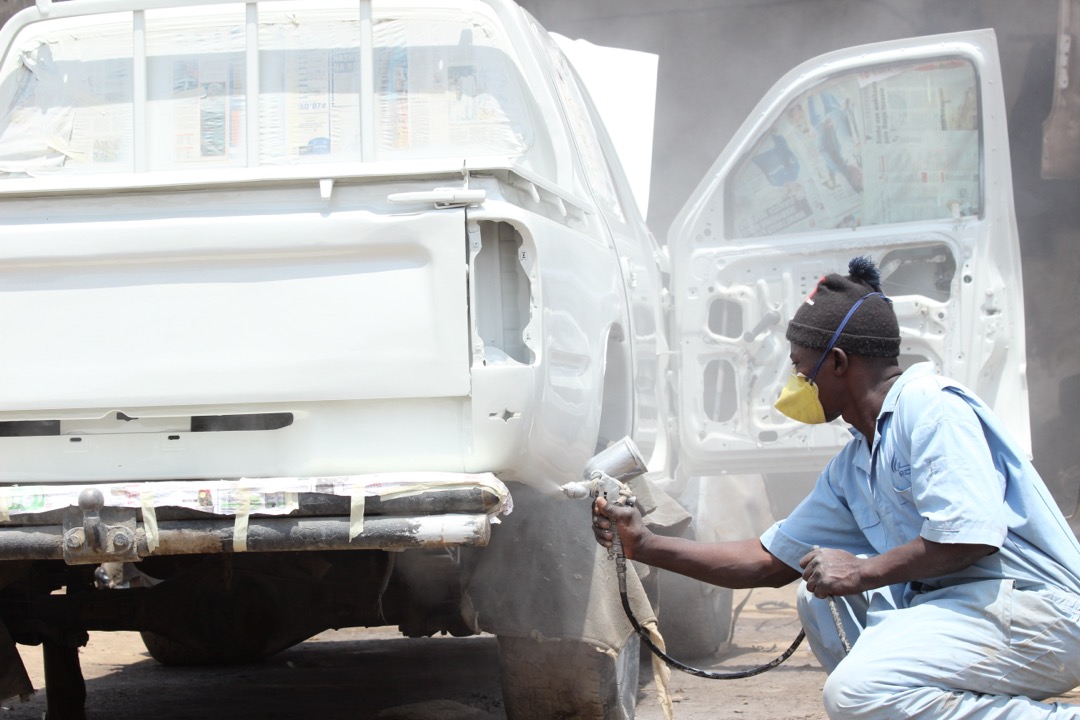
A quick honest note before the picks: “best paint sprayer for cars” is a different tool entirely — automotive work needs a compressor-fed detail gun, not the airless and home-HVLP units below. This guide is about painting your house, not your hood.
| Product | Price | Buy |
|---|---|---|
| Graco Magnum X5 Airless Paint SprayerBest Overall | $365.00 | View on Amazon |
| HomeRight Super Finish Max HVLP Paint SprayerBudget Pick | $57.00 | View on Amazon |
| Graco Magnum X7 Cart Airless Paint SprayerPremium Pick | $459.00 | View on Amazon |
| Graco ProX19 Cart Airless Paint SprayerRunner-Up | $749.00 | View on Amazon |
| Fuji Semi-PRO 2 HVLP Spray System | $569.00 | View on Amazon |
| Graco Project Painter Plus Airless Paint Sprayer | $285.40 | View on Amazon |
| Wagner Control Spray Max HVLP Sprayer | $150.99 | View on Amazon |
How We Chose These Sprayers
I evaluated every sprayer in this roundup against the same criteria I use when spec-ing tools for a job: motor and pressure capability for the intended workload, hose length for real-world reach, cleanup time honest to the manufacturer’s design, annual capacity rating versus expected residential use, and verified buyer reliability data from thousands of long-term reviews. I cross-referenced specs against my own field experience using these or comparable units on actual job sites — not in a controlled showroom test.
I also weighted reliability heavily. A sprayer that costs less but dies after one season costs more than a unit that runs for a decade. Graco’s airless lineup dominates this list because the build quality genuinely earns it — but I included HVLP options from HomeRight, Fuji, and Wagner because no airless sprayer can deliver the finish quality those units produce on cabinets and furniture.
Best Paint Sprayers Overall
These are the seven sprayers I would put in front of any homeowner or light-duty contractor asking for one paint sprayer to own. Each is reviewed in full below — start here for the all-around best, then drop into the use-case sections underneath to fine-tune the pick for your specific surface or project.
Graco Magnum X5 Airless Paint Sprayer — Best Overall
The Magnum X5 is the airless sprayer I recommend to 80 percent of homeowners who ask me what to buy. It hits the right balance of power, capacity, and price for someone who paints a fence one season, a house exterior the next, and a basement remodel the year after. The 3,000 PSI pump pulls latex straight out of a 5-gallon bucket and atomizes it cleanly through the included 515 SwitchTip — no thinning required for any wall or exterior paint I have tested.
The PowerFlush garden-hose cleanup is the feature that separates the Magnum line from cheaper airless competitors. Connect a garden hose to the pump, pull the gun trigger, and fresh water flushes the entire pump, hose, and gun in about 5 minutes. I have cleaned no-name airless sprayers that took 25 minutes of disassembly to get clean — the time difference is enormous over the life of the tool, and it is the difference between a sprayer that gets used regularly and one that lives in the back of the garage.
The honest limitation is the 10-gallon-per-year capacity rating. Graco engineers their consumer airless line for residential use cycles, not contractor workloads. If you are painting more than three or four large projects per year, the X5 is going to wear sooner than you want and you should look at the X7 or ProX19 instead. For a homeowner with one major project per year and occasional touch-ups, the X5 has a 10-plus-year service life.
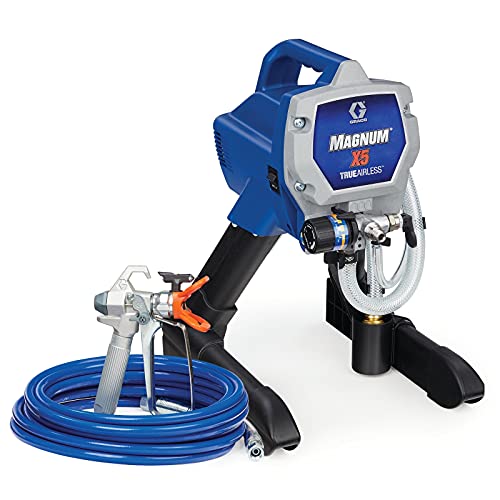
Graco Magnum X5 Airless Paint Sprayer
by Graco
The most balanced airless sprayer for DIY homeowners — real Graco reliability at a price that won't require a contractor's budget.
Pros
- Simple plug-and-spray setup with no air compressor needed
- PowerFlush garden-hose cleanup takes about 5 minutes
- Sprays unthinned latex and stains directly from a 5-gallon bucket
- Consistent, even coverage on large surfaces — walls, siding, fences
Cons
- Can struggle with very thick paints and heavy-body primers without thinning
- Annual use limit (10 gal) makes it a poor fit for frequent or professional jobs
HomeRight Super Finish Max HVLP — Best Budget
If you cannot stomach a 365-dollar sprayer for a one-time furniture project, the HomeRight Super Finish Max is genuinely the right tool. It has the highest review count of any paint sprayer on Amazon for a reason — over 10,500 verified buyers cannot all be wrong. For under 60 dollars, you get a handheld HVLP unit with three brass tips that cover stains, light latex, and thick primers, plus three spray patterns (horizontal, vertical, round) for different surface geometries.
The finish quality on furniture is genuinely impressive at this price. I have used a Super Finish Max on a refinished dresser, a set of dining chairs, and a small bookcase, and the results came out comparable to my Fuji Semi-PRO 2 on smaller pieces — not the same, but close enough that the price difference makes the HomeRight the rational choice for occasional projects. The 40 fl oz cup means you can finish a small piece without refilling.
The honest tradeoff is cleanup time. The HomeRight does not have a quick-clean system — you fully disassemble the gun, rinse the cup, needle, nozzle, and gasket, and reassemble. Plan for 10 to 15 minutes of detailed cleaning every time you use it. For occasional users, that is acceptable. For someone who would skip cleanup, this is not the sprayer to buy. Heavy latex paints also need thinning to spray smoothly through HVLP at this power level — a 10 percent water dilution usually does it.
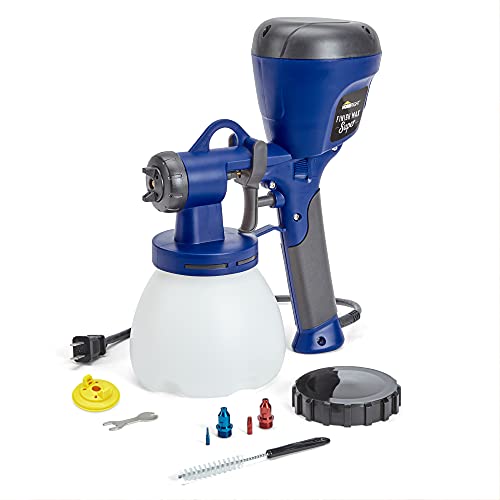
HomeRight Super Finish Max HVLP Paint Sprayer
by HomeRight
The undisputed gateway HVLP sprayer — more owners trust this unit than any other paint sprayer on Amazon.
Pros
- Highest review count of any paint sprayer on Amazon — real-world proof of value
- Three brass tips cover stains, latex, and thick primers right out of the box
- Delivers surprisingly fine finish on furniture and cabinets at this price
- 2-year warranty with US-based customer service, uncommon under a hundred dollars
Cons
- Cleanup requires full disassembly and rinse — plan for 10 to 15 minutes
- Heavy latex paints may need thinning for smooth atomization
Graco Magnum X7 Cart Airless Paint Sprayer — Upgrade Pick
The X7 is the X5 with more motor, more reach, and a cart. The step up costs roughly a hundred dollars more than the X5 at current new prices, which is a real decision rather than a rounding error, so be honest about your paint schedule before you make it. The 125-gallon-per-year capacity rating is twelve times the X5’s, which means the X7 can handle every interior repaint, every exterior cycle, and every fence project you throw at it for a decade without worrying about pump life. If you paint more than once a year, that headroom is what you are buying.
The cart is the under-appreciated upgrade. On the X5, you pick up the unit and carry it. On the X7, you tilt it back like a hand truck and roll it. That sounds trivial until you have spent a day painting a 4,000 sq ft exterior and you realize how often you need to reposition the sprayer. The 100-foot hose support means you can park the unit at one corner of a two-story house and reach the entire structure without moving the cart again — most weekends, I move the X7 a single time per side.
PushPrime is the other quiet improvement over the X5. Both sprayers prime by submerging the suction tube in paint and pulling the trigger, but the X7’s PushPrime button bypasses any startup hesitation in cold weather or with thicker paints. On a 45-degree morning in early spring, I have started the X7 reliably while the X5 needed two or three priming attempts. For a homeowner who paints across all four seasons, that reliability is worth the upgrade by itself.
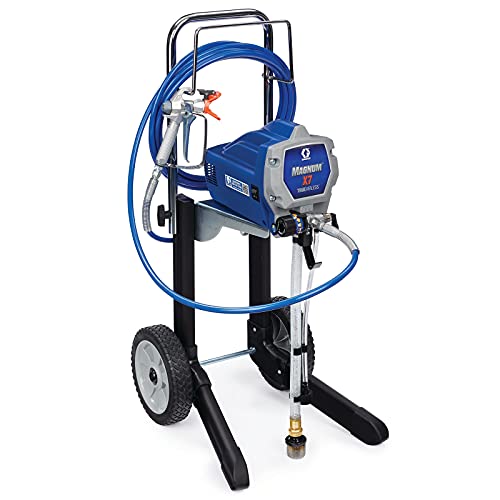
Graco Magnum X7 Cart Airless Paint Sprayer
by Graco
Everything that makes the X5 great, with more motor, more reach, and a cart — the right step up for homeowners who spray more than twice a year.
Pros
- More powerful motor handles thicker paints and larger tip sizes than the X5
- Cart design makes moving between rooms and around the job site effortless
- 100 ft hose support reaches second- and third-story peaks without moving the unit
- PushPrime startup — reliable priming every time, no fussing
Cons
- Cart adds bulk — takes more storage space than the X5 stand unit
- Roughly a hundred dollars more than the X5 at current new prices, and casual DIYers will never use the extra capacity
Graco ProX19 Cart Airless Paint Sprayer — Pro-Grade Runner-Up
The ProX19 is the sprayer I run on multi-family exterior repaints and rental property cycles, but it is overkill for almost any single-family homeowner. With a 500-gallon-per-year capacity rating, an InstaClean pump filter that reduces tip clogs by trapping debris before it reaches the gun, and a swappable pump system that allows on-the-job pump replacement, the ProX19 is built for daily contractor use, not weekend DIY.
The 150-foot hose support is the spec that genuinely changes how you work. On a four-story building, I can park the ProX19 once per side and spray the entire elevation from grade to gutter without repositioning. The InstaClean filter is the feature most homeowners do not appreciate until they have rebuilt a clogged tip in the middle of a job — debris in the paint is the number one cause of mid-spray downtime, and the InstaClean filter eliminates 90 percent of those clogs.
If you own three or more rental properties, run a part-time painting business, or routinely paint structures larger than 4,000 sq ft, the ProX19 is the right tool. For everyone else, the X7 does the same job for roughly two-thirds the price and never wears out under residential use cycles. The 42-pound unit also requires the cart to move comfortably — this is not a sprayer you set on the ground and pick up by hand.

Graco ProX19 Cart Airless Paint Sprayer
by Graco
Graco's most capable consumer-facing airless sprayer — built for pros, rental property owners, and anyone who measures annual paint use in dozens of gallons.
Pros
- InstaClean pump filter dramatically reduces tip clogs from debris in the paint
- 500 gal/year capacity handles full contractor workloads without wearing out
- Swappable pump system allows on-the-job pump replacement — zero downtime
- 150 ft hose reaches four-story buildings without relocating the machine
Cons
- Overkill for homeowners — the X7 handles most DIY needs for about two-thirds the price
- Heavier at 42 lbs — cart is essential, not optional
Fuji Semi-PRO 2 HVLP Spray System — Best for Cabinets and Fine Wood
When the project is kitchen cabinets, built-in furniture, or any wood finish where atomization quality determines the outcome, the Fuji Semi-PRO 2 is in a different league than every other sprayer in this roundup. The 2-stage turbine pushes air through a non-bleed pro gun with a 1.3mm air cap that delivers genuinely glass-smooth lacquer and polyurethane finishes. I have sprayed precat lacquer through the Semi-PRO 2 onto cabinet doors and the result was indistinguishable from factory.
The non-bleed gun is the feature that separates Fuji from the Wagner and HomeRight options. On a bleeder gun, air flows continuously while the trigger is held back — meaning when you stop spraying, the air keeps moving and overspray drifts. On the Semi-PRO 2’s non-bleed gun, releasing the trigger stops both paint and air at the same instant, which gives you razor-sharp control over edges and prevents the overspray drift that ruins fine finishes. For cabinet boxes and furniture edges, this matters enormously.
The honest limitation is workload. The Semi-PRO 2 is not designed for whole-house exterior painting — the turbine atomization is too slow and the cup capacity is too small to compete with airless on volume. It is also a 25-pound investment that demands honest project planning before you spend the money. If your work is cabinets, furniture, trim, and fine wood — buy it. If your work is walls, fences, and exteriors — buy a Graco airless instead.

Fuji Semi-PRO 2 HVLP Spray System
by Fuji
The go-to HVLP system for woodworkers and cabinetmakers who need finish quality that budget turbine guns cannot deliver.
Pros
- Professional-grade finish quality on wood — lacquer, precat, polyurethane, stain
- Non-bleed gun stops overspray the instant you release the trigger
- Air control valve on hose provides fine-tuned spray pressure adjustment
- 2-year parts and labor warranty — best coverage in the category
Cons
- 2-stage turbine requires significant thinning for heavy-body paints
- Not designed for large-scale exterior painting — too slow vs airless
Graco Project Painter Plus — Best One-Time Project Buy
The Project Painter Plus is what I recommend to a homeowner who has a single big project on the calendar — a deck, a fence, one exterior repaint — and wants a real Graco airless without spending Magnum money. At 13 pounds, it is the lightest Graco airless on the market, which makes it the easiest to set up and break down for a one-and-done project. The 3,000 PSI pump and SG2 metal gun are functionally the same hardware as the Magnum line for the actual spraying experience.
The Made in USA build quality is genuinely there at this price point. I have used Project Painter Plus units on rental property work where I knew the sprayer would only see one or two big jobs per year, and they have held up across four-plus years of light seasonal use. For occasional users, the Project Painter Plus is a real Graco sprayer at the lowest entry price the brand offers.
The honest limitations are two: no PushPrime button and a 5-gallon-per-year capacity rating. Without PushPrime, priming in cold weather or with thicker paints is more finicky — you may need to cycle the prime valve two or three times to get a clean fluid path. The 5-gallon annual capacity means this sprayer is engineered for one major project per year, not three or four. If your project list is larger than a single big job per season, step up to the X5.
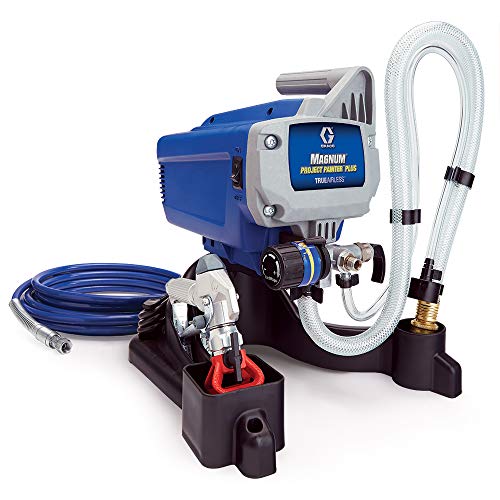
Graco Project Painter Plus Airless Paint Sprayer
by Graco
The most affordable way to get genuine Graco airless performance — built for homeowners with a single big project to tackle.
Pros
- Made in USA — Graco build quality at the lowest entry price in their airless line
- Lightest Graco airless at 13 lbs — easiest to carry and set up
- Sprays unthinned latex and stains straight from a 5-gallon bucket
- 7,500 plus reviews confirm real-world reliability for occasional use
Cons
- No PushPrime button — priming can be inconsistent, especially in colder weather
- 5 gal/year cap limits it to one or two projects before the pump wears out
Wagner Control Spray Max HVLP — Best Mid-Range HVLP for Trim and Furniture
The Wagner Control Spray Max sits in the gap between a budget handheld HomeRight and a professional Fuji turbine, and for many users that is exactly the right place to be. The 20-foot hose between the turbine base and the gun is the key feature — it lets you keep the heavy 11-pound turbine on the floor while you work, which dramatically reduces hand and shoulder fatigue compared to handheld HVLP units. For an afternoon of trim work or a full furniture refinish, the hose-based design is a tangible upgrade.
The two cups (1.5 qt plastic for water-based paints, 1 qt metal for solvent-based stains and lacquers) cover most material types without cross-contamination. I have used the Control Spray Max for interior trim repaints, baseboards, casing, and a set of furniture refinishes — the finish quality is genuinely respectable, somewhere between the HomeRight and the Fuji depending on the material.
The honest limitations are 2-stage turbine power and overspray in windy conditions. Heavy-body latex paints need 10 to 15 percent water thinning to spray smoothly, and the Control Spray Max produces more overspray than the Fuji on exterior work. For indoor trim and furniture in a controlled environment, it is the right tool. For exterior siding work, you want airless instead.

Wagner Control Spray Max HVLP Sprayer
by Wagner
The step between a HomeRight handheld and a Fuji system — ideal for indoor trim, furniture, and cabinets where keeping the heavy unit on the floor matters.
Pros
- 20 ft hose keeps the heavy turbine on the ground while you work — reduces hand fatigue
- Two cups included (plastic and metal) for different material types
- No air compressor required — self-contained turbine, plug and spray
- Minimal overspray compared to airless — practical for indoor trim work
Cons
- 2-stage turbine lacks power for heavy latex without thinning
- Overspray can still be an issue on exterior work in windy conditions
Best Paint Sprayer for Cabinets
Cabinets are the one job where finish quality beats speed, and that means HVLP, not airless. You want fine atomization, low overspray, and enough control to lay an even coat on door faces and frames without runs. The Fuji Semi-PRO 2 is the finish-quality pick — its non-bleed turbine gun sprays lacquer and polyurethane close to factory-smooth. If a kitchen full of doors is a once-a-decade job, the HomeRight handheld does a genuinely respectable job for a fraction of the outlay, and the Wagner’s floor-standing turbine keeps weight off your hand while you work the boxes.
| Product | Price | Buy |
|---|---|---|
| Fuji Semi-PRO 2 HVLP Spray SystemBest finish quality Non-bleed 2-stage turbine lays glass-smooth lacquer and polyurethane on cabinet doors | $569.00 | View on Amazon |
| HomeRight Super Finish Max HVLP Paint SprayerBest budget pick The most-owned sprayer on Amazon — three brass tips handle a one-time kitchen refinish | $57.00 | View on Amazon |
| Wagner Control Spray Max HVLP SprayerBest hose-fed control 20 ft hose keeps the turbine on the floor so you can work cabinet boxes without arm fatigue | $150.99 | View on Amazon |
Best Paint Sprayer for Furniture
Furniture spans a huge range — a single chair up to a wall of built-ins — so the right sprayer depends on the piece. For small items, the 4.4 lb HomeRight handheld is the easiest tool to pick up and finish a project in an afternoon. For larger dressers, tables, and multi-piece sets, the Wagner’s hose-fed turbine and two material cups reduce fatigue and cover more surface. When the piece is a keeper and the finish has to be flawless, step up to the Fuji.
| Product | Price | Buy |
|---|---|---|
| HomeRight Super Finish Max HVLP Paint SprayerBest for small pieces 4.4 lbs handheld — the easiest way to spray a chair, dresser or bookcase | $57.00 | View on Amazon |
| Wagner Control Spray Max HVLP SprayerBest for larger furniture Two cups and a floor-standing turbine for bigger dressers, tables and sets | $150.99 | View on Amazon |
| Fuji Semi-PRO 2 HVLP Spray SystemBest pro finish Turbine atomization budget guns can't match when the piece has to look factory-made | $569.00 | View on Amazon |
Best Paint Sprayer for Walls and Ceilings
Interior walls and ceilings are an airless job — you want to pull wall latex straight from the bucket and lay a flat, uniform coat fast. For most homeowners the Magnum X5 is the right balance of power and price. If it is a single room or a ceiling and you want real Graco airless on a budget, the lighter Project Painter Plus does the job. For a whole house of interiors in one push, the X7’s cart and 100 ft hose support keep you moving.
| Product | Price | Buy |
|---|---|---|
| Graco Magnum X5 Airless Paint SprayerBest all-around 3,000 PSI sprays unthinned wall latex from a 5-gallon bucket with a clean, flat finish | $365.00 | View on Amazon |
| Graco Project Painter Plus Airless Paint SprayerBest one-room budget Lightest Graco airless — right for a single room or ceiling without overspending | $285.40 | View on Amazon |
| Graco Magnum X7 Cart Airless Paint SprayerBest for whole-house interiors Cart and 100 ft hose support cover a full house of walls and ceilings from one spot | $459.00 | View on Amazon |
Best Paint Sprayer for House Exterior
Exteriors reward reach and capacity. The number that matters is how much of the house you can cover before repositioning the unit, and how many gallons per year the pump is rated for. The Magnum X7’s cart and 100 ft hose support make it the right call for most two-story homes. The X5 handles a smaller single-story exterior for less. For multi-story buildings and back-to-back rental repaints, the ProX19’s 500 gal/yr capacity and 150 ft hose earn their keep.
| Product | Price | Buy |
|---|---|---|
| Graco Magnum X7 Cart Airless Paint SprayerBest for most homes Cart plus 100 ft hose support reaches second-story peaks and siding from one setup | $459.00 | View on Amazon |
| Graco Magnum X5 Airless Paint SprayerBest value Same 3,000 PSI airless for a smaller single-story exterior at the lowest Magnum price | $365.00 | View on Amazon |
| Graco ProX19 Cart Airless Paint SprayerBest for multi-story & rentals 500 gal/yr and 150 ft hose for four-story buildings and repeat rental repaints | $749.00 | View on Amazon |
Best Paint Sprayer for Fences and Decks
Fences and decks are stain-and-go work — long runs of repetitive surface where an airless pulls stain straight from the bucket and chews through the job. The Magnum X5 is the workhorse for a big fence line. For a single deck or fence stain project, the Project Painter Plus is sized right and costs less. For pickets, lattice, and small privacy fences where an airless would just blow stain everywhere, the handheld HomeRight gives you the control.
| Product | Price | Buy |
|---|---|---|
| Graco Magnum X5 Airless Paint SprayerBest for big fences Pulls stain and fence paint from the bucket — chews through a long fence line fast | $365.00 | View on Amazon |
| Graco Project Painter Plus Airless Paint SprayerBest for one-time stain jobs Airless sized for a single deck or fence stain project without overspending | $285.40 | View on Amazon |
| HomeRight Super Finish Max HVLP Paint SprayerBest for small fences & lattice Handheld control for pickets, lattice and small privacy fences where airless is overkill | $57.00 | View on Amazon |
Best Paint Sprayer for Home Use and Beginners
If you are buying your first sprayer for general home use, buy the tool that is forgiving and actually gets reused. The Magnum X5 is the do-everything first airless — and Graco’s PowerFlush cleanup is the reason it does not end up abandoned in the garage. If you want the lowest-risk, lowest-cost way to learn, the HomeRight handheld is the cheapest way in and beginner-proof. For learning on indoor trim, doors, and furniture with less overspray to clean up, the hose-fed Wagner is the gentler starting point.
| Product | Price | Buy |
|---|---|---|
| Graco Magnum X5 Airless Paint SprayerBest overall for homeowners The forgiving do-everything first airless — PowerFlush cleanup means it gets reused | $365.00 | View on Amazon |
| HomeRight Super Finish Max HVLP Paint SprayerEasiest & cheapest to start Lowest-risk way to learn spraying: three tips and 10,000+ owners behind it | $57.00 | View on Amazon |
| Wagner Control Spray Max HVLP SprayerBest for indoor projects Hose-fed HVLP keeps overspray down while you learn on trim, doors and furniture | $150.99 | View on Amazon |
Best Paint Sprayer by Job: Stain, Doors and Metal
A few more common jobs and the sprayer from the lineup I would reach for on each. Every pick keeps its live price and Amazon link so you can compare without leaving the page.
| Product | Price | Buy |
|---|---|---|
| Fuji Semi-PRO 2 HVLP Spray SystemBest for stain, polyurethane & lacquer Fine-finish turbine built for oil-based stain, poly and lacquer where atomization decides the result | $569.00 | View on Amazon |
| Wagner Control Spray Max HVLP SprayerBest for doors & trim Hose-fed HVLP with fine control for doors, trim and garage doors without heavy overspray | $150.99 | View on Amazon |
| Graco Magnum X5 Airless Paint SprayerBest for metal & stucco Airless 3,000 PSI drives thick coatings onto metal railings, gates and stucco | $365.00 | View on Amazon |
Should You Even Buy a Sprayer? The Honest GC Answer
Here is the section every other paint sprayer roundup skips. Most of you should not buy a sprayer. Let me show you the math.
The rental option. Home Depot and Lowe’s both rent the Graco Magnum line — typically the X5 or X7 — for roughly 55 to 85 dollars per day depending on market and season. For a single project, renting is the rational choice. The X5 runs around 365 dollars new, which means rental breakeven sits at roughly four to seven full rental days depending on your rental rate. If your project list is one fence this spring and nothing else for two years, rent the sprayer. You save close to 300 dollars and you do not have a piece of equipment depreciating in your garage.
The masking and prep math. Spraying lays paint down two to four times faster than rolling once you start. The trap is that masking and prep take longer than rolling the entire project. A typical bedroom spray prep — plastic on the floor, plastic over the door, masking tape on the trim, drop cloths on furniture, plastic on outlets and light fixtures — runs 60 to 90 minutes. Spraying that same bedroom takes 15 to 20 minutes of actual paint application. Total: 75 to 110 minutes. Rolling the same room with brush cutting-in: 60 to 75 minutes total, with no masking. For a single bedroom, rolling wins. Spraying starts pulling ahead at three rooms or more, and dominates at full-house volume.
The overspray waste math. Airless sprayers waste 30 to 40 percent more paint than rolling on the same surface. On a 2,000 sq ft exterior repaint requiring eight gallons rolled, you will burn 11 to 12 gallons sprayed — three to four extra gallons that vanish into atomized overspray and pump priming. At 40 to 50 dollars per gallon for quality exterior latex, that is 120 to 200 dollars of paint waste per project. HVLP wastes less, around 20 percent over rolling, but it still wastes more than a roller. Factor the paint waste into your project cost when you are deciding whether to spray.
Check the condition before you check out. As of September 2026, Graco is no longer stocking the Magnum line with Amazon directly, and the default offer on the X5, the X7 and the Project Painter Plus is an Amazon Resale open-box unit rather than a new one. Those units are often fine and the return window is the same, but the headline price you see first is a used price, and the new price from a third-party seller runs 30 to 130 dollars higher depending on the model. Two things to do before you buy: read the condition line directly under the price, and open “New & Used from” to compare the actual new offers. The ProX19 is the one model Amazon still sells new itself, though it ships on an 8 to 14 day lead time. Prices on this page are the new-unit prices, because a used pump with unknown hours is not the thing I am recommending.
When to buy a sprayer. Buy a sprayer when at least two of the following are true: you have three or more sprayer-appropriate projects on a 24-month horizon, your project sizes are above 800 sq ft of paintable surface, finish quality matters more than time savings (HVLP), or you own rental property and will spray regularly across the next five-plus years. Otherwise, rent. The math does not work in your favor.
HVLP vs Airless: Which Type Do You Actually Need?
The choice between HVLP and airless is not subtle, and the decision tree is shorter than most reviews make it.
Airless if you are spraying walls, ceilings, exterior siding, fences, decks, or any surface above roughly 400 sq ft. Airless is fast, handles unthinned latex from a 5-gallon bucket, and produces a flat uniform finish that is acceptable for the vast majority of construction and renovation surfaces. It also produces meaningful overspray and demands thorough masking.
HVLP if you are spraying cabinets, furniture, trim, doors, or any project where finish quality is the primary concern. HVLP atomization is finer, overspray is significantly lower, and the resulting surface is glassier than airless can produce. Speed is slower, the cup is smaller, and you will need to thin most water-based paints. The Fuji Semi-PRO 2 is the right HVLP for serious finish work; the HomeRight Super Finish Max is the right HVLP for occasional furniture projects.
Both if you have a real workshop. Most serious DIYers eventually own one of each — an airless for whole-house and exterior projects, an HVLP for cabinets and furniture. They are not redundant tools; they do different jobs.
How to Read Spray Tip Numbers
Tip selection is the spec that confuses new sprayers most, and it should not. Once you understand the system, picking the right tip takes 10 seconds.
Airless tips are coded as 3-digit numbers like 515 or 517. Double the first digit for the fan width in inches at 12 inches from the surface — a 515 tip sprays a 10-inch fan. The last two digits are the orifice size in thousandths of an inch — a 515 tip has a 0.015-inch orifice. Larger orifices flow more paint per second; larger fan widths cover more area per pass. For thinner finishes (lacquer, stain), use 0.009 to 0.013-inch orifices. For exterior latex, 0.015 to 0.019 is the standard range. For thick coatings (elastomeric, block filler), step up to 0.021 or larger.
HVLP air caps are sized in millimeters — 1.0mm, 1.3mm, 1.5mm, 2.0mm. Smaller air caps produce finer atomization; larger air caps handle thicker materials. For lacquer and varnish, 1.0 to 1.3mm is right. For water-based latex, 1.5 to 1.8mm works. For thicker primers and heavy paints, 2.0 to 2.5mm is needed.
The single most common new-sprayer mistake is using a tip that is too large for the paint, producing tail spray (uneven edges of the fan pattern) and a lap-marked finish. When in doubt, start one size smaller than recommended and step up if flow is inadequate.
Buyer's Guide
I have rented, bought, and worn out enough paint sprayers across two decades of contracting that I have stopped recommending them universally. The right sprayer depends on your project scale, frequency, and how honest you are about prep and cleanup time. Here are the six factors I evaluate before recommending a sprayer to a client or a homeowner.
Project Scale and Frequency
Sprayers earn their keep on volume. If you are painting a single bedroom or one piece of furniture, a sprayer is almost certainly slower end-to-end than a roller and brush once you account for masking and cleanup. Sprayers start winning on projects above roughly 800 sq ft of paintable surface — large rooms, full house exteriors, fences, decks, and multi-room repaints. Frequency matters too. A homeowner who paints once every five years should rent. A homeowner who repaints every season, owns rental properties, or maintains a large fence line should buy. Match the sprayer's annual capacity rating to your real expected use, not your aspirational use.
Sprayer Type — HVLP vs Airless
Airless sprayers atomize paint by forcing it through a tiny tip at 2,000 to 3,000 PSI. They are fast, handle unthinned latex straight from a 5-gallon bucket, and dominate large exterior and interior wall jobs. They also produce significant overspray and demand more thorough masking. HVLP (high volume, low pressure) sprayers use a turbine to push paint through a larger orifice at low pressure. The result is a much finer finish with less overspray, ideal for cabinets, furniture, trim, and any job where finish quality matters more than speed. Most serious DIYers eventually own one of each. If you must choose one, airless is the higher-leverage tool for whole-house painting.
Pressure and Flow Rate
For airless, the spec to watch is GPM (gallons per minute) and maximum tip size. The Graco Magnum line tops out at 0.27 GPM and a maximum tip of 0.017 inches, which is plenty for any latex wall paint and most exterior coatings. Pro-grade units like the ProX19 push 0.34 GPM with a maximum tip of 0.019 inches, opening up heavier-body coatings like elastomeric and block filler. For HVLP, look at turbine stages — 2-stage handles thinner finishes and most water-based paints, while 3-stage adds power for thicker materials. Higher pressure does not mean better finish; it means more capability with thicker paints.
Hose Length and Reach
Hose length determines how often you have to move the unit. A 25 ft hose is fine for single-room interior work. A 50 ft hose lets you stand on a ladder while the unit stays on the ground for soffit and fascia work. A 100 ft hose covers a full two-story house exterior from a single setup spot. Buying a longer hose later costs around 100 dollars and is an obvious upgrade once you understand how much time it saves. The Graco Magnum X7 supports up to 100 ft and the ProX19 supports up to 150 ft — both are worth it on multi-story exterior work.
Cleanup Time
Cleanup is where sprayers get abandoned. Graco's PowerFlush garden-hose adapter is the single best cleanup feature in the category — connect the garden hose, pull the trigger, and fresh water flushes the entire pump and hose in about 5 minutes. HVLP guns require full disassembly of the cup, needle, nozzle, and air cap, which adds 10 to 15 minutes of detailed cleaning. Plan cleanup time into every spray session. Skipping cleanup is the most common cause of sprayer failure — dried paint inside a pump is a dead pump.
Overspray and Paint Waste
Airless sprayers waste 30 to 40 percent more paint than rolling on the same surface — that paint atomizes into overspray, primes the hose and pump, and remains in the system at cleanup. On a 2,000 sq ft exterior that requires eight gallons rolled, you will use 11 to 12 gallons sprayed. At quality exterior latex prices, that is 120 to 160 dollars in extra paint per project. HVLP wastes less, around 20 percent over rolling, because the lower pressure produces less overspray. Factor the waste into your paint budget. On large projects, the time savings still win. On small projects, the waste outweighs the time savings.
How to Use a Paint Sprayer: A Contractor’s Setup Checklist
Even with the right sprayer, technique decides outcome. Here is the setup I run every time I uncrate a sprayer on a job. Before you start, glove up — solvent cleanup is the part of spraying that wrecks your hands, and a chemical-resistant pair from our work gloves roundup costs less than a quart of lacquer thinner.
Practice on cardboard first. Always. Set up the sprayer with the actual paint you are using, then run a 30-second test spray on a piece of corrugated cardboard. Adjust pressure (start at 5 of 10 on the dial and increase only if you see tail spray) and fan width before you touch the actual project surface. This single habit prevents the majority of “I ruined the wall” mistakes new sprayers make.
Distance and speed. Hold the gun 12 inches from the surface, perpendicular to the work, and move at roughly one foot per second. Closer than 10 inches deposits too much paint and creates runs. Further than 14 inches produces dry spray and a sandpaper finish. Watch your arm speed, not your wrist — sweep with your shoulder for consistent distance.
Overlap each pass by 50 percent. Your second pass should cover the bottom half of your first pass and the top half of unsprayed surface. This eliminates lap marks and produces a uniform finish.
Trigger the gun before each pass and release at the end. Never start your motion with a held trigger — that deposits a heavy band of paint at the start point. Move the gun first, pull the trigger when it is in motion, release the trigger before you stop moving. This is the discipline that separates sprayed walls that look professional from sprayed walls that look obviously sprayed.
When NOT to spray. Above 85°F, paint dries before it lays out and you get orange-peel finish. Below 50°F, paint does not flow correctly and you get tail spray. In wind above 10 mph outdoors, overspray drifts and lap pattern becomes inconsistent. On peeling existing paint that has not been properly prepped, no amount of fresh spray covers the underlying failure — you will be redoing the work in 18 months. Prep matters as much as the equipment: for exterior repaints, blast loose paint, mildew, and chalking with one of our recommended electric pressure washers before you ever load the sprayer, otherwise the new finish is only as durable as the old one underneath it.
How to Choose the Best Paint Sprayer
The right sprayer for you depends on three honest questions: how often you will paint, what surfaces you will paint, and whether finish quality or speed matters more.
For most homeowners painting walls and exteriors, the Graco Magnum X5 is the right answer. It is the balance point of capability, capacity, and price for residential use cycles.
For homeowners painting more than once a year or covering multi-story exteriors, step up to the Graco Magnum X7. The cart, the 100-foot hose support, and the 125-gallon annual capacity justify the roughly hundred-dollar step up over the X5 if you paint on any kind of schedule.
For one-time projects or budget-constrained buyers, the HomeRight Super Finish Max is the right tool for furniture and small jobs, and the Graco Project Painter Plus is the right tool for one big airless project.
For cabinet and furniture finishing, buy the Fuji Semi-PRO 2 — it is in a different league than every other HVLP option in this roundup.
For contractors, rental property owners, and high-volume painters, the Graco ProX19 earns its keep on workload that would wear out the consumer Magnum line.
Final Verdict
For most homeowners, the Graco Magnum X5 is the paint sprayer to buy. It hits the right balance of power, reliability, capacity, and price for residential use cycles, and Graco’s PowerFlush cleanup system makes it the rare sprayer that actually gets used regularly instead of abandoned in the garage. At this price point, it is also low-risk — Graco’s airless line has the longest service life of any sprayer category I have used, and the X5 routinely runs for a decade with proper cleanup.
If you want a budget HVLP for occasional furniture projects, the HomeRight Super Finish Max is the right pick — over 10,000 verified buyers cannot be wrong, and at this price, it is hard to lose. For homeowners painting more than once a year, the Graco Magnum X7 is the obvious upgrade with its cart and 125-gallon annual capacity. And before you buy any sprayer, run the rental math first — if you have one project and nothing else on a two-year horizon, rent. The gear is a means to a finished surface, not the goal. Pair the right sprayer with the right paint chemistry and the work itself becomes easier than the planning.
Frequently Asked Questions
Is it cheaper to rent or buy a paint sprayer?
Is it faster to spray or roll interior walls?
How much extra paint does an airless sprayer waste compared to rolling?
Do I need to thin paint for a sprayer?
How do I clean a paint sprayer after use?
Related Articles
Oil-Based vs Latex Paint: Which One You Should Actually Be Using in 2026
painting-supplies
7 Best Electric Pressure Washers of 2026
outdoor-power
Essential Tools Every New Homeowner Needs: A Contractor's Tiered Buying Guide
hand-tools
7 Best Interior Paints for Walls in 2026 (Tested by a Licensed Contractor)
painting-supplies
How to Paint a Room Like a Pro: What Contractors Know That DIYers Skip
painting-supplies
About the Reviewer

Jake Morrison, Licensed General Contractor
B.S. Construction Management, Purdue University
Jake Morrison has spent 14 years in residential construction and home renovation before founding DIYRated in 2026. After helping hundreds of homeowners choose the right tools and materials for their projects, he started writing the product guides he wished existed when he was starting out. Jake tests every major product recommendation in his workshop in Indianapolis and focuses on real-world performance over spec-sheet marketing.