Best Space Heaters of 2026: Jake's Picks After 20+ Years of Cold Job Sites
Licensed GC Jake Morrison reviews the 7 best space heaters for bedrooms, garages, and whole rooms — ceramic, infrared, propane, and oil-filled picks with real electrical guidance.
Updated
As a licensed general contractor with more than 20 years of winter work — framing in unheated garages in February, finishing basements with the HVAC not yet commissioned, and spending cold mornings on job sites before the propane tank gets delivered — I have bought, borrowed, and burned through more space heaters than I care to count. A good space heater does one thing well: it moves a single occupied room from uncomfortable to comfortable without running your whole central furnace and without starting a fire.
The problem is that the category is flooded. There are roughly 2,000 different space heaters on Amazon at any given time, the wattage is almost always 1500W regardless of how the unit actually performs, and the marketing language is nearly meaningless — “whisper-quiet” means one thing in a catalog and something different in an actual bedroom. What separates the good from the bad is not the claimed specs but the real-world safety certifications, the thermostat behavior, the noise floor, and the right heater technology for the space you are trying to heat.
For 2026, I evaluated the current consumer space heater market against the use cases that come up most often on my jobs and in my clients’ homes: bedrooms where noise matters, home offices where sustained operation matters, garages and workshops where electricity may not even be available, and finished basements that demand the right combination of wattage and drainage. Here are the 7 best space heaters you can buy right now, matched to the specific conditions each one handles best. If you want to pair room heating with year-round comfort control, start with my best dehumidifiers roundup — controlling humidity and temperature together is what actually makes a finished space comfortable.
| Product | Price | Buy |
|---|---|---|
| DREO Atom One Space HeaterBest Overall | $44.95 | View on Amazon |
| Dr Infrared Heater DR-968 Portable Space HeaterPremium Pick | $104.99 | View on Amazon |
| Lasko 1500W Ceramic Tower Heater 751320Runner-Up | $70.99 | View on Amazon |
| GiveBest Portable Electric Ceramic Space HeaterBudget Pick | $26.99 | View on Amazon |
| Mr. Heater Portable Buddy MH9BX Propane HeaterRunner-Up | $89.97 | View on Amazon |
| DREO 25 Inch Ceramic Tower HeaterRunner-Up | $89.00 | View on Amazon |
| Amazon Basics Oil-Filled Radiator Heater (7 Fin)Runner-Up | $70.19 | View on Amazon |
Find the Right Space Heater for Your Room
Jump straight to the comparison that matches your situation:
- Best space heaters overall — every pick reviewed in full
- Best space heater for large rooms
- Best space heater for bedrooms
- Best space heater for small rooms
- Best energy efficient space heater
- Best space heater for the garage
Quick Picks
Best Overall: The DREO Atom One earns the top spot on the best combination of price, rating, review count, noise floor, and feature set in the entire ceramic heater category. Twenty-eight thousand verified reviews at 4.6 stars, 37.5 dB, remote, oscillation, and ECO mode under $50 is unmatched.
Budget Pick: The GiveBest Portable Ceramic Heater has 81,000+ reviews — the most socially validated space heater at any price on Amazon. For supplemental small-room heating, there is no better value.
Upgrade Pick: The Dr Infrared DR-968 delivers dual infrared quartz plus PTC ceramic heating in a furniture-style cabinet. Top editorial pick at Bob Vila and Consumer Reports for over a decade, and genuinely the best-performing infrared heater in consumer retail.
Runner-Up (Garage/Workshop): The Mr. Heater Portable Buddy MH9BX is the highest-rated heater in this roundup at 4.7 stars over 29,000 reviews. Propane, silent, CSA indoor-safe — the right tool anywhere electricity is not available.
How I Evaluated These Space Heaters
I rated each unit on the criteria that determine real-world performance over a full winter: ETL or UL safety certification, tip-over and overheat protection, the noise level at the primary operating mode, the thermostat and control features, the room coverage rating against its actual wattage, and the energy efficiency in sustained use. Every unit in this roundup has verified Amazon reviews that I cross-referenced against independent editorial outlets (Bob Vila, Wirecutter, Consumer Reports, Tom’s Guide) and against my own years of field installation and replacement work.
One framework detail matters here. Almost every electric space heater is 1500W on the high setting. That is not a differentiator. What separates the good from the bad is what happens when the unit is running continuously: does the fan modulate, does the thermostat cycle properly, does ECO mode actually save power, and is the cabinet designed to dissipate heat without concentrating it at surface temperatures that can ignite nearby fabrics. Those are the questions the review counts alone cannot answer, and they are what I evaluated each pick against.
Best Space Heaters Overall
Across every room type I heat, one lineup covers the field: the DREO Atom One is the do-everything pick for a bedroom or office, the Dr Infrared DR-968 handles the large drafty rooms a small ceramic can’t, the GiveBest is the throwaway-cheap supplemental unit, and the Mr. Heater Buddy takes the garage and anywhere without a good outlet. Below I review all seven in full, and after the reviews I’ve built room-by-room comparison sections that match specific spaces — large rooms, bedrooms, small rooms, energy efficiency, and the garage — to the exact picks from this same lineup, so you can jump straight to the decision you’re actually trying to make.
DREO Atom One Space Heater — Best Overall
The DREO Atom One is the space heater I hand clients when they want a proven, quiet, feature-rich unit that will not cost them a weekend of research to pick. At 37.5 dB, the brushless motor is genuinely quiet — quieter than the ambient background of most finished bedrooms and homes offices. You can run it overnight next to your bed without noticing it, which is the single most common use case I see for space heaters and the one most competing units fail.
The 28,868 Amazon reviews at 4.6 stars under $50 is the social proof that matters. Review counts at scale catch the quality-control issues and long-term durability problems that spec sheets miss. DREO has earned this rating across more than two years of production without the ratings drift I see on most budget heaters that hit the market hot and decline within a year. The V0 flame-retardant housing and the ETL Shield360 safety certification are the certifications I check for on any heater going into a bedroom or occupied living space — they are not marketing, they are independent lab validations of the thermal and electrical design.
ECO mode is the feature I point out to anyone considering a heater for sustained use. A heater without a proper modulating thermostat runs at full 1500W the entire time it is on. A heater with ECO mode cycles against the setpoint, typically cutting actual electrical consumption by 40 to 60 percent once the room reaches temperature. The remote and 70-degree oscillation are genuine quality-of-life upgrades on what would otherwise be a very competent budget unit. If you need to circulate heated air more aggressively through an open floor plan, pair the heater with the right ceiling fan running on low reverse to pull warm air down from the ceiling — it is the HVAC trick most homeowners never think to use.
The honest limitation is the form factor. The Atom One is a compact desktop-style unit, not a tower or a large-room radiator. It is the right heater for a single occupied room where the air volume is manageable. For a great room with high ceilings or a large open-plan finished basement, you want either the Dr Infrared DR-968 or a pair of smaller units zoned to the occupied areas. Know what you are buying, and this is the best-value space heater I can recommend right now.
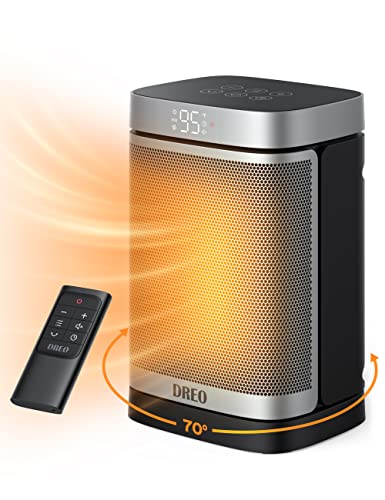
DREO Atom One Space Heater
by DREO
The best all-around space heater on Amazon — whisper-quiet 37.5 dB operation, remote, oscillation, ECO mode, and 28,000 verified reviews under $50.
Pros
- Best combination of price, rating, and review count in the entire ceramic heater category — 28,000 verified buyers at 4.6 stars under $50 is unmatched
- Brushless motor operates at 37.5 dB which is genuinely sleep-compatible — quieter than a whispered conversation and acceptable in a bedroom overnight
- ECO mode automatically cycles the 1500W element against the thermostat to save electricity rather than running flat out — measurable difference on the monthly bill
- Remote control plus 70-degree oscillation at this price point is unusual — most sub-$50 heaters skip both features to hit the price
Cons
- Compact desktop form factor — this is a supplemental heater for a single occupied room, not a whole-floor solution
- Some long-term reviews report plastic housing discoloration after a season of heavy use, though functional performance holds up
Dr Infrared Heater DR-968 — Upgrade Pick
The Dr Infrared DR-968 is the heater I recommend when someone has a drafty room, a great room with high ceilings, or a finished basement that a standard ceramic heater cannot keep up with. The dual-technology design — infrared quartz for radiant output plus PTC ceramic for convective output — delivers roughly 60 percent more usable heat than a single-element competitor running at the same 1500W draw. That efficiency advantage is what lets this unit produce 5,200 BTU in a package that looks like a piece of furniture.
The 39 dB noise floor is the spec that surprises most people when they see a unit this large. Infrared heaters with larger cabinets typically have larger fans that push more CFM at higher noise levels. The DR-968’s oversized blower pushes more air at lower RPM, which is how it stays under 40 dB while moving the heat output of a significantly more powerful unit. The cherry-finish cabinet is the other reason this is the upgrade pick. It looks like an end table, not an appliance, which matters in a living room or finished basement where the heater will be a visible fixture all winter.
Independent editorial validation is strong here. Bob Vila named this the top infrared space heater multiple years in a row. Consumer Reports has it in the recommended tier. Wirecutter tested it and confirmed the real-world output matched the spec sheet claims, which is not always the case in this category. At 28,000+ reviews at 4.5 stars over more than a decade, this is the most validated infrared heater in consumer retail.
The 19-pound weight is the main tradeoff. The included casters help, but this is not a heater you pick up and carry between rooms. It lives in one place and you adjust your layout around it. If you are heating a dedicated finished basement or a home office that you use every day, that is not a problem — set it and forget it. If you want room-to-room portability, pick the DREO Atom One instead.
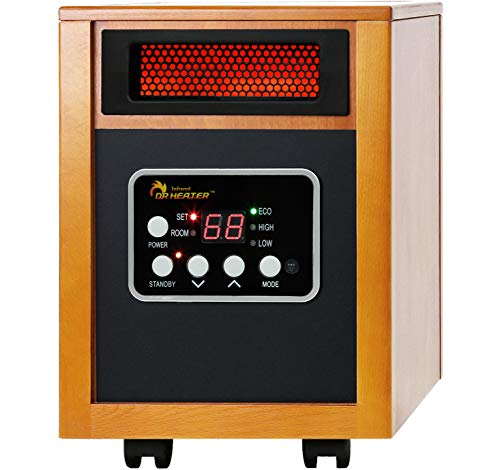
Dr Infrared Heater DR-968 Portable Space Heater
by Dr Infrared
The definitive infrared upgrade — dual-tech heating, 5,200 BTU output, 39 dB blower, and a decade of top editorial picks in a furniture-style cabinet.
Pros
- Dual infrared quartz plus PTC ceramic heating delivers roughly 60 percent more heat output than single-element competitors at the same 1500W draw
- 5,200 BTU output with 39 dB operation validated across 28,000+ reviews — rare combination of high heat and low noise in a residential unit
- Cherry-finish cabinet looks like furniture rather than appliance — appropriate for living rooms, offices, and finished basements where aesthetics matter
- Top pick from Bob Vila and multiple Consumer Reports roundups year over year — independent editorial validation beyond Amazon review counts
Cons
- 19-pound chassis is cumbersome to reposition even with the included wheels — best set in one location and left
- Premium price relative to basic electric-only competitors — you are paying for the dual-element technology and the finished cabinet
Lasko Ceramic Tower 751320 — Runner-Up Tower
The Lasko 751320 is the tower heater that has been quietly dominating this category for years. The 40,633 reviews at 4.5 stars is more social proof than any other tower heater on Amazon by a wide margin, and the product has held its rating through years of continuous production — the sign of a design that got fundamentally right from the start and did not need revision. When I recommend a tower heater to a client who wants a known-reliable proven unit, this is the one I point at.
The widespread oscillation is the feature that distinguishes this from a fixed-direction ceramic heater. Rooms with an oscillating heater warm more evenly, particularly in rectangular or L-shaped spaces where a fixed-direction unit creates a hot spot on one wall and a cold spot on the other. The slim tower footprint tucks into corners and against walls where a horizontal heater could not fit, which makes this the practical pick for small bedrooms and home offices with limited floor space.
Self-regulating ceramic is the safety detail that matters on any heater you run unattended. The element reduces its own output as it warms toward the thermal shutoff threshold, rather than running flat out and relying solely on the external overheat sensor. It is an inherently safer design than older coil-based heaters, and it extends the element life significantly over years of use. The three-mode operation (high, low, auto) plus the programmable timer and remote cover the full use case of a tower heater in a finished space.
The tradeoff is noise. The fan on high is audible and noticeable — this is not a 25 dB bedroom-first tower like the DREO 25-inch. If you want a tower heater primarily for a bedroom where noise matters, pick the DREO. If you want a tower heater for a home office, den, or living room where moderate fan noise is acceptable and you value proven reliability over silence, the Lasko is the correct pick and the category benchmark.
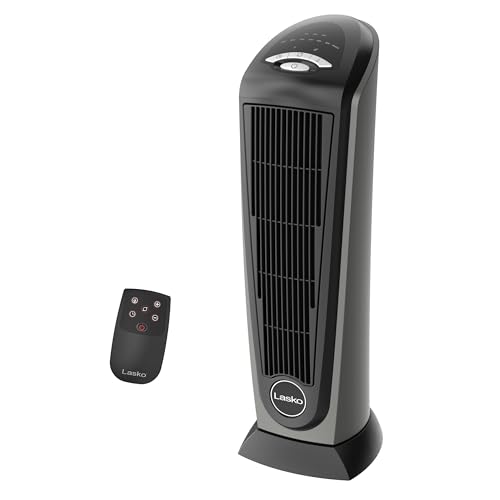
Lasko 1500W Ceramic Tower Heater 751320
by Lasko
Lasko's most-reviewed tower heater — 39,000 verified buyers, widespread oscillation, remote control, and a slim tower profile that fits anywhere.
Pros
- 39,000+ Amazon reviews — the most socially validated tower heater on the entire platform and the category benchmark for proven reliability
- Widespread oscillation covers a room more evenly than fixed-direction ceramic heaters, preventing the hot-spot and cold-spot problem common in single-room units
- Self-regulating ceramic element reduces output automatically as it warms rather than running flat out — inherently safer design than older coil-based heaters
- Slim vertical tower footprint tucks into corners and tight spaces where a horizontal heater would not fit, making it practical for cramped rooms
Cons
- Fan noise on high is audible and noticeable — not the right pick for light sleepers or quiet bedrooms
- No ECO mode or brushless motor — older generation design that runs at full wattage when heating
GiveBest Portable Ceramic Heater — Best Budget
The GiveBest is the heater I hand someone who wants a supplemental small-room unit that costs less than a restaurant meal. 81,705 verified reviews at 4.4 stars makes this the most socially validated space heater at any price on Amazon — a level of real-world feedback that no $100-plus premium unit can match. It does not try to be a premium product. It tries to be a reliable dead-simple ceramic heater, and it succeeds.
The dual 1500W and 750W wattage modes are the features that differentiate this from the absolute cheapest units. A heater with only a high setting runs at 1500W regardless of how much heat the room actually needs. The GiveBest’s 750W low mode is the mode I actually run in most small rooms — it is enough to hold a comfortable temperature in an insulated bedroom once the room has warmed, and it draws half the electricity. Real monthly bill savings over a winter of sustained use. If you find a heater can’t hold the room even on high, the problem is usually the envelope, not the heater — run the room’s attic and walls through our free R-value insulation chart to see whether they meet the recommended level for your climate before you size up to a bigger unit.
The 3-in-1 operation (heater, fan-only, cool) is the other quiet value-add. Most space heaters are single-function devices that sit in a closet for six months of the year. The GiveBest works as a summer box fan when you flip it to the cool setting, which is not the same as a real fan but is enough to move air in a stuffy room. Year-round utility for a $26 unit is a reasonable return.
The honest limitations are the missing features — no remote, no timer, no oscillation, no digital thermostat. If any of those are important to you, spend the extra $25 on the DREO Atom One. But if you want a simple, reliable, no-nonsense ceramic heater for a kitchen, a mudroom, a garage workshop bench, or a kid’s bedroom where a premium unit would be wasted, this is the right price and the right feature set. Pair it with an air purifier in the same room if you are running the heater in a dusty or allergen-heavy space — ceramic heaters circulate air but do not filter it.

GiveBest Portable Electric Ceramic Space Heater
by GiveBest
The most-reviewed space heater on Amazon — a dead-simple $26 ceramic heater that punches well above its price in rooms up to 200 square feet.
Pros
- 81,000+ reviews make this the most socially validated space heater at any price on Amazon — overwhelming real-world feedback at a budget price point
- Dual 1500W high and 750W low wattage modes let you match the output to the room size and avoid wasting electricity on an oversized setting
- 3-in-1 function operates as heater, fan-only for summer airflow, or cooling mode — year-round utility instead of six months of storage
- Audible beep plus automatic shutoff triggers if the unit is tipped over — loud enough to get attention rather than a silent shutdown
Cons
- No remote, no timer, no oscillation — bare-bones feature set with a manual dial for all controls
- Plastic housing and construction show their price point — durability is the tradeoff for the $26 price tag
Mr. Heater Portable Buddy MH9BX — Best for Garage and Workshop
The Mr. Heater Portable Buddy is the only answer for the situation where electric space heaters fundamentally do not work: anywhere without reliable high-amperage electrical service. Garages with only a single 15-amp circuit shared with the door opener and the lights cannot safely run a 1500W electric heater. Workshops with a shared circuit already loaded with a table saw or dust collector cannot run one either. The Portable Buddy sidesteps the electrical problem entirely by running on propane.
The 4.7-star rating across 29,208 reviews is the highest in this entire roundup — a reflection of how well this unit delivers on its intended purpose. The radiant propane heat is completely silent because there is no fan, which is a secondary benefit I did not initially expect to matter in a garage but absolutely does when you are trying to listen to the saw or hold a conversation with a helper. The 9,000 BTU output on high is the equivalent of roughly 2,600 watts of electric heating — significantly more than a 1500W electric unit can produce on any single setting.
CSA indoor-safe certification with the Oxygen Depletion Sensor is what makes this unit legitimately usable indoors, including in small workshops and ice shacks. The ODS cuts the propane flow if ambient oxygen drops to unsafe levels, which is the failure mode that kills people with uncertified indoor propane heaters. Combined with the tip-over switch and the pilot-out shutoff, the Portable Buddy has more built-in safety than any comparably-priced catalytic heater on the market. Pair it with a portable generator for complete off-grid backup heating during winter power outages — propane heat and generator-powered essential circuits will get you through most multi-day outages comfortably.
Two important caveats. First, propane costs ongoing money. 1-pound canisters run $4 to $6 each and burn for 2.4 hours on high or 5.4 hours on low. For occasional garage use, that is reasonable. For continuous daily heating, you want the refill hose kit that lets you run off a 20-pound tank — it brings the effective per-hour cost down significantly. Second, the ODS sensor false-triggers above roughly 7,000 feet elevation because of the lower ambient oxygen. High-altitude users should look at non-ODS alternatives.
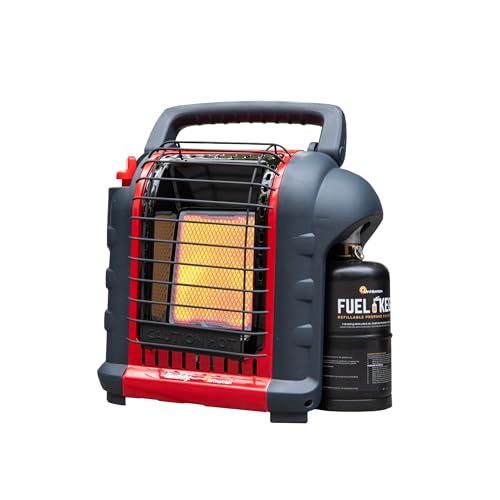
Mr. Heater Portable Buddy MH9BX Propane Heater
by Mr. Heater
The highest-rated heater in this roundup — silent, propane-powered, 9,000 BTU wherever outlets do not reach, from garages to power outages to ice shacks.
Pros
- 4.7 stars is the highest rating in this entire roundup — sustained across 29,000 reviews over more than a decade of continuous production
- Radiant propane heat is completely silent with no fan — works in garages, job sites, ice shacks, and power-outage scenarios where electricity is unavailable
- CSA indoor-safe certification with Oxygen Depletion Sensor (ODS) plus tip-over and pilot-out shutoffs — engineered specifically for unvented indoor use
- 4,000 and 9,000 BTU settings run 5.4 hours or 2.4 hours respectively on a single 1-pound propane canister — honest runtime with well-documented fuel consumption
Cons
- Ongoing propane canister expense — 1-pound bottles at $4-6 each or a refill hose kit to use 20-pound tanks for longer runtime
- Requires ventilation for safe use indoors — cracking a window is standard practice regardless of the ODS certification
- ODS sensor false-triggers above roughly 7,000 feet elevation due to thinner air — not usable in high-altitude mountain cabins
DREO 25-Inch Tower — Best Quiet Bedroom Tower
The DREO 25-inch tower is the heater I recommend when a client specifically wants a tower form factor for a bedroom and noise is the hard requirement. At 25 dB, this is the quietest verified tower heater in this roundup — below the noise floor of a typical library and effectively inaudible across a bedroom at normal sleeping distance. The Lasko tower is a more proven design, but it is not this quiet. For bedroom tower use, the DREO is the correct pick.
Child lock is the safety feature that is worth calling out here. Most tower heaters in this price range either skip the child lock entirely or reserve it for premium models. A tower heater in a room with children or curious pets benefits from a control lock that prevents accidental setting changes, which this unit includes as standard equipment. Combined with the V0 flame-retardant plastics, the ETL certification, the tip-over switch, and the overheat shutoff, the safety package on this unit is appropriate for overnight unattended operation in an occupied bedroom.
The ECO mode and dedicated fan-only function are the other features that extend this beyond a single-season winter appliance. ECO mode modulates output against the thermostat setpoint to cut electrical use after the room reaches temperature. Fan-only mode turns the unit into a tower fan during summer, which saves storage space and gives you year-round utility from the same footprint. Most single-function tower heaters collect dust in a closet from March through October. This one earns its space in the corner all year.
The main tradeoff is track record. DREO as a brand has only been in the US market for a few years, and the 25-inch tower is a newer model than the Atom One. The 12,191 reviews at 4.4 stars are a strong signal but not yet at the Lasko’s 40,000-review saturation. For buyers who specifically want a bedroom tower at the lowest verified noise level, this is the right pick. For buyers who want maximum proven track record, the Lasko is the safer default.

DREO 25 Inch Ceramic Tower Heater
by DREO
At 25 dB, DREO's 25-inch tower is the quietest heater in this roundup — a bedroom-first design with child lock, ECO mode, and year-round fan-only capability.
Pros
- 25 dB noise rating is the quietest verified tower heater in this roundup — below a typical library and genuinely bedroom-safe for light sleepers
- Child lock is standard equipment at this price point — a safety feature most competing tower heaters reserve for premium models or skip entirely
- ECO mode plus dedicated fan-only function makes this a year-round room comfort device rather than a winter-only appliance stored half the year
- Modern clean aesthetic fits finished bedrooms and home offices without looking like a utility heater — visual presence appropriate for living spaces
Cons
- Relatively new model with a shorter track record than the Lasko tower that has been in production for years with tens of thousands of reviews
- Some reviewers report short remote signal range — needs to be within roughly 10 feet to register reliably
Amazon Basics Oil-Filled Radiator — Best Silent Overnight
The Amazon Basics 7-fin oil-filled radiator is the heater I recommend for anyone who is genuinely sensitive to noise and wants to run a heater next to their bed overnight. The other bedroom-friendly picks in this roundup — the DREO Atom One at 37.5 dB and the DREO 25-inch tower at 25 dB — are quiet but not silent. This one is silent. There is no fan. The only sound it makes is the occasional faint click of the thermostat cycling.
It takes this slot from the PELONIS oil-filled radiator I had here previously. That unit is no longer worth sending you to: its Amazon listing has no new stock left at all, only used warehouse returns, which is not something I will recommend as a primary heater going into winter. The Amazon Basics unit is the closest like-for-like — seven sealed fins, the same 600W, 900W, and 1500W settings, ETL listing with tip-over and overheat protection, and the same no-fan silence.
The way oil-filled radiators work is fundamentally different from every other heater in this roundup. A sealed reservoir of mineral oil absorbs heat from a 1500W electric element and radiates it out through the metal fins. The heat comes slowly but steadily, without the hot-air blast of a ceramic fan unit. More importantly, the oil reservoir continues radiating warmth for 20 to 30 minutes after the thermostat cycles off — the room holds temperature more smoothly and the unit runs a lower duty cycle over a full night. Radiant heat also preserves ambient humidity rather than drying out the room the way fan-forced ceramic heaters do, which matters if you are sensitive to dry winter air.
Three wattage modes (600W, 900W, and 1500W) give you more control over electrical draw than almost any competing unit in this price range. Running on 600W in an already-warm bedroom holds temperature overnight at a fraction of the electrical cost of a 1500W ceramic cycling on and off. The built-in casters and front handle make this actually portable despite the oil-filled weight, which is not a given in this category.
The honest tradeoffs are the slow warm-up and the bulk. An oil-filled radiator from a cold start takes 15 to 30 minutes to feel warm in the room. A DREO Atom One feels warm within 60 seconds. If you walk into a cold room and want immediate heat, this is the wrong pick. If you set the heater at 6 PM and you want the bedroom comfortable all night with zero noise, this is the right pick. The floor footprint is also significantly larger than a ceramic or tower unit — plan your layout accordingly.

Amazon Basics Oil-Filled Radiator Heater (7 Fin)
by Amazon Basics
The only completely silent pick in the roundup — sealed oil-filled fins deliver sustained, humidity-friendly radiant heat for bedrooms and overnight use.
Pros
- Completely silent operation with no fan — the only zero-noise pick in this roundup and the correct choice for light sleepers and overnight use
- Three heat settings at 600W, 900W, and 1500W give you direct control over electrical draw and operating cost rather than a single all-or-nothing setting
- Seven sealed oil-filled fins retain heat and keep radiating warmth after the unit cycles off — a smoother temperature curve than fan-forced units
- Radiant heat preserves ambient humidity rather than drying out the room the way fan-forced ceramic heaters do during long continuous runs
Cons
- Slow warm-up from a cold start — you cannot walk into a cold room and feel heat immediately the way a ceramic fan heater delivers
- Bulky floor footprint — oil-filled radiators are physically larger and heavier than ceramic or infrared alternatives at equivalent output
- Manual knob controls only — no remote, no digital readout, no timer, no smart features at this price tier
Best Space Heater for Large Rooms
The hard ceiling on any electric space heater is the 1500W circuit limit — that’s roughly 150 square feet of properly insulated space, and a great room or open basement blows right past it. That’s why the large-room answer is the Dr Infrared DR-968: its dual infrared-plus-ceramic elements squeeze about 60 percent more usable heat out of the same 1500W draw, and infrared warms the people and objects directly instead of trying to raise the temperature of a huge air volume that just rises to the ceiling and escapes. If your problem is coverage rather than raw output, the DREO 25-inch tower’s oscillation spreads heat across the room more evenly, and the Amazon Basics oil-filled radiator is the silent option for a large bedroom or den where you want steady radiant warmth without a blower running all evening.
| Product | Price | Buy |
|---|---|---|
| Dr Infrared Heater DR-968 Portable Space HeaterBest for large rooms Dual-element infrared delivers the most usable heat per watt in a big space | $104.99 | View on Amazon |
| DREO 25 Inch Ceramic Tower HeaterWidest coverage Oscillating tower spreads heat evenly across the room | $89.00 | View on Amazon |
| Amazon Basics Oil-Filled Radiator Heater (7 Fin)Silent large-room option Oil-filled radiant heat warms a large room with zero fan noise | $70.19 | View on Amazon |
Best Space Heater for Bedrooms
In a bedroom, noise and overnight safety matter more than raw output. My default is the DREO Atom One at 37.5 dB — quiet enough to sleep beside, with a 12-hour timer and ETL Shield360, tip-over, and overheat protection for unattended running. If you’re a genuinely light sleeper, step up to the Amazon Basics oil-filled radiator, which is truly silent because it has no fan at all and holds heat after the thermostat cycles off, so it stays quiet all night. The Lasko tower is the pick if you want oscillation and a programmable timer and can tolerate an audible fan on high. Whichever you choose, give it three feet of clearance, plug it straight into the wall, and lean on the timer rather than running it flat out until morning.
| Product | Price | Buy |
|---|---|---|
| DREO Atom One Space HeaterQuietest fan heater 37.5 dB with timer and full safety certifications for bedside use | $44.95 | View on Amazon |
| Amazon Basics Oil-Filled Radiator Heater (7 Fin)Truly silent overnight No fan at all — silent, with heat retention after it cycles off | $70.19 | View on Amazon |
| Lasko 1500W Ceramic Tower Heater 751320Oscillating tower with timer Widespread oscillation plus a programmable timer for whole-room comfort | $70.99 | View on Amazon |
Best Space Heater for Small Rooms
For a small bedroom, a home office, or a spot under the desk, you don’t need whole-room output — you need something quiet, safe, and cheap to run at the low setting. The DREO Atom One is my pick here: it’s compact, whisper-quiet, and its ECO mode cycles against the thermostat so it isn’t burning 1500W once the small space is warm. If the budget is the deciding factor, the GiveBest is the cheapest reliable unit on Amazon, and its 750W low mode is plenty to hold a small insulated room while drawing half the power.
| Product | Price | Buy |
|---|---|---|
| DREO Atom One Space HeaterBest small-room pick Compact, quiet, and ECO-cycled so it won't run flat out in a small space | $44.95 | View on Amazon |
| GiveBest Portable Electric Ceramic Space HeaterCheapest for desks Dual 1500W/750W modes make it the value pick for a desk or tiny room | $26.99 | View on Amazon |
Best Energy Efficient Space Heater
Here’s the honest truth a contractor will tell you that the marketing won’t: every resistive electric heater is about 100 percent efficient at turning electricity into heat, so no ceramic or oil unit is meaningfully “more efficient” than another watt-for-watt. Real savings come from not running flat out — a thermostat that cycles the element and a lower wattage mode you can actually hold a warm room on. The DREO Atom One’s ECO mode modulates against the setpoint instead of blasting 1500W continuously. The oil-filled radiator keeps radiating for 20 to 30 minutes after it cycles off, so it spends more of the night coasting than heating. And the DR-968’s dual-element design puts out more heat per watt, so it reaches temperature faster and settles into a lower duty cycle in a big room. Match the setting to the space and use the timer, and that’s where the bill actually drops.
| Product | Price | Buy |
|---|---|---|
| DREO Atom One Space HeaterBest thermostat control ECO mode cycles against the setpoint instead of running at full 1500W | $44.95 | View on Amazon |
| Amazon Basics Oil-Filled Radiator Heater (7 Fin)Best heat retention Oil reservoir keeps radiating after it cycles off, lowering duty cycle | $70.19 | View on Amazon |
| Dr Infrared Heater DR-968 Portable Space HeaterMost heat per watt Dual-element output reaches temperature fast, then settles to a low cycle | $104.99 | View on Amazon |
Best Space Heater for the Garage
A garage is where electric heaters usually fail you: most are on a single 15-amp circuit shared with the door opener and lights, and a 1500W heater already eats about 83 percent of that circuit before you plug in anything else. That’s why the garage pick is the Mr. Heater Portable Buddy — propane, no electricity required, 9,000 BTU (roughly the equivalent of 2,600 electric watts), and CSA indoor-safe with an oxygen depletion sensor. Crack a window or door for ventilation and watch for CO buildup regardless of the ODS rating; that’s non-negotiable with any unvented combustion heater. If your garage is insulated and has proper dedicated electrical service, the DR-968 is the electric alternative — but only on a circuit with nothing else drawing at the same time. Before you buy either, run the garage’s dimensions through my free BTU calculator — it accounts for ceiling height, insulation, and climate zone, and tells you straight whether you’re in plug-in, propane, or hardwired territory.
| Product | Price | Buy |
|---|---|---|
| Mr. Heater Portable Buddy MH9BX Propane HeaterBest for unheated garages Propane 9,000 BTU works with no outlet — ventilate and watch for CO | $89.97 | View on Amazon |
| Dr Infrared Heater DR-968 Portable Space HeaterBest electric garage option The electric choice for an insulated garage on a dedicated circuit | $104.99 | View on Amazon |
Electrical Safety: The Part Most Articles Skip
A 1500W space heater draws 12.5 amps at 120 volts under continuous load. Most residential circuits in US homes are 15-amp general-purpose circuits. The math means a 1500W heater uses roughly 83 percent of the available capacity on a dedicated 15-amp circuit — and a significantly higher percentage on a circuit shared with any other load. If you have a bedroom lamp, a phone charger, a cable modem, and a 1500W heater all on the same circuit, you are running that circuit above its continuous-duty rating, and the breaker should eventually trip. If it does not trip, it means either the circuit is miswired or the breaker itself is failing — both of which are real fire hazards.
The practical rule I enforce on every job: a 1500W space heater should be on a circuit with no other significant loads running simultaneously. That means unplugging other items on the same outlet, not running the heater on the same circuit as a kitchen appliance or office equipment, and verifying which breaker controls the outlet before you start. If you do not know which breaker controls your bedroom outlet, turn off the breakers one at a time until the bedroom loses power — that is the right one, and now you know not to share it.
Extension cords are the single most common source of space heater fires, and the reason is simple. A 16-gauge household extension cord has thinner conductors than the 14-gauge wire inside your wall. Pushing 12.5 continuous amps through a 16-gauge cord heats the cord itself — particularly at the plug connections, where resistance is highest. The cord can reach temperatures high enough to melt the insulation and ignite nearby fabric. Twelve-gauge minimum is the rule for any 1500W heater. Fourteen-gauge is acceptable only for short (under 6 feet) runs. Never use a power strip or surge protector with a space heater. The trip ratings are not designed for continuous high-amperage loads and the internal contacts are not built to dissipate the heat.
If your setup requires the heater more than a few feet from an outlet, the right solution is not a longer extension cord — it is an electrician adding an outlet where you actually need one. That is a $150 to $300 job on a typical residential wall. It is also a permanent solution that eliminates the extension cord risk for the life of the house. Do not let a cord become a long-term solution to a missing outlet. For outdoor spaces and exterior work areas, stick to the Mr. Heater Buddy on propane rather than trying to run an extension cord through a door seal to a ceramic heater — you end up with both a heat source and a compromised weatherstripping gap letting cold in.
How to Choose the Best Space Heater
The buyer’s guide factors in the frontmatter section above expand on each criterion. Here is the short version for quick decisions.
Bedroom with noise-sensitive sleeper: Amazon Basics oil-filled (silent) or DREO 25-inch tower (25 dB).
Bedroom with moderate noise tolerance: DREO Atom One (37.5 dB). Faster warm-up than the oil-filled radiator, smaller footprint than the tower, and the feature set most buyers want.
Home office, den, or living room: Dr Infrared DR-968 for large open spaces, Lasko 751320 tower for smaller rooms or where you want proven reliability over peak performance.
Budget supplemental unit for small room: GiveBest. 81,000 reviews. No serious competitors at this price point.
Garage, workshop, or job site: Mr. Heater Portable Buddy MH9BX. Propane, silent, CSA indoor-safe. The only correct answer when electricity is limited.
Drafty finished basement or great room: Dr Infrared DR-968. Dual-technology output and 5,200 BTU handle what a standard 1500W ceramic cannot.
Outage-ready backup heat: Mr. Heater Portable Buddy paired with one of the portable generators I reviewed earlier. Propane heat plus generator power is the combination that gets you through a multi-day winter outage comfortably.
Buyer's Guide
I have wired, installed, and replaced more space heaters on job sites and in client homes than I can count. Here are the six factors I check every time before recommending a unit, in the order I evaluate them.
Heater Type: Ceramic, Infrared, Oil-Filled, or Propane
The four mainstream heater technologies each solve a different problem. Ceramic fan-forced heaters (DREO Atom One, Lasko tower, GiveBest) heat the air in a sealed room fast — best for bedrooms, home offices, and dens you use for a few hours at a time. Infrared heaters (Dr Infrared DR-968) heat objects and people directly rather than the air, which works better in drafty or large spaces where heating all the air is wasteful. Oil-filled radiators (the Amazon Basics 7-fin) warm up slowly but hold heat longer and run silently, which makes them the quietest overnight option for bedrooms. Propane radiant heaters (Mr. Heater Buddy) work without electricity and are the right answer for garages, workshops, job sites, and power-outage scenarios where ceramic and infrared are not usable. Match the technology to the environment before you pick a specific model.
Safety Certifications and Tip-Over Protection
Every space heater I buy has three non-negotiable safety features. First, ETL or UL certification — this is the independent lab safety testing that confirms the unit meets US electrical and fire safety standards. Second, tip-over shutoff — an internal switch that cuts power the moment the unit leaves its upright position. Third, overheat shutoff — a thermal sensor that kills power if the internal temperature exceeds the safety threshold, typically because an intake or exhaust was blocked by a curtain or piece of clothing. Beyond those three, cool-touch housings are meaningful if the unit will ever be within reach of children or pets, child-lock controls are worth having on any tower heater in a shared space, and V0 flame-retardant plastics (rated on the DREO units) are a meaningful upgrade for overnight operation. As context on why these matter: the January 2025 CPSC recall of the Vornado VH2 portable heater was driven by a fire hazard on units that passed initial certification but developed issues in field use. Stick with brands that have sustained review history and current safety certifications, and always verify the specific model number you are buying matches the certified one.
Room Coverage and Wattage Sizing
The standard rule is 10 watts per square foot for a standard 8-foot ceiling in a reasonably insulated room. A 1500W heater is rated to heat roughly 150 square feet of floor area under those conditions — which is why almost every consumer space heater is 1500W on the high setting. Real-world adjustments: uninsulated or drafty rooms need 50 percent more wattage per square foot; high ceilings push the demand up further because you are heating more air volume; and basements typically need 20 to 30 percent more wattage than the square footage alone suggests because of the cooler concrete floor and foundation walls. For garages and unfinished spaces, the Mr. Heater Buddy's 9,000 BTU propane output is the equivalent of roughly 2,600 watts of electric heating — much more output than any standard 1500W electric heater can deliver, and the right tool for that application. Do not undersize the heater thinking you will save money; an undersized unit runs at 100 percent duty cycle and never actually warms the room, wasting more electricity than a properly sized unit that cycles off.
Noise Level by Install Location
Where the heater lives determines how much noise matters. In a garage or workshop, the heater's noise is irrelevant — you close the door and forget about it. In a home office, moderate fan noise (39-45 dB) is acceptable during work but becomes tiresome on video calls. In a bedroom where you sleep, you need a heater at 40 dB or below, and ideally closer to 30 dB or silent. Anything louder will wake light sleepers and become genuinely intolerable by the end of a cold week. Three of our picks are specifically engineered for low noise: the DREO Atom One at 37.5 dB, the DREO 25-inch tower at 25 dB (the quietest in this roundup), and the Amazon Basics oil-filled radiator at genuinely zero decibels because it has no fan at all. If you are shopping for a bedroom primary heater, specify noise as a hard requirement at the front of the search and drop units that cannot meet your threshold.
Thermostat, Controls, and Timer
A thermostat that cycles the heater on and off based on room temperature is the single biggest electricity-saver you can specify. A unit without a proper thermostat (just a high/low switch) runs at full wattage the entire time it is on, regardless of whether the room has already reached comfortable temperature. A proper digital thermostat with ECO mode (DREO Atom One, DREO 25-inch tower, Dr Infrared DR-968) modulates output and cycles against the setpoint, typically cutting runtime by 40 to 60 percent after the room reaches temperature. Timer functions are the next most valuable control feature — a 12-hour programmable timer lets you set the heater to run for a 1-2 hour burst in the morning or evening without leaving it running unattended all day. Remote controls are a quality-of-life upgrade on tower heaters and larger units where the thermostat panel is not within easy reach from your bed or desk. For the cold-on-arrival scenario, a smart heater with app control can preheat the room before you get home, though none of our current picks include native WiFi.
Energy Efficiency and Operating Cost
No electric space heater is 100 percent efficient at heating a whole home — that is what central HVAC is for. Space heaters make economic sense when you zone-heat a single occupied room and let the rest of the house run cooler. The cost math: a 1500W heater at $0.15/kWh costs about $0.22 per hour at full output, or roughly $54 for 8 hours of overnight use across a 30-day month. Three practical ways to cut that number. First, use a heater with ECO mode that modulates wattage against a thermostat setpoint (DREO units) rather than running flat out. Second, use a heater with multiple wattage modes (GiveBest at 750W/1500W, Amazon Basics radiator at 600W/900W/1500W) and run at the lower setting when the room is already close to your target temperature. Third, use a timer to limit runtime to the hours the room is actually occupied rather than running 24 hours per day. For garages and uninsulated spaces where electric resistance heating is economically punishing, the Mr. Heater Buddy on propane typically works out cheaper per BTU — 1 pound of propane delivers about 21,600 BTU at a cost of roughly $4, versus about $0.95 for the same BTU output from electric resistance at $0.15/kWh. Propane wins for short, high-output garage sessions; electric wins for sustained low-output room heating.
Final Verdict
For the vast majority of homeowners who want a reliable, quiet, feature-rich space heater for a bedroom, home office, or single finished room, the DREO Atom One is the best overall purchase. The combination of 37.5 dB operation, ECO mode, 70-degree oscillation, remote control, and 28,000 verified reviews at 4.6 stars under $50 is unmatched in the current market. For nine out of ten space heater shopping scenarios, this is the one I recommend without hesitation.
For budget buyers who want a supplemental small-room heater at an unbeatable price, the GiveBest Portable Ceramic Heater delivers 81,000 reviews of social proof at a price that makes upgrading from a no-name heater a trivial decision. The feature set is bare-bones, but the core function works and the safety certifications are in place.
For the garage, workshop, ice shack, or emergency power-outage heating scenario where electricity is limited or unavailable, the Mr. Heater Portable Buddy is the only correct tool. The 4.7-star rating across 29,000 reviews, the CSA indoor-safe certification, the 9,000 BTU output, and the complete silence of radiant propane heat make this the non-negotiable pick for every application where a 1500W electric heater simply cannot do the job. Winter weather preparation is one of the few areas where buying the right tool once is demonstrably cheaper than trying to improvise with the wrong one — the same logic applies whether you are buying a space heater, a snow blower, or a standby generator. Spec it correctly the first time and the purchase pays for itself in the first hard winter.
Frequently Asked Questions
Is it safe to leave a space heater running overnight?
Ceramic vs. infrared — which heater type should I buy?
How much electricity does a 1500W space heater actually use?
Can I use a space heater in my bathroom?
What kind of extension cord can I use with a space heater?
Related Articles
About the Reviewer

Jake Morrison, Licensed General Contractor
B.S. Construction Management, Purdue University
Jake Morrison has spent 14 years in residential construction and home renovation before founding DIYRated in 2026. After helping hundreds of homeowners choose the right tools and materials for their projects, he started writing the product guides he wished existed when he was starting out. Jake tests every major product recommendation in his workshop in Indianapolis and focuses on real-world performance over spec-sheet marketing.