11 Best Sump Pumps of 2026: A Licensed GC's Picks by HP, Basement, and Backup
Jake Morrison, Licensed General Contractor, ranks the 11 best sump pumps of 2026 — with picks for basements, heavy rain, battery and water-powered backup, pedestals, and crawl spaces, plus the sizing and check-valve advice other roundups skip.
Updated
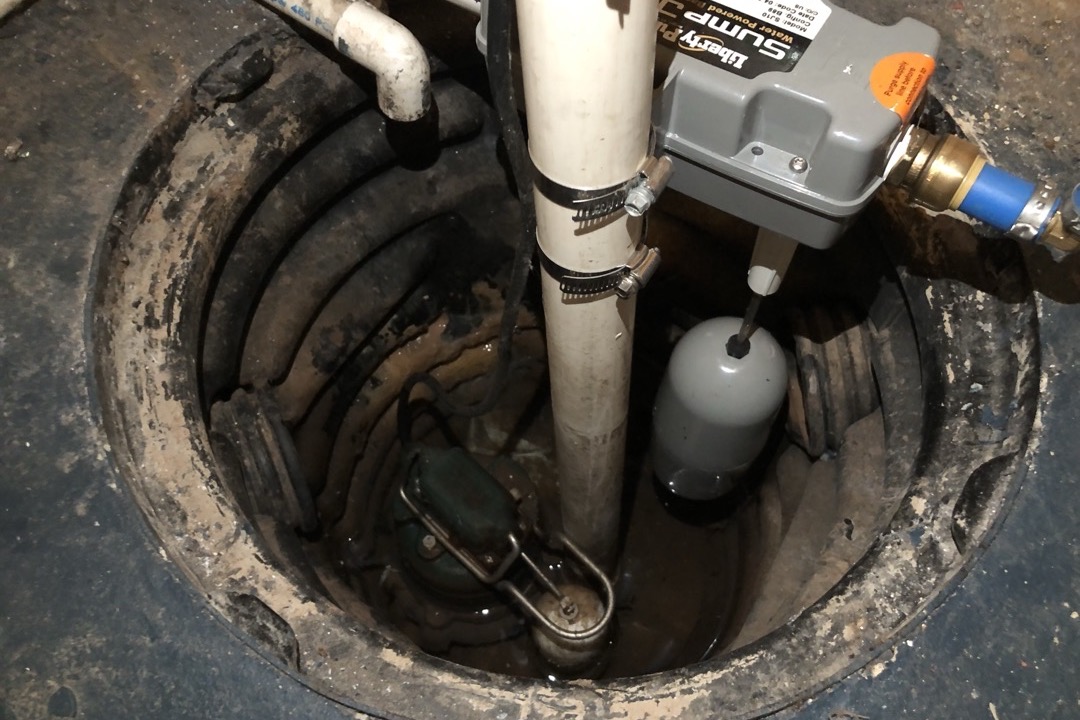
A sump pump is the one appliance in your house whose entire job is to work on the single worst night of the year — when the storm is dumping water faster than the ground can take it and your basement’s fate comes down to a pump in a hole in the floor. As a licensed general contractor, I have installed them in new builds and pulled dead ones out of flooded basements, and I can tell you the difference between a dry basement and a five-figure insurance claim is almost always a pump that was chosen and sized correctly, backed up for the power outage that arrives with the storm. If you are fighting basement dampness even between floods, a pump is only half the answer — a good basement dehumidifier handles the humidity a pump never touches.
Most “best sump pump” roundups rank a handful of the same submersibles and stop there. The problem is that “the best sump pump” depends entirely on your situation: a normal basement with an average water table needs a completely different pump than a home over a high water table, a crawl space needs something a float pump physically cannot do, and the backup question — battery, combination, or water-powered — is its own decision that most articles barely cover. I have picked 11 pumps I would put in a client’s home, sorted by the exact job each one is best at, and told you plainly where each is the wrong choice. Every ASIN below was verified live with a working Amazon buy box as of publication.
Find the Best Sump Pump for Your Situation
Jump straight to the pump that matches your basement:
- Overall best sump pumps
- Best for a basement
- Best battery backup
- Best combination unit
- Best for heavy rain and a high water table
- Best pedestal
- Best for a crawl space
- Best water-powered backup
- More use cases
How I Tested and Chose These Sump Pumps
I evaluated every pump here the way I decide what goes into a client’s pit: capacity first, because a pump that cannot keep up with your water table is useless no matter how well it is built; then housing and switch type, because those decide how many years and how many storms it survives; then the honest track record from the review base. I leaned on verified review volume — several of these carry thousands to tens of thousands of reviews, a long-run reliability signal no single test can match — and I confirmed every product was live with a working Amazon buy box, not a third-party-only listing, as of publication.
I also deliberately picked across situations instead of crowning one submersible. There is a trusted overall pick, a high-capacity workhorse for a high water table, a full 1 HP monster, standalone and combination battery backups, a water-powered backup that needs no battery at all, a pedestal for narrow pits, and a specialist for crawl spaces — because the honest answer to “what is the best sump pump” is that it depends on your basement, and the pump that is perfect for a home over a high water table is the wrong one for a dry crawl space.
Best Sump Pumps Overall
For most basements, the right buy is a proven cast-iron submersible sized to your water table, backed up for the outage that comes with the storm. These are the picks that anchor the rest of the roundup — the pumps I reach for first before matching the rest to a specific situation.
Zoeller M53 Mighty-Mate — Best Overall
The Zoeller M53 is the pump I have dropped into more pits than any other, and it earns the top spot the way it earns its reputation among contractors: it is a cast-iron submersible that simply does not quit. The heavy iron housing pulls heat out of the motor so it runs cool and quiet, and the mechanical vertical float is about as close to unbreakable as a moving part gets — there is very little to go wrong. For a standard basement with an average water table, this is all the pump you need, and it is the one I would put in my own home.
The honest limitations are two. It costs more than an off-brand 1/3 HP submersible, because you are paying for the cast iron and the Zoeller name — both of which are worth it. And 1/3 HP is correctly sized for a normal basement but not for a high water table or a long, high discharge run; if that is your situation, the high-capacity picks below are the smarter buy. For everyone else, the M53 is the default recommendation and the safest money in the category.
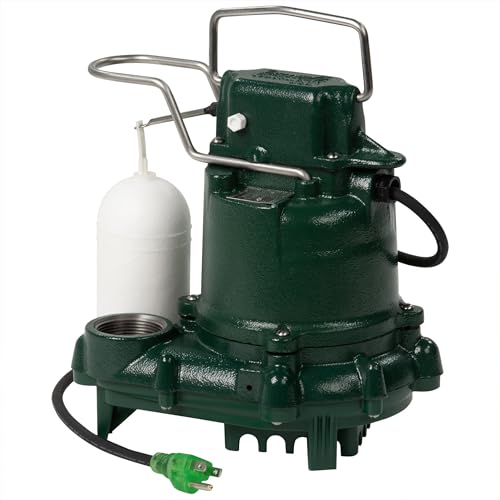
Zoeller M53 Mighty-Mate Submersible Sump Pump (1/3 HP)
by Zoeller
The pump contractors themselves buy — proven, quiet, and built to outlast the house. The default choice for a standard basement.
Pros
- The pump contractors install in their own homes — a decades-long reputation for reliability
- Cast-iron motor housing runs quiet and sheds heat far better than thermoplastic
- The simple mechanical vertical float almost never fails, because there is little to go wrong
- Compact footprint fits the narrow basins common in older basements
Cons
- Costs more than off-brand 1/3 HP submersibles at the same power
- The non-adjustable float offers less flexibility in odd-shaped or very shallow pits
- 1/3 HP is right-sized for a normal basement but not for a high water table
Superior Pump 91250 — Best Budget
If the goal is the most pump for the least money, nothing on Amazon touches the Superior 91250’s combination of price and track record — over 26,000 reviews at 4.6 stars, an Amazon’s Choice badge, and a genuine 25-foot lift from a pump that costs a fraction of any cast-iron primary. It is also the most versatile tool here: it will drain a flooded window well, a clogged pool cover, or a basement that already took on water.
But you have to understand what it is, because a huge share of budget “sump pump” buyers get this wrong. The 91250 is a manual utility pump — it has no float switch, so it cannot run unattended as a true 24/7 primary. You plug it in when you need it and unplug it when you are done. That makes it a superb spare to keep on the shelf, an emergency dewatering tool, or a backup you deploy by hand — but if you want a set-and-forget primary at a budget price, look at an automatic float-equipped pump instead. Bought for what it is, it is the best value in the category.

Superior Pump 91250 Thermoplastic Submersible Utility Pump (1/4 HP)
by Superior Pump
The budget favorite — just know it is a manual pump, not a set-and-forget primary. Perfect as a spare on the shelf or emergency dewatering tool.
Pros
- By far the largest review base in the category — over 26,000 ratings at 4.6 stars
- Genuinely strong for its size, lifting water up to 25 feet
- Doubles as an all-purpose dewatering tool for pools, window wells, and flooded rooms
- A fraction of the price of any automatic primary pump
Cons
- No float switch — it is a manual utility pump, not a set-and-forget primary
- Only a one-year warranty against three to five years on cast-iron pumps
- Thermoplastic housing will not match cast-iron longevity under constant use
WAYNE CDU1000 — Best Upgrade (Maximum Power)
The Wayne CDU1000 is the pump I spec when a basement has a genuinely severe water problem and the homeowner never wants to think about it again. It is a full 1 HP cast-iron submersible — the most powerful true primary in this roundup — moving up to 6,100 gallons an hour at zero lift, with a top-suction anti-airlock design that means no weep hole to drill and no airlock stalls after the pit drains. Cast-iron volute, stainless housing, five-year warranty, assembled in the USA: this is a pump built to outlast the basement.
The catch is that most homes do not need it. At the moment the CDU1000 and its 3/4 HP CDU980E sibling sit within a couple of dollars of each other, so the real cost of the extra horsepower is not money — it is bulk and behavior. It is a heavier unit to wrestle in and out for service, and in a small pit that refills slowly a full 1 HP empties the basin faster than it fills, short-cycling in a way that wears the switch out early. But for a home over a high water table, on a hillside that funnels runoff, or with a history of overwhelming lesser pumps, the extra horsepower buys margin you will be grateful for on the worst night.
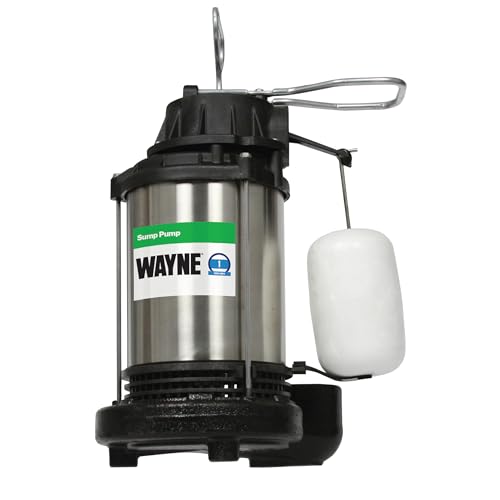
WAYNE CDU1000 Submersible Sump Pump (1 HP Cast Iron)
by Wayne
The most muscle you can get in a true cast-iron primary pump — for the worst basements and highest water tables.
Pros
- The most powerful true cast-iron submersible in this roundup, at a full 1 HP
- Top-suction anti-airlock design means no weep hole to drill and no airlock stalls
- Cast-iron volute and stainless housing built to run for years
- Backed by a 5-year warranty and assembled in the USA
Cons
- A full 1 HP short-cycles in a small pit that refills slowly, wearing the switch and motor early
- Heavier to lift in and out for service
- Genuine overkill for a normal basement with a modest water table
WAYNE CDU980E — Best High-Capacity
The Wayne CDU980E is the pump most homes with a real water problem should actually buy — it sits in the 3/4 HP sweet spot, moving a serious 5,490 GPH without the CDU1000’s bulk or its tendency to short-cycle in a small pit. It is the same trusted cast-iron-and-stainless build with the same no-weep-hole top-suction design, and its large, well-established review base makes it one of the safest high-capacity bets on Amazon.
It is louder and heavier than a 1/3 HP unit, and it is overkill for a dry basement that rarely sees the pump cycle. A small share of reviews report early failures within the warranty window, which is why the five-year coverage matters. But for a home that regularly overwhelms a standard primary during heavy rain, this is the pump that clears a fast-filling pit and keeps the floor dry.

WAYNE CDU980E Submersible Sump Pump (3/4 HP Cast Iron)
by Wayne
The pick for homes that regularly overwhelm a standard primary — high flow without paying for a full horsepower you may not need.
Pros
- Moves serious volume — 5,490 GPH keeps up with heavy storms and a high water table
- Cast iron and stainless build with the same no-weep-hole top-suction design
- A 3/4 HP sweet spot that clears a fast-filling pit without jumping to a full 1 HP
- 5-year warranty and a large, well-established review base
Cons
- Louder and heavier than a 1/3 HP unit — overkill for a dry basement
- A small share of reviews report early failures within the warranty window
The Basement Watchdog Special CONNECT — Best Battery Backup
The Basement Watchdog Special CONNECT is the backup I add to a pit that already has a primary the owner trusts. The whole point is the moment your primary is helpless — a power outage, which almost always arrives with the very storm that is flooding the basement. This unit installs alongside the existing pump and takes over on 12-volt DC power when the grid drops, and its WiFi-capable CONNECT module pushes a real alert to your phone the instant the power fails or the pump runs. The dual-float design also cuts the false triggers that plague cheaper single-float backups.
Two honest costs. The battery is sold separately, so budget for a suitable AGM battery on top of the pump, and that battery needs periodic fluid and charge checks to stay dependable — a dead backup battery is worse than none because you think you are covered. The WiFi module is also a further add-on. But for a homeowner who already has a working primary and wants outage insurance without replacing it, this is the cleanest way to buy peace of mind. Pair it with a portable generator and you cover both the pump and the rest of the house.

The Basement Watchdog Special CONNECT Battery Backup System
by Basement Watchdog
Peace-of-mind insurance for a primary pump you already trust — the standalone backup that guards against the outage, not the pump.
Pros
- Installs alongside a primary you already trust, so an outage never leaves the pit unattended
- WiFi-capable CONNECT module sends real power-outage and pump-failure alerts to your phone
- Dual-float design sharply cuts the false triggers that plague single-float backups
- Compact enough to drop into a small or narrow pit beside the primary
Cons
- The battery is sold separately — budget extra for a suitable AGM battery
- Owners note the battery needs periodic fluid and charge checks to stay dependable
- The WiFi module is a further add-on purchase
The Basement Watchdog Big Combo CITS-50 — Best Combination System
When I am building a pit from scratch or replacing a whole basin, the CITS-50 is the pump I reach for because it solves primary and backup in a single box. It ships preassembled and preplumbed — a 1/2 HP cast-iron primary and a 2,890 GPH DC backup, tied to a 24-hour monitoring controller with an audible alarm and WiFi-capable alerts — so there is no separate backup pump to source, mount, and plumb yourself. For new construction or a full basin rebuild, that “install once” simplicity is worth real money.
The tradeoffs are size and the backup side’s mixed reviews. It is a bulkier, heavier install into an existing basin than a standalone primary, it needs a larger basin to fit both pumps, and the battery is still a separate purchase. But if you want primary and backup engineered to work together out of one carton, this is the most complete single-purchase system here.
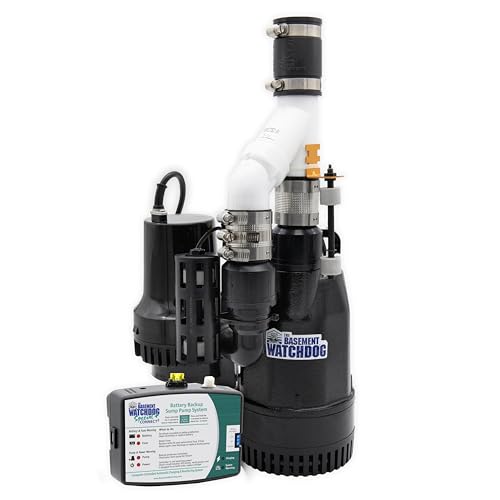
The Basement Watchdog Big Combo CITS-50 Primary + Backup System
by Basement Watchdog
The install-once answer for anyone who wants primary and backup solved in one purchase — ideal for new construction or a full basin rebuild.
Pros
- A true single-box solution — primary and battery backup preassembled and preplumbed
- 24-hour monitoring controller with an audible alarm and WiFi-capable alerts
- A 1/2 HP cast-iron primary paired with a 2,890 GPH backup in one install
- No separate backup pump to source, mount, and plumb yourself
Cons
- A bulkier, heavier install into an existing basin than a standalone primary
- The battery is still a separate cost, and long-term reports on the backup side are mixed
- Needs a larger basin to fit both pumps side by side
Superior Pump 92551 — Best Pedestal
The Superior 92551 is the pump I put in narrow, shallow, or debris-prone pits where a submersible struggles. A pedestal design stands the motor on a column above the pit, with only the intake down in the water — which means the motor never sits submerged, stays cooler, and can be serviced without pulling the entire unit out of the sump. In a tight or dirty pit, that above-water motor placement is exactly why pedestals routinely outlast submersibles.
The compromises are real: the exposed motor column is a trip-and-knock hazard under a low pit lid, raw flow is weaker than a comparable submersible, and the adjustable float rod can drift and needs an occasional check. It is not the pump for a deep pit in a finished basement where noise and looks matter. But for a shallow basin, a narrow crock, or a homeowner who values easy servicing over maximum flow, the cast-iron 92551 is the right call — and the easiest pump here to keep running for years.

Superior Pump 92551 Cast Iron Pedestal Pump (1/2 HP)
by Superior Pump
The go-to for narrow or shallow pits where the motor needs to stay out of the water — and the easiest pump here to service.
Pros
- The motor sits above the pit, so it stays dry and can be serviced without pulling the pump
- Above-water pedestals routinely outlast submersibles in shallow, debris-prone pits
- Cast-iron and stainless build with an adjustable metal float rod
- Quieter than you would expect, thanks to the motor sitting out of the water
Cons
- The exposed motor column is a trip-and-knock hazard under a low pit lid
- Weaker raw flow than a comparable submersible
- The float rod can drift out of adjustment over time and needs an occasional check
WAYNE WaterBUG — Best for Crawl Spaces and Tight Spots
The Wayne WaterBUG does something no float-switch pump can: it fits and fully drains spaces a standard sump pump physically cannot handle. Its Multi-Flo top-and-side discharge design pumps standing water down to 1/16 of an inch, and its small body slips into crawl spaces, window wells, flat roofs, and stairwells where a bulky submersible with a swinging float would never work. At 1,350 GPH with a 30-foot lift and over 3,600 reviews, it is a proven specialist.
Like the budget Superior, it is a manual pump — no float, so you plug it in and unplug it yourself, which makes it a targeted dewatering tool rather than a 24/7 automatic primary. The short cord limits reach in a larger crawl space, and the thermoplastic housing is not built for constant heavy-duty cycling. But for the specific job of clearing water out of a tight or shallow space down to almost nothing, nothing else here comes close.

WAYNE WaterBUG Submersible Pump with Multi-Flo (1/6 HP)
by Wayne
The tool to grab when a float-switch pump physically will not fit the space — and the only one that drains water down to almost nothing.
Pros
- Purpose-built for tight spots — crawl spaces, window wells, flat roofs, and stairwells
- Multi-Flo top-and-side discharge pumps standing water down to 1/16 of an inch
- 1,350 GPH and a 30-foot lift in a body small enough to fit where float pumps cannot
- Over 3,600 reviews at 4.5 stars for a specialist pump
Cons
- Not automatic — there is no float, so you plug and unplug it yourself
- The short cord limits reach in a larger crawl space
- Thermoplastic housing is not built for constant primary-pump duty
Liberty Pumps SumpJet — Best Water-Powered Backup
The Liberty SumpJet is the backup for anyone who has been burned by a dead battery — because it does not have one. It runs entirely on your home’s municipal water pressure, using a mechanical float valve with no electronics and no battery to ever charge, maintain, or replace. That means it keeps pumping through a multi-day outage that would flatten any battery backup, and it sits silent until the water actually rises. Many owners buy it specifically after a battery backup let them down. Its 1,300-plus reviews are the strongest base of any backup pump here.
The requirement is strong, consistent municipal water pressure, which makes it a poor fit for most well-water homes, and it does consume tap water while running, so a long event will show up on the water bill. It is best used alongside a solid primary, not as a standalone pump. But for a home on city water with a history of long outages, it is the only backup that genuinely cannot run down.

Liberty Pumps SumpJet Water-Powered Backup Sump Pump (SJ10)
by Liberty Pumps
Zero electronics, zero battery — just your home's water pressure standing guard through the longest outages a battery could never survive.
Pros
- No battery to ever buy, maintain, or replace — it runs on your home's water pressure
- Keeps working through multi-day outages that outlast any battery backup
- A fully mechanical float valve with no electronics to fail
- The strongest review base of any backup pump here, at over 1,300 ratings
Cons
- Requires strong, consistent municipal water pressure — a poor fit for most well-water homes
- It consumes tap water while running, which shows up on the water bill
- Best paired with a solid primary, not used as a standalone pump
WAYNE WSS30VN — Best Backup-Ready Primary
The Wayne WSS30VN is for the homeowner who wants a strong primary today and a battery backup someday without buying a whole new system. It drops in preassembled — Wayne cites a 15-minute install with no weep hole — as a robust 5,100 GPH primary tested to a million cycles, and it is engineered to accept a battery backup whenever you decide to add one. Buy the pump now, add the battery later: it is the phased approach to full protection.
Be clear-eyed about two things. The backup battery is a separate cost you will eventually pay, and despite the premium price the housing is reinforced polypropylene, not cast iron — you are paying for the backup-ready engineering and the Amazon’s Choice track record, not for metal. It is also heavy at 44 pounds and needs a 16-inch-or-larger basin. But for a buyer who wants a Wayne primary that is future-proofed for backup, it is a smart, if pricey, foundation.

WAYNE WSS30VN Sump Pump with Battery Backup Capability (1/2 HP)
by Wayne
A Wayne-branded primary that is ready for a battery backup the day you want to add one — buy the pump now, add the battery later.
Pros
- Drops in preassembled — Wayne cites a 15-minute install with no weep hole to drill
- A strong 5,100 GPH primary tested to one million cycles
- A vertical float switch and a design ready to accept a battery backup whenever you add one
- Amazon's Choice with a large, established review base
Cons
- The required backup battery is sold separately, a real added cost
- Heavy at 44 pounds and needs a 16-inch or larger basin
- Reinforced polypropylene housing, not cast iron, despite the premium price
WAYNE CDU800 — Best Value Step-Up
This slot used to hold the Aquastrong 1/2 HP, and it changed for a plain reason: Amazon no longer has a new unit of that pump for sale, only used returns. I am not going to send anyone to a secondhand sump pump, so the value 1/2 HP pick moves to the Wayne CDU800. It is the better pump anyway.
The CDU800 is for a buyer whose pit works harder than a 1/3 HP pump likes but does not need the 3/4 HP or 1 HP class. It shares the cast-iron and steel build of the CDU980E and CDU1000 above, which pulls motor heat into the surrounding water so it runs cool, and it moves up to 5,100 GPH at zero lift. The integrated vertical float rides straight up and down on the pump body, so it cannot swing into the wall of a narrow basin. Owners consistently describe it as quiet and simple to swap in, and they have been saying so for years.
Two honest caveats. The warranty is three years, against five on the bigger Wayne pumps. And a minority of owners report a unit giving out after about a year, which is the argument for pairing any primary with a backup in a finished basement. For a wetter-than-average pit, it is the value buy; for a normal water table, the Zoeller M53 is still all the pump you need.

WAYNE CDU800 Submersible Sump Pump (1/2 HP Cast Iron)
by Wayne
The value step-up to 1/2 HP: Wayne's cast-iron build and a deep, highly rated review base without paying for a 3/4 or 1 HP pump.
Pros
- Cast-iron top and steel body pull motor heat into the pit water, the way a primary pump should be built
- Up to 5,100 GPH at zero lift, a real step up from a 1/3 HP unit for a wetter pit
- Integrated vertical float rides straight up and down, so it will not snag the wall of a narrow basin
- Owners consistently call it quiet and simple to swap in, backed by well over a thousand ratings
Cons
- A 3-year warranty, against five years on the CDU980E and CDU1000
- The fixed vertical float has a wider on/off range than an adjustable switch, which matters in a shallow pit
- A minority of owners report a unit failing after about a year, so pair it with a backup in a finished basement
Best Sump Pump for a Basement
For a standard finished or unfinished basement, the decision comes down to matching capacity to your water table and pit depth, then choosing cast iron for longevity. A normal basement is well served by a trusted 1/3 HP cast-iron pump; a wet one that fills fast needs the extra 3/4 HP flow; and a budget backup or spare has its place on the shelf. The perennial “Wayne versus Zoeller” question mostly comes out even — both make excellent cast-iron pumps — so buy on the capacity and switch that fit your pit, not the badge.
| Product | Price | Buy |
|---|---|---|
| Zoeller M53 Mighty-Mate Submersible Sump Pump (1/3 HP)Best overall for a basement Trusted cast-iron 1/3 HP — the default for a normal basement water table | $217.04 | View on Amazon |
| WAYNE CDU980E Submersible Sump Pump (3/4 HP Cast Iron)Best for a wet basement 3/4 HP and 5,490 GPH for a basement that fills fast in a storm | $189.00 | View on Amazon |
| Superior Pump 91250 Thermoplastic Submersible Utility Pump (1/4 HP)Best budget spare A manual utility pump to keep as an emergency backup on the shelf | $68.19 | View on Amazon |
Best Battery Backup Sump Pumps
A battery backup exists for the outage that arrives with the storm, when your primary loses power exactly when you need it most. There are three shapes: a standalone unit that guards an existing primary, a full combination that packages primary and backup together, and a backup-ready primary you add the battery to later. Match it to whether you already have a primary you trust.
| Product | Price | Buy |
|---|---|---|
| The Basement Watchdog Special CONNECT Battery Backup SystemBest standalone battery backup Adds DC-powered protection beside a primary you already trust, with WiFi alerts | $279.00 | View on Amazon |
| The Basement Watchdog Big Combo CITS-50 Primary + Backup SystemBest all-in-one combo Primary and backup preassembled in one box for a fresh install | $469.00 | View on Amazon |
| WAYNE WSS30VN Sump Pump with Battery Backup Capability (1/2 HP)Best backup-ready primary A strong primary now, ready to accept a battery whenever you add it | $549.99 | View on Amazon |
Best Combination Sump Pump with Battery Backup
If you want primary and backup solved in a single purchase, a combination system is the answer — but there are two philosophies. A true preassembled combo ships both pumps plumbed and wired to one controller, while a backup-ready primary gives you a robust main pump engineered to accept a battery later. The combo is the install-once route; the backup-ready primary spreads the cost over time.
| Product | Price | Buy |
|---|---|---|
| The Basement Watchdog Big Combo CITS-50 Primary + Backup SystemBest preassembled combo One box, one controller — primary plus DC backup with a monitoring alarm | $469.00 | View on Amazon |
| WAYNE WSS30VN Sump Pump with Battery Backup Capability (1/2 HP)Best phased-in backup A 5,100 GPH primary you can add a battery backup to whenever you are ready | $549.99 | View on Amazon |
Best Sump Pump for Heavy Rain and a High Water Table
This is where I part ways with every other roundup, because heavy rain and a high water table are not the same problem. A surge from heavy rain is a short, intense burst you clear with raw flow; a high water table is constant pressure that keeps the pit filling around the clock and rewards both capacity and a backup. For either one, size up on GPH — and if the water table is truly high, add a backup, because the pump will be working hard and often.
| Product | Price | Buy |
|---|---|---|
| WAYNE CDU980E Submersible Sump Pump (3/4 HP Cast Iron)Best high-capacity value 3/4 HP and 5,490 GPH — the sensible high-capacity pick for most wet basements | $189.00 | View on Amazon |
| WAYNE CDU1000 Submersible Sump Pump (1 HP Cast Iron)Best maximum power A full 1 HP and 6,100 GPH for the most severe water tables | $213.00 | View on Amazon |
| The Basement Watchdog Big Combo CITS-50 Primary + Backup SystemBest for storm plus outage Combination primary and backup for the storm that also cuts the power | $469.00 | View on Amazon |
Best Pedestal Sump Pump
Pedestal pumps get dismissed as the inferior legacy option, but that is lazy — in the right pit, a pedestal is the smarter buy. For a shallow, narrow, or debris-prone basin, the above-water motor stays cool, resists clogging, and is far easier to service than a submersible you have to haul out of the water. The real decision is pedestal versus submersible, so here is that comparison head to head.
| Product | Price | Buy |
|---|---|---|
| Superior Pump 92551 Cast Iron Pedestal Pump (1/2 HP)Best pedestal pump Cast-iron pedestal with a serviceable above-water motor for shallow or narrow pits | $148.99 | View on Amazon |
| Zoeller M53 Mighty-Mate Submersible Sump Pump (1/3 HP)Best submersible alternative The quieter, higher-flow submersible for a normal deep pit in a finished basement | $217.04 | View on Amazon |
Best Sump Pump for a Crawl Space
A crawl space is a problem a standard sump pump cannot solve: there is rarely a deep pit, the clearance is tight, and you need to pull standing water down to almost nothing. That calls for a low-profile pump that fits where a float pump cannot and drains flat, with a budget utility pump as the simplest alternative for occasional water.
| Product | Price | Buy |
|---|---|---|
| WAYNE WaterBUG Submersible Pump with Multi-Flo (1/6 HP)Best low-profile for crawl spaces Multi-Flo design fits tight clearances and drains water down to 1/16 inch | $135.00 | View on Amazon |
| Superior Pump 91250 Thermoplastic Submersible Utility Pump (1/4 HP)Best budget utility alternative A cheap manual utility pump for a crawl space that only floods occasionally | $68.19 | View on Amazon |
Best Water-Powered Backup Sump Pump (No Battery)
If you are on municipal water and dread the maintenance and lifespan of a battery, a water-powered backup is the answer no battery can match — it runs on your home’s water pressure and never needs charging or replacing, so it survives outages that last for days. The tradeoff is the battery-versus-water decision itself, so here is the head-to-head.
| Product | Price | Buy |
|---|---|---|
| Liberty Pumps SumpJet Water-Powered Backup Sump Pump (SJ10)Best water-powered (no battery) Runs on municipal water pressure — nothing to charge, ideal for long outages | $231.27 | View on Amazon |
| The Basement Watchdog Special CONNECT Battery Backup SystemBest battery backup alternative The battery route for well-water homes or where water pressure is weak | $279.00 | View on Amazon |
Best Sump Pumps by Use Case
A few narrower needs come up often enough to call out directly. Each of these points to the single best-fit pump from the roundup for that specific horsepower or situation, with its Amazon buy button right in the row.
| Product | Price | Buy |
|---|---|---|
| Zoeller M53 Mighty-Mate Submersible Sump Pump (1/3 HP)Best 1/3 HP sump pump The trusted cast-iron 1/3 HP that suits a normal basement | $217.04 | View on Amazon |
| WAYNE CDU800 Submersible Sump Pump (1/2 HP Cast Iron)Best 1/2 HP sump pump A cast-iron 1/2 HP step-up for a wetter pit | $166.41 | View on Amazon |
| WAYNE CDU980E Submersible Sump Pump (3/4 HP Cast Iron)Best 3/4 HP sump pump The 3/4 HP high-capacity pick for a high water table | $189.00 | View on Amazon |
| WAYNE CDU1000 Submersible Sump Pump (1 HP Cast Iron)Best 1 HP sump pump A full 1 HP for the most severe water problems | $213.00 | View on Amazon |
| WAYNE WaterBUG Submersible Pump with Multi-Flo (1/6 HP)Best for window wells and outdoor A low-profile manual pump for window wells, stairwells, and outdoor dewatering | $135.00 | View on Amazon |
Buyer's Guide
I have set sump pumps into fresh new-construction pits and clawed dead ones out of thirty-year-old basements at two in the morning during a spring thaw. The pump itself is a simple machine, but choosing the wrong one shows up in the worst possible way — a flooded finished basement, a pump that short-cycles itself to death, or a backup that was never sized to outlast the storm. These are the six things I actually weigh before I tell a client which pump to put in the ground, in the order that matters.
HP and GPH: Sizing the Pump to Your Water Problem
Horsepower is shorthand for how much water a pump can move and how high it can push it, but the number that actually matters is GPH (gallons per hour) at your real discharge height — because head pressure devours flow. A pump rated at 5,000 GPH at zero lift might move barely half that once it has to raise water ten feet and run it out to the yard. For a typical basement with an average water table and a standard-depth pit, 1/3 HP (the Zoeller M53) is correctly sized. Move up to 1/2 or 3/4 HP (the Wayne CDU800 or CDU980E) when you have a high water table, frequent storm surge, a deep pit, or a long discharge run. Go to a full 1 HP (the Wayne CDU1000) only for genuinely severe water problems. Bigger is not automatically better: an oversized pump empties the pit faster than it refills, short-cycling on and off in a way that wears out the switch and motor early. Size to your pit's refill rate and your lift, not to your worst nightmare.
Submersible vs. Pedestal
These are two different answers to where the motor lives. A submersible pump sits fully in the pit, underwater, sealed inside a housing — it runs quieter, is out of the way under a sealed lid, and moves more water, which is why it is what most homes should buy. A pedestal pump (the Superior 92551) puts the motor on a column above the pit, with only the intake down in the water. The pedestal's advantages are real in specific cases: the motor never sits in water, so it stays cooler and is far easier to service, and pedestals often outlast submersibles in shallow, narrow, or debris-heavy pits where a submersible would clog or overheat. The tradeoffs are that the exposed motor is a knock hazard under a low lid and moves less water. My rule: submersible for a normal deep pit and a finished basement where noise matters; pedestal for a shallow or narrow pit, a debris-prone sump, or a homeowner who wants to service the motor without pulling the whole unit.
Cast Iron vs. Thermoplastic: What Actually Lasts
This is the single biggest longevity decision, and the price gap tells you why. A cast-iron pump (the Zoeller M53, the Wayne CDU-series) uses a heavy metal housing that acts as a heat sink, pulling motor heat out into the surrounding water so the pump runs cooler and lasts longer — cast-iron primaries routinely give a decade or more of service. A thermoplastic pump (the Superior 91250, most of the cheapest units) is lighter and easier to carry, but the plastic holds heat, so under constant heavy cycling it wears faster and typically carries a shorter warranty. Thermoplastic is genuinely fine for a backup pump, a utility pump, or a pit that rarely runs. But for a primary pump that has to protect a finished basement through years of wet springs, cast iron is worth every bit of the difference — it is the part of the pump you cannot upgrade later without a full replacement.
Switch Type: Vertical Float, Tethered, and Manual
The switch is the part most likely to fail, so how it works is not a detail. A vertical float switch (on the Zoeller M53 and the Wayne pumps) rides straight up and down on a rod as the water rises — it is compact, reliable, and the best choice for narrow pits because it cannot swing into the pit wall. A tethered float hangs on a cord and swings out as the water rises; it works well in wider pits but can snag on the pump, the pipe, or the pit wall in a tight basin and either stick on or fail to trigger. A manual pump (the Superior 91250 and Wayne WaterBUG) has no switch at all — you plug it in when you need it and unplug it when you are done, which makes it a dewatering tool, not a 24/7 primary. For an automatic pump you leave in the ground, a vertical float in a properly sized pit is the most trouble-free setup; whichever you choose, a dual-float backup controller adds a second trigger so one stuck float does not sink you.
Backup Strategy: Battery (AGM vs. Lithium) or Water-Powered
Your primary pump dies the moment the storm knocks out your power, so a backup is really a plan for when the grid fails. Three options: a standalone battery backup (Basement Watchdog Special CONNECT) that installs beside your existing primary; a combination unit (Big Combo CITS-50) that packages primary and backup together; and a water-powered backup (Liberty SumpJet) that runs on municipal water pressure with no battery at all. On the battery itself, the choice in 2026 is AGM versus lithium: a deep-cycle AGM battery is the sealed, lower-cost standard most systems assume and is fine where outages are short and rare, while a lithium (LiFePO4) battery costs more up front but delivers far more usable capacity, tolerates deeper discharge, and lasts several times as many charge cycles — my pick for anyone whose power goes out for hours at a time. Water-powered is the only backup that never runs down, but it needs strong municipal pressure and is a poor fit for well-water homes. Size any battery to outlast your typical outage, not just to switch on.
The Check Valve and Pit Sizing
Two install details decide whether the pump you bought actually keeps up. First, the check valve: it is a one-way valve on the discharge pipe just above the pump that stops the column of water in the pipe from draining back down into the pit every time the pump shuts off. Without one, that backflow refills the pit, the pump kicks on again seconds later, and you get the same short-cycling that burns out motors — a quality spring-loaded, quiet check valve is a cheap part that saves the pump. Second, pit size: the basin has to be big enough that the pump is not switching on and off constantly, and a common minimum for a combination or backup system is a 16-inch-or-larger diameter basin so two pumps and their floats fit without fouling each other. A pit that is too small forces short-cycling no matter how good the pump; a properly sized pit with a solid check valve lets a correctly sized pump run the way it was designed to. Neither part comes with the pump, and both are where a rushed install goes wrong.
The Installation Reality Check: What a GC Wants You to Know
This is the part every other sump pump roundup skips, and it is where most DIY installs go wrong. The pump is only as good as three things around it that never come in the box. First, the check valve on the discharge pipe: without a good one, the water in the pipe drains back into the pit every time the pump shuts off, the pump kicks on again seconds later, and that short-cycling burns out the motor within a season. Buy a quiet, spring-loaded check valve and install it just above the pump. Second, the discharge routing: the water has to go far enough from the foundation that it does not just seep back to the pit, and in cold climates the line has to be pitched and protected so it cannot freeze shut — a frozen discharge is a dead pump on the coldest night. If you are getting your home ready for winter anyway, my guide to winterizing your home covers the freeze-protection basics that apply here.
Third, and the detail that catches people: the electrical. A sump pump wants its own dedicated GFCI-protected circuit, because it sits in water and because sharing a circuit risks a nuisance trip that silently kills your protection right when a storm loads everything up. If your pit does not have a proper dedicated outlet, adding one is electrical work, and combining new electrical with the plumbing under a cramped basement is where I tell a homeowner to bring in a licensed pro. A like-for-like pump swap on an existing, code-compliant setup is very DIY-approachable and takes most people an hour or two; a fresh pit, a new circuit, and new discharge plumbing is not a beginner project.
How to Choose the Best Sump Pump
Start with capacity, because it decides whether the pump can keep up: 1/3 HP for a normal basement, 1/2 to 3/4 HP for a high water table or storm surge, a full 1 HP only for severe water. Then choose cast iron over thermoplastic for any primary that has to protect a finished basement, and a vertical float switch for a narrow pit. Decide your backup strategy separately — a battery backup for most homes, a water-powered backup if you are on strong municipal water and dread the battery, or a combination system if you are building the pit from scratch. Finish with the two parts nobody mentions: a quality check valve and a properly sized pit. Match the pump to your basement instead of buying the most horsepower or the biggest brand, and you will have a pump that quietly does its job on the one night it has to.
Final Verdict
For most basements, the Zoeller M53 Mighty-Mate is the right buy — a trusted cast-iron submersible that runs quiet and outlasts the house, correctly sized for a normal water table. Budget buyers and anyone who wants a spare on the shelf should grab the Superior Pump 91250, remembering it is a manual utility pump, not an automatic primary. Homes with a high water table or heavy storm surge should step up to the 3/4 HP Wayne CDU980E, or the full 1 HP CDU1000 for the worst cases. And whatever primary you choose, protect it for the outage that comes with the storm: a Basement Watchdog Special CONNECT beside an existing pump, a Big Combo CITS-50 for a fresh install, or the battery-free Liberty SumpJet if you are on municipal water. Get the check valve and pit sizing right, put the pump on its own GFCI circuit, and you will stay dry on the night it counts. To keep the whole basement healthy between storms, pair your pump with a dehumidifier and stay ahead of trouble with a spring home maintenance checklist.
Frequently Asked Questions
What is better, a 1/3 HP or 1/2 HP sump pump?
Are battery backup sump pumps worth it?
How big of a battery backup do I need?
Do I need a sump pump alarm?
Can a sump pit cause a radon problem?
Related Articles
11 Best Drain Cleaners of 2026: A Contractor's Picks by Clog Type
plumbing
Best Dehumidifiers of 2026: Jake's Picks After 20+ Years in Basements
home-air-filtration
7 Best Portable Generators of 2026
power-tools-workshop
How to Winterize Your Home: A Contractor's Complete Checklist
outdoor-garden
Spring Home Maintenance Checklist: A Contractor's Priority-Order Guide
outdoor-garden
About the Reviewer

Jake Morrison, Licensed General Contractor
B.S. Construction Management, Purdue University
Jake Morrison has spent 14 years in residential construction and home renovation before founding DIYRated in 2026. After helping hundreds of homeowners choose the right tools and materials for their projects, he started writing the product guides he wished existed when he was starting out. Jake tests every major product recommendation in his workshop in Indianapolis and focuses on real-world performance over spec-sheet marketing.