8 Best Tool Chests of 2026
Jake Morrison, Licensed General Contractor, ranks the 8 best tool chests for garages, jobsites, and apartments — with steel gauge decoded, drawer load math, and an in-store buying test.
Updated
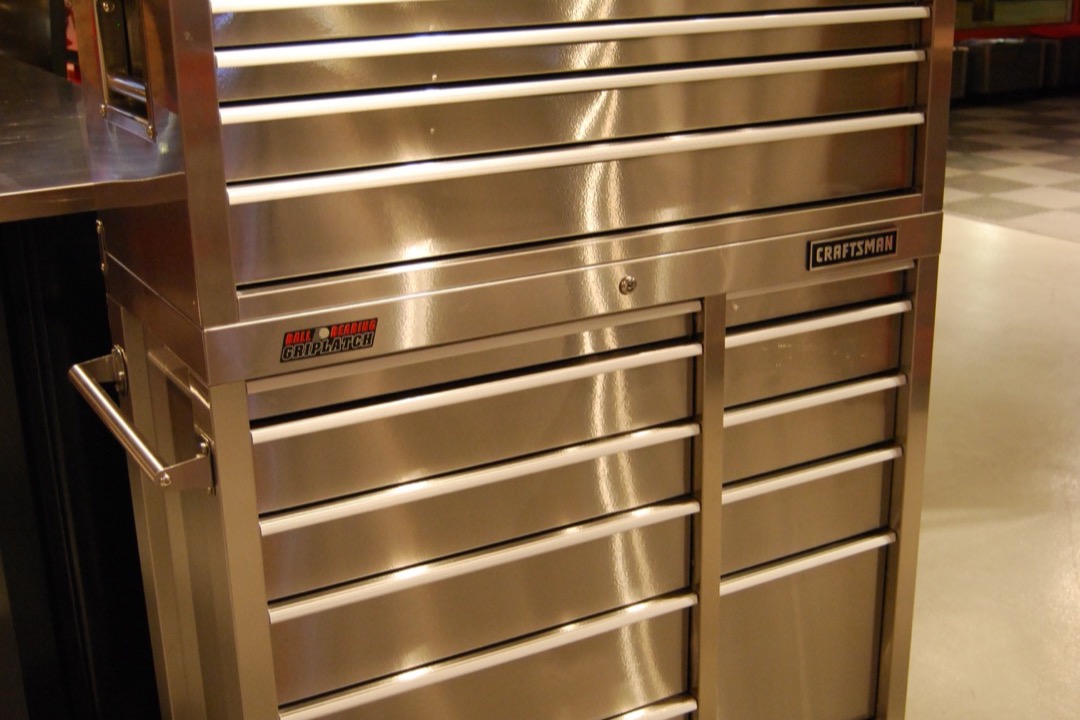
After two decades as a licensed general contractor, the tool chest question is one of the most common ones I get from clients finishing a garage or basement workshop. Most people walk into a hardware store, look at the wall of chests, and pick the one with the most drawers in their budget. Six months later they call me because the drawers are sagging, the casters are stuck, and the lock key bent in the cylinder. The chests in this roundup are the ones I actually specify when a client asks — chosen against the same criteria I apply to my own jobsite storage.
The biggest mistake I see homeowners make is buying too small. The ten-drawer cabinet that looks intimidating in the showroom fills up in 18 months once you start collecting cordless tools, automotive sockets, and the assortment of bits and accessories that come with home ownership. Buy the chest you need in three years, not the one that holds your tools today. Stepping up from a five-drawer combo to a ten-drawer cabinet costs roughly an extra few hundred dollars at purchase; buying the wrong-size chest now and replacing it in two years costs the original purchase plus the entire cost of the upgrade unit.
This roundup focuses on the chests I have personally evaluated against real install conditions: garage shops, jobsite trailers, mobile mechanic vans, and apartment workbenches. The picks below are paired with specific use cases — pick the one that matches how you actually work, not the one that looks good on the shop floor. If you are building out the rest of your workshop alongside the chest, pair it with a reliable cordless drill for assembly and proper garage storage systems so the chest is the centerpiece of an organized space rather than an island in a sea of leaning ladders.
| Product | Price | Buy |
|---|---|---|
| CRAFTSMAN 26" 5-Drawer Rolling Tool Chest ComboBest Overall | $288.00 | View on Amazon |
| BIG RED 20.5" Portable 3-Drawer Steel Tool Box (Torin ANTBD133-XB)Budget Pick | $64.65 | View on Amazon |
| CRAFTSMAN 41" 10-Drawer Rolling Tool Cabinet (CMST341102RB)Premium Pick | $754.00 | View on Amazon |
| Milwaukee PACKOUT 22-Inch Rolling Tool Box (48-22-8426)Runner-Up | $189.00 | View on Amazon |
| Olympia Tools 27-Inch 5-Drawer Rolling Tool Cabinet (91-058)Runner-Up | $494.01 | View on Amazon |
| INTERGREAT 8-Drawer Rolling Tool Chest with Detachable Top BoxRunner-Up | $169.99 | View on Amazon |
| Goplus 5-Drawer Rolling Tool ChestRunner-Up | $249.99 | View on Amazon |
| Mini 3-Drawer Pink Steel Tool BoxRunner-Up | $49.99 | View on Amazon |
Find the Right Tool Chest for Your Space
Jump straight to the comparison that matches how and where you work:
- Best tool chests overall — all eight picks reviewed in full
- Best rolling tool chest for the garage
- Best portable tool chest
- Best heavy-duty and large tool chest
- Best pink tool chest
How We Chose These Tool Chests
I evaluated each chest against the same criteria I apply when specifying storage for a client’s shop: realistic per-drawer slide rating, body steel gauge, caster build, locking mechanism, and how the chest holds up after months of daily use. I gave significant weight to drawer hardware because that is what determines whether a chest still feels solid after three years or starts binding and sagging in the first year. Lock quality and caster ratings matter almost as much — a chest with great drawers but a flimsy lock cylinder or under-rated casters is a chest that fails the first time you load it to rated capacity.
I also scored each chest against form-factor fit. A pro shop cabinet is the wrong answer for an apartment workshop, and a portable bench-top chest is the wrong answer for a permanent two-car garage. The eight picks below cover the full range of real-world mobility patterns — fixed garage shops, mobile jobsite use, rental and apartment workshops, and granular drawer organization at multiple price tiers.
Steel Gauge: The Counterintuitive Number You Must Understand
Before we get into the picks, you need to understand the single most misread spec in tool chest marketing: steel gauge. The number runs backward — lower gauge means thicker steel. A 14-gauge cabinet is roughly twice as thick as a 22-gauge cabinet, and the strength difference is dramatic in practice.
Here is the gauge decoder I use when evaluating chests:
- 14 to 16 gauge — Pro shop grade. What you find in serious commercial garages, dealership service bays, and Snap-on trucks. Thick enough that drawers stay aligned under maximum load and the cabinet does not flex when rolled across an uneven floor.
- 18 gauge — Serious DIY grade. The sweet spot for a home workshop where drawers run loaded daily. The upgrade-pick CRAFTSMAN 41-inch I-frame design uses this gauge.
- 20 to 22 gauge — Homeowner grade. Acceptable for typical garage service with normal hand-tool storage. Drawers do not sag at moderate loads, but the cabinet is noticeably lighter and more flex-prone than 18-gauge alternatives.
- 24 gauge — Light duty. The floor of acceptable build for any chest costing more than a hundred dollars. Fine for light tool storage, not appropriate for full socket sets or heavy power tools loaded into every drawer.
- 26 gauge or thinner — Decorative grade. Avoid. The drawer sides flex when you reach into a loaded drawer, and the cabinet will dent if a wrench falls off a shelf onto it.
A telling sign: if a manufacturer does not publish gauge on the product page, assume the chest is 24 gauge or thinner. Real shop-grade brands publish the spec because it is a competitive advantage. Cheap chests hide it because the answer is unfavorable.
Rolling Chest vs Modular System — Which Is Right for You?
Most tool-chest roundups skip this question, which is a disservice because the wrong form factor is the most expensive mistake you can make. Steel rolling chests and modular polymer systems (like Milwaukee Packout) solve different problems.
Choose a rolling steel chest when:
- Your shop is permanent — garage, basement workshop, dedicated workspace
- You need traditional drawer organization for socket sets, wrench rolls, and hand tools
- The chest will live in one place 95 percent of the time
- Climate is conditioned or semi-conditioned (not exposed to rain or sub-freezing winters)
Choose a modular polymer system when:
- You move tools between job sites, apartments, or work locations frequently
- Your tools need to survive rain, jobsite dust, or wash-down
- You drive a truck or van and need stackable storage that fits in a bed or cargo area
- You prefer bin-and-foam organization over traditional drawers
The Milwaukee Packout is the only modular system I recommend in this roundup because it has the wheel size, weather seal, and stack-locking that justify the price over a steel chest. Cheaper modular systems exist but generally fail at the wheel-deflection-under-load test that real jobsite use demands.
Buy Bigger Than You Think You Need
This is the GC heuristic I share with every client buying their first tool chest. Your tool collection grows faster than you expect — every project adds tools, every season adds accessories, and within 18 months the chest you bought feels half-full at the start now feels half-empty.
The math is straightforward. Stepping up from a 5-drawer combo (around $269) to a 10-drawer cabinet (around $800) costs roughly $530 extra at purchase. Buying the smaller chest first and replacing it with the larger one in two years costs the original $269 plus the full $800 upgrade — a total of $1,069. The “save money by buying small” approach actually costs more than buying right the first time, and you spend two years working with a chest that does not fit your tool collection.
The way I evaluate chest size for clients: list every tool you own today, every tool you plan to buy in the next two years, and every tool category you might add (cordless platform expansion, automotive, woodworking, electrical). If your current tool collection fills three drawers, you need a five-drawer chest minimum. If your current collection fills five drawers, you need a ten-drawer cabinet. The tools always find their way into the empty drawers; the empty drawers do not stay empty for long.
There are exceptions — apartment workshops where space is the binding constraint, renters who need portable storage, jobsite contractors using modular systems. For those use cases, buy the form factor that fits the constraint, not the tool collection. But for permanent home shops, the upgrade pick is almost always the right answer over the entry-level combo.
Best Tool Chests Overall
One lineup covers every real workshop. The CRAFTSMAN 26-inch combo is the do-everything homeowner rolling chest; the BIG RED 3-drawer portable is the apartment and bench-top pick; the CRAFTSMAN 41-inch I-frame is the heavy-duty upgrade; the Milwaukee PACKOUT rolling box is the weatherproof jobsite base; the Olympia 27-inch and Goplus 5-drawer are the brand-name and tight-space rolling cabinets; the INTERGREAT 8-drawer is the most drawers per dollar; and the Mini Pink Steel box is the honest Amazon pink pick. Below I review all eight in full, then compare them by the way you actually work — rolling garage chests, portable chests, heavy-duty and large chests, and pink.
CRAFTSMAN 26” 5-Drawer Rolling Tool Chest Combo — Best Overall
The CRAFTSMAN 26-inch 5-drawer combo is the chest I recommend most often for homeowner workshops, and it has been for years. The combo configuration — top chest stacked on rolling cabinet — covers the full range of drawer depths in a single purchase, which is the single biggest reason it beats out three-drawer-only chests at similar price points. Five drawers gives you shallow tray space for layout tools, medium drawers for socket sets and screwdrivers, and deeper drawers for power tools and accessories.
The 30 lb per-drawer ball-bearing slides are the spec that earns this its best-overall ranking at this price tier. Friction slides at this price would have been a deal-breaker — they bind under real loads, fall out of alignment after six months, and feel cheap from day one. Ball-bearing slides at 30 lbs handle a full socket set per drawer, a wrench roll per drawer, and a cordless drill kit in the deeper drawers without binding or sagging. That is the bar a homeowner-tier chest has to meet, because the drawers are what you interact with every day.
The 300 lb caster rating with dual-lock front pair handles real garage use without the wheel-deflection problems that plague cheaper chests. Roll a fully loaded combo across an unfinished concrete floor and the casters track straight without binding. Lock down the front pair and the chest stays stable when you reach into the top drawer for a tool. The single-key central lock secures both the top chest and rolling base in one turn — fast daily lock-up, which is the right answer for a shared garage or a household with kids around. The honest caveat is that the 20 to 24 gauge body is mid-tier; if you plan to load drawers near max rating every day, the upgrade-pick I-frame is worth the step up. For typical homeowner service with normal tool collections, this combo is the right answer for years.
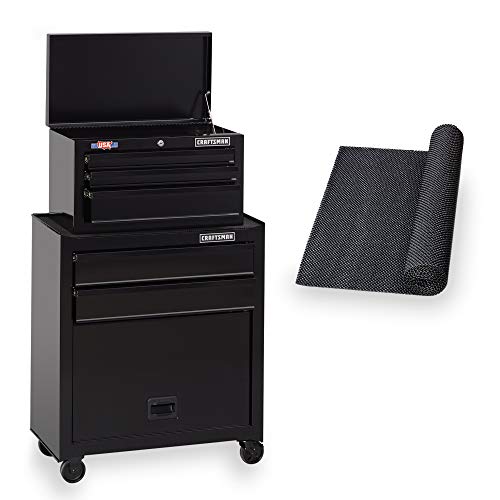
CRAFTSMAN 26" 5-Drawer Rolling Tool Chest Combo
by CRAFTSMAN
The CRAFTSMAN 26-inch 5-drawer combo is the chest I recommend most often for homeowner workshops — combo configuration, ball-bearing drawers, locking casters, and a price that fits a real garage budget without skimping on the hardware that matters.
Pros
- Five-drawer combo configuration with a top chest plus rolling cabinet covers the everyday hand-tool, socket, and power-tool storage needs of a homeowner workshop in a single purchase
- 30 lb per-drawer ball-bearing slides handle full socket sets, wrench rolls, and impact driver kits without binding or sagging the way friction-slide budget chests do
- 300 lb rated swivel casters with a dual-lock front pair keep the unit stable when loaded and let you roll a full chest across an unfinished concrete floor without wheel deflection
- Single-key central locking system secures both the top chest and rolling base in one turn, which is the right answer for a shared garage or home with kids around
Cons
- 20 to 24 gauge steel body is mid-tier — fine for garage and workshop service but lighter than the I-frame upgrade pick if you plan to load drawers near their max ratings every day
- Single-key lock is convenient but means losing the key takes both compartments offline at once, so plan for a spare and store it somewhere obvious to the household
BIG RED 20.5” Portable 3-Drawer Steel Tool Box — Best Budget
The BIG RED Torin 3-drawer portable is the cheapest credible tool chest you can buy that still has confirmed ball-bearing drawer slides, and it earns its budget-pick spot because it solves the apartment-workshop problem without compromising on the hardware that matters. At a 20.5-inch width with an 8.5-inch depth, this chest fits on a standard workbench, a closet shelf, or under-stair storage — places where a full rolling cabinet cannot go.
The ball-bearing slide rating is the spec that separates this chest from generic-brand portable chests at similar price points. Most chests in this footprint use friction slides that bind on day one and never improve; the ball-bearing slides here run smoothly out of the box and stay smooth after a year of daily use. Each drawer fits a small socket set, a screwdriver organizer, or a starter pliers and wrench collection — adequate for an apartment electronics or household-repair workshop. The hinged top lid latches all three drawers shut when it closes, so you can pick the box up fully loaded and carry it to the work without spilling tools.
The honest limitations are real. There are no casters or wheels — the chest must be lifted to reposition, which is fine for stationary bench-top use but rules out rolling it across a workshop. The steel latch closure is not a keyed lock, which makes this unsuitable for chemicals, sharp tools around children, or any situation where unauthorized drawer access matters. And quality control varies batch to batch — a minority of units arrive with a dented corner or a latch that works loose under heavy daily carry, so inspect yours on arrival. For renters, dorm rooms, apartment workshops, and anyone who needs real drawer organization in a footprint that fits on a bench, this is the right starting point — and because it ships from and is sold by Amazon directly, returns and warranty support go through Amazon rather than a third-party seller account that may vanish next year.
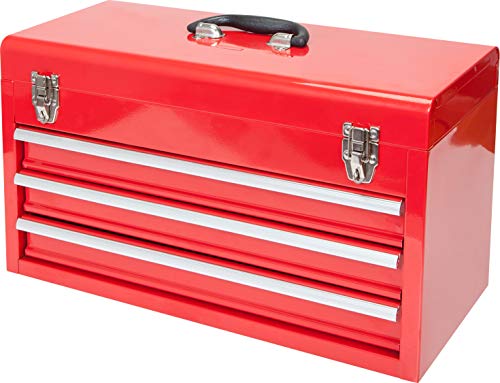
BIG RED 20.5" Portable 3-Drawer Steel Tool Box (Torin ANTBD133-XB)
by BIG RED
The BIG RED Torin 3-drawer portable is the cheapest credible tool chest with confirmed ball-bearing slides that still ships direct from Amazon — the right answer for renters, apartment workshops, and anyone who needs real drawer storage in a footprint that fits on a workbench.
Pros
- Three-drawer portable bench-top format is the right answer for apartments, dorm rooms, and renters who cannot dedicate floor space to a rolling cabinet but still need real drawer organization
- Confirmed ball-bearing drawer slides deliver smooth full-extension drawer action out of the box — a genuine step up from the friction slides most chests use at this price point
- Ships from and sold by Amazon directly, so returns and warranty support run through Amazon rather than a third-party seller account that may not exist next year
- Hinged top lid latches all three drawers shut automatically when closed, so the chest can be carried fully loaded without drawers sliding open and spilling tools
Cons
- No casters or wheels means the chest must be lifted to reposition — at roughly 15 lbs empty plus loaded drawers, plan for a sturdy bench or shelf and do not store on a flimsy folding table
- Steel latch closure only — there is no keyed lock, which makes this unsuitable for chemicals, sharp tools around children, or any situation where unauthorized drawer access is a real concern
- Quality control varies batch to batch — a minority of units arrive with a dented corner or a latch that loosens under heavy daily carry, so inspect on arrival
CRAFTSMAN 41” 10-Drawer Rolling Tool Cabinet — Upgrade Pick
The CRAFTSMAN 41-inch 10-drawer cabinet is the upgrade pick for serious home shops and pro mechanics, and it earns the price step over the homeowner combo because of build details that compound over years of use. The 18 to 20 gauge I-frame steel body is the structural difference between a homeowner chest and a shop-grade cabinet — drawers stay aligned under load even after years of opening and closing, and the cabinet does not flex when rolled across rough concrete with a full tool kit inside.
The 100 lb per-drawer soft-close ball-bearing slides are pro-grade hardware. Soft-close means the drawer decelerates as it approaches closed and seats itself with a gentle thud rather than slamming — protects tools from knocking around inside the drawer, and protects the cabinet structure from the cumulative shock of years of slam-shut closures. At 100 lbs per drawer, you can load full socket cases with extensions, dense impact driver kits, and angle grinders into individual drawers without the slides sagging or binding. The ten-drawer configuration spans all three depth tiers — shallow trays for layout tools and ratchet handles, medium drawers for socket sets and pliers, and deep drawers for power tools and oversized items — which is why it covers a complete shop in one unit rather than requiring a separate bin storage solution.
The 1500 lb caster rating with full dual-lock pairs is the spec that turns this stationary-grade cabinet into a fully mobile shop station. Roll a loaded cabinet across an automotive lift bay floor and the casters track without binding; lock the brake pairs and the cabinet stays rigid when you reach into the deep drawer for an impact wrench. The honest caveats are size and price. The 41-inch width and 36-inch height demand a dedicated floor zone — measure your garage layout including door swing and parked vehicle clearance before ordering, because a misplaced cabinet in a tight garage becomes a daily annoyance. And the premium price reflects pro-grade build that occasional weekend users will not fully utilize — if your tool collection fits in five drawers today, the homeowner combo is sufficient. For anyone with a serious tool collection or a shop where the chest sees daily heavy use, this is the right answer for a decade.
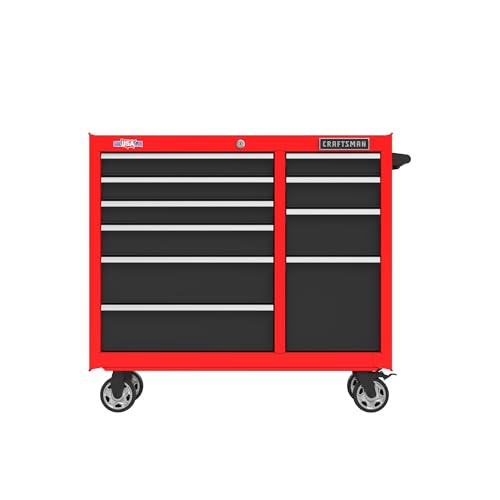
CRAFTSMAN 41" 10-Drawer Rolling Tool Cabinet (CMST341102RB)
by CRAFTSMAN
The CRAFTSMAN 41-inch 10-drawer cabinet is the upgrade pick for serious home shops and pro mechanics — I-frame steel, 100 lb soft-close drawers, and 1500 lb casters that turn a stationary chest into a fully mobile shop station.
Pros
- Ten-drawer configuration spans shallow trays for layout tools, medium drawers for socket sets and pliers, and deep drawers for power tools and impact drivers — covers a complete shop in one unit
- 100 lb per-drawer soft-close ball-bearing slides handle dense socket cases, full impact driver kits, and angle grinders without binding, and the soft-close action protects tools from slamming
- 18 to 20 gauge I-frame steel body is the structural difference between a homeowner chest and a serious shop cabinet — drawers stay aligned under load, and the cabinet does not flex when rolled
- 1500 lb rated heavy-duty casters with full dual-lock pairs let a fully loaded cabinet roll smoothly across rough concrete and lock down rigid for stationary bench use
Cons
- 41-inch width and 36-inch height demand a dedicated floor zone — measure your garage layout including door swing and parked vehicle clearance before ordering
- Premium price reflects pro-grade build that occasional weekend users will not fully utilize — if your tool collection fits in five drawers today, the homeowner combo unit is sufficient
Milwaukee PACKOUT 22-Inch Rolling Tool Box — Best for Jobsite and Mobile Use
The Milwaukee PACKOUT 22-inch rolling box is the runner-up because it solves a problem that no steel chest in this roundup can solve: tool storage that survives rain, gravel, and the back of a contractor truck. This is the wheeled foundation of the PACKOUT system rather than a full kit, which is the point — every PACKOUT toolbox and organizer latches onto it with positive locks, so you build the stack your work actually needs. Pull the top boxes off for a single-room kitchen install, leave the rolling base in the truck, then reassemble the full stack at the end of the day.
The IP65 weather seal rating is the spec that separates this from every other chest in this roundup. IP65 means the system is dust-tight and resistant to water jets — your tools stay dry when the toolbox sits in the bed of a pickup truck through a thunderstorm, when it gets wash-down at the end of a concrete pour, and when it lives in an unheated detached garage through a humid summer. No steel chest in this roundup matches that protection, and for any contractor, mobile mechanic, or homeowner with an outdoor storage scenario, that single spec justifies the form-factor switch.
The 9-inch all-terrain wheels are the second feature that earns this its place. Standard 4 to 5-inch shop casters fail when you roll across gravel, jobsite curbs, or uneven concrete — the wheels deflect, the bearings bind, and the chest fights you across the ground. The PACKOUT’s 9-inch wheels handle all of that without complaint, which is what a real jobsite system has to do. The honest caveats are real. There are no drawers, and the box ships as one large compartment — organization relies on the optional interior tray, third-party foam, or PACKOUT organizer boxes stacked on top, all sold separately. If you want a traditional drawer feel for socket sets and wrench rolls, this is not the right system. And the 250 lb rated capacity is far below a steel rolling cabinet — PACKOUT is designed for a working tool kit, not for storing the entire shop’s hardware inventory. For mobile use, jobsite work, and outdoor-tolerant storage, it is unmatched. For a permanent garage shop, a steel rolling cabinet is still the right answer.
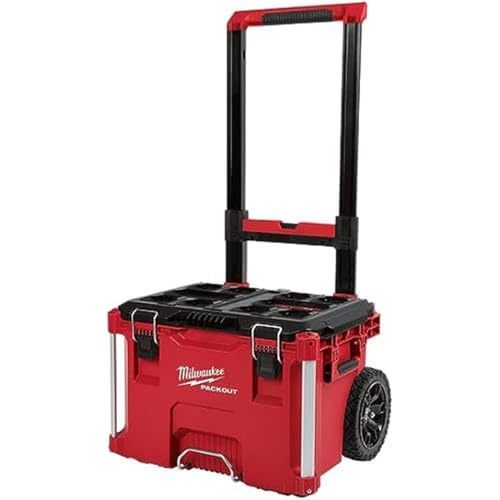
Milwaukee PACKOUT 22-Inch Rolling Tool Box (48-22-8426)
by Milwaukee
The Milwaukee PACKOUT 22-inch rolling box is the runner-up for jobsite contractors, mobile mechanics, and anyone who needs tool storage that survives rain and gravel — it is the wheeled foundation of the PACKOUT system, weather-sealed, and the right answer when steel-and-drawers is the wrong form factor.
Pros
- This is the wheeled base of the PACKOUT system, so every PACKOUT toolbox and organizer latches onto it — build the stack you need for the jobsite, then pull the top boxes off for a single-room install
- IP65 weather seal means it tolerates rain, jobsite dust, and wash-down without water reaching stored tools — the only pick in this roundup that survives outdoor jobsite conditions
- 9-inch all-terrain wheels roll over gravel driveways, jobsite curbs, and uneven concrete without the wheel deflection that kills small-caster chests on rough ground
- At 23.4 lb empty the impact-resistant polymer shell is dramatically lighter than a steel chest when rolling between jobs, and it handles drops from truck-tailgate height without cracking
Cons
- No drawers, and it ships as one large compartment — the interior organizer tray is a separate purchase, so budget for trays or foam if you want a drawer-like feel for sockets and wrench rolls
- 250 lb rated capacity is far below a steel rolling cabinet — PACKOUT is designed for a working tool kit, not for storing the entire shop's hardware inventory
Olympia Tools 27-Inch 5-Drawer Rolling Tool Cabinet — Runner-Up
The Olympia Tools 27-inch is the runner-up for homeowners who want a brand-name rolling cabinet with real load capacity behind it. Olympia has been making hand tools and storage for decades, which matters when you commit to a chest you expect to keep for years — replacement keys, drawer hardware, and customer service run through a real channel rather than the orphaned-import dead end that swallows most no-name chests after the warranty lapses.
The full-extension ball-bearing slides are the build detail that justifies the price between the homeowner combo and the upgrade cabinet. Full extension means each drawer pulls all the way out so the back of the drawer is accessible from the front — you are not reaching past a front row of sockets to grab the wrench at the back. Anti-slip liners come installed in all five drawers, so tools stay put instead of sliding into a pile every time you roll the cabinet across the shop. For a chest that moves around a working garage, that combination keeps the drawers organized between projects.
The five-drawer layout plus the bottom storage compartment is what you are paying for here. Five drawers gives you more granular organization than a three-drawer chest but less than the 10-drawer upgrade cabinet — best paired with a separate bin storage unit for small parts and fasteners, or with a wall-mounted pegboard storage zone for hand tools. The drawers are deep enough to accommodate larger items like cordless drill kits, oscillating multi-tools, and laser levels that do not fit in shallow socket-tray drawers. The internal locking bar and tubular cam lock secure every drawer and the lid on one key (the key box ships in the carton), which is what you want in a shared garage or carport. The 600 lb rated body on 100 lb ball-bearing slides puts it above the entry combo on load, and that is the real argument for it. The honest caveat is availability: Amazon lists it as usually shipping within one to two months, so order it before you need it, not the week you do.

Olympia Tools 27-Inch 5-Drawer Rolling Tool Cabinet (91-058)
by Olympia Tools
The Olympia Tools 27-inch is the runner-up for homeowners who want a brand-name rolling cabinet with real load capacity — five drawers on 100 lb ball-bearing slides, a 600 lb rated body, and one-key locking, provided you can wait out its restock window.
Pros
- Every drawer rides 100 lb rated ball-bearing slides with hold-in detents, so a loaded drawer stays where you put it instead of coasting shut while you work
- Anti-slip liners come installed in all five drawers, keeping sockets and hand tools from sliding and rattling when the cabinet is rolled across the shop
- Established Olympia Tools brand with a real parts-and-service channel — replacement keys and hardware are obtainable rather than orphaned the way most import-only chests are
- An internal locking bar and tubular cam lock secure all five drawers and the lid on one key, with the key box in the carton — the right setup for a shared garage or carport
Cons
- Amazon lists it as usually shipping within one to two months — Olympia restocks this cabinet in batches, so it is the wrong pick if you need storage in the garage this week
- Only 49 reviews, one of the thinnest review bases in this roundup, so long-term durability data is still building even though the build and the brand channel are sound
INTERGREAT 8-Drawer Rolling Tool Chest with Detachable Top Box — Most Drawers Per Dollar
The INTERGREAT 8-drawer with detachable top box is the runner-up for homeowners who prioritize granular drawer organization over premium build quality. Eight drawers — two large, three medium, three small — plus a bottom cabinet compartment puts this at the most-drawers-per-dollar position in this roundup, which is the right answer for shops that store small parts, fasteners, electrical components, and varied hand tools that need their own drawer rather than a shared bin.
The detachable top box is the workflow-friendly feature that earns this its place over a single-piece eight-drawer cabinet. The top box separates from the rolling base for a portable tool kit you can carry into a single-room project — a kitchen install, an electrical run, an attic repair — then re-attaches to the base with a positive lock for full chest service. For DIYers who do project-based work that pulls them out of the garage and into specific rooms of the house, that detachability saves trips back to the chest for forgotten tools.
The independent locks on the top box and bottom cabinet are the second feature worth calling out. Lock the top box (where you store the most-used or most-sensitive tools) for daily security, leave the bottom cabinet open for general access — a real workflow benefit in a shared shop. The honest caveat is that 210 lb total cabinet capacity is below the heavy-duty alternatives, so load drawers strategically with smaller items lower and avoid storing the heaviest power tools in the top box. The 392 review count is below the more established brands in this roundup, which means long-term durability data is still building, though early reviews report no significant issues. For granular organization at a price below the three-drawer competitors, this is the right pick.
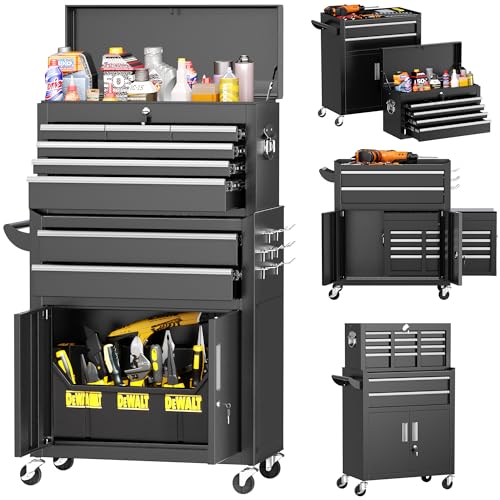
INTERGREAT 8-Drawer Rolling Tool Chest with Detachable Top Box
by INTERGREAT
The INTERGREAT 8-drawer with detachable top box is the runner-up for granular organization on a budget — the most drawers per dollar in this roundup, plus a workflow-friendly detachable top for portable jobs.
Pros
- Eight-drawer configuration with two large, three medium, and three small drawers covers granular tool organization at a price below most three-drawer competitors
- Detachable top box separates from the rolling base for a portable tool kit you can carry into a single-room project, then re-attaches with a positive lock for full chest service
- Independent locks on the top box and bottom cabinet let you secure the most-used drawers daily while leaving the lower cabinet open for shop access — a real workflow benefit
- Bottom cabinet compartment beneath the drawer stack adds bulk storage for cordless drill kits, paint supplies, or larger tools that do not need a dedicated drawer
Cons
- 210 lb total cabinet capacity is below the heavy-duty alternatives — load drawers strategically with smaller items lower and avoid storing the heaviest power tools in the top box
- Lower review volume than the CRAFTSMAN combo or Milwaukee picks means long-term durability data is still building, though early reviews report no significant issues
Goplus 5-Drawer Rolling Tool Chest — Best for Tight Spaces and Under-Bench Storage
The Goplus 5-drawer rolling chest is the runner-up for shops where floor space is at a premium — narrow garages, single-bay workshops, basement spaces with low ceilings, and any setup where a 41-inch upgrade cabinet simply does not fit. At 28 inches wide, this chest fits between standard 30-inch workbench legs, which makes it a practical under-bench rolling storage solution for shops that cannot dedicate floor space to a standalone cabinet.
The five-drawer configuration with full-extension ball-bearing slides matches the drawer count of the CRAFTSMAN best-overall pick at a comparable price point with similar build quality. The drawers extend fully — meaning the back of each drawer is accessible from the front, which sounds minor until you are reaching past stored tools to grab the one in the back. Three-quarter extension slides on cheaper chests force you to remove front-row tools to access back-row tools, which is the kind of small annoyance that adds up over years of daily use.
The 360-degree swivel wheels with two lockable casters are purpose-built for tight-space navigation. Standard straight-rolling chests struggle to maneuver around parked vehicles, stationary tools, and the inevitable jobsite clutter that accumulates in a garage. 360-degree swivel wheels turn in place, which means you can roll the chest around a parked car or pivot it past a miter saw stand without bumping anything. The central single-key lock secures all five drawers in one turn, and the lock cylinder accepts a standard tubular key blank — useful if you ever need a replacement key cut at a hardware store rather than ordering through the manufacturer. The 209 lb total cabinet capacity is in the mid range for this size class, so load deep drawers strategically and avoid stacking the heaviest tools all on one side. The 55-review base is thin, but the product appears solidly built and the reviews that exist report no significant issues.

Goplus 5-Drawer Rolling Tool Chest
by Goplus
The Goplus 5-drawer rolling chest is the runner-up for under-bench storage and tight garages — narrow footprint, 360-degree wheels, central locking, and a configuration that fits between standard workbench legs.
Pros
- Five-drawer configuration with full-extension ball-bearing slides matches the drawer count of the CRAFTSMAN best-overall pick at a similar price point with comparable build quality
- Central single-key lock secures all five drawers in one turn — fast morning lock-up without managing multiple keys, and the lock cylinder accepts a standard tubular key blank
- 360-degree swivel wheels with two lockable casters give you full directional control in tight garage spaces where straight-rolling chests struggle to navigate around vehicles
- 28-inch width fits between standard 30-inch workbench legs, which makes this a practical under-bench rolling storage solution for shops where floor space is at a premium
Cons
- 209 lb total cabinet capacity is in the same range as the INTERGREAT — load deep drawers strategically and avoid stacking the heaviest tools all on one side
- A 55-review base is thin — the product appears solidly built, but there is not yet multi-year durability history behind it
Mini 3-Drawer Pink Steel Tool Box — Best Compact Pink Pick
“Pink tool chest” is one of the highest-volume searches in this whole category, and for a long time my honest answer was that Amazon did not really have one. The chests most people are picturing, The Original Pink Box and the Kobalt pink line, are Lowe’s and Home Depot exclusives. What Amazon has is a long tail of plastic craft caddies wearing the word “tool” in the title. This little three-drawer box is the exception worth naming: it is genuinely powder-coated steel, it has aluminum drawer trim, and it is the best-reviewed pink option on the site that is not a toy.
Set your expectations at the right size and it does its job well. This is a desktop organizer. It fits on a craft bench, a sewing table, a hobby desk, or an apartment shelf, and you can pick it up with one hand. Three drawers plus the top compartment is enough structure for small hand tools, a jewelry-making kit, craft supplies, or the starter household toolkit that otherwise lives loose in a kitchen drawer. Compared with a single open tote, the drawers are the entire point.
Two things to be clear-eyed about before you buy. The drawers ride friction slides, not ball bearings, which is exactly the hardware I spend the rest of this roundup telling you to avoid. On a chest holding embroidery scissors and a screwdriver set that is a non-issue; on anything dense it will feel stiff and stay stiff. And the listing is a third-party storefront rather than Amazon itself, though it is fulfilled by Amazon, so shipping and returns still run on Amazon’s terms. Treat this as the right answer to “is there a real pink tool box on Amazon” and not as a small version of the steel rolling cabinets above, because it is not built to be one.

Mini 3-Drawer Pink Steel Tool Box
by Generic
The Mini 3-Drawer Pink Steel Tool Box is the honest answer to 'is there a good pink tool chest on Amazon' — a real steel bench-top chest in pink for crafters, hobbyists, and gift buyers, with the caveat that the big pink rolling cabinets remain Lowe's and Home Depot exclusives.
Pros
- The best-reviewed pink steel tool chest that actually ships from Amazon — a genuine powder-coated steel three-drawer box, not a plastic craft caddy, for buyers who want the pink aesthetic without dropping into a Lowe's-exclusive brand
- Compact desktop footprint fits on a craft bench, sewing table, hobby desk, or apartment shelf where a full rolling cabinet has no place, and it lifts and moves with one hand
- Three drawers plus a top compartment organize small hand tools, craft supplies, a jewelry-making kit, or a starter household toolkit better than a single open tote
- Fulfilled by Amazon rather than shipped from a spare room, so delivery, returns, and replacement run on Amazon's terms even though the seller itself is a third-party storefront
Cons
- Small capacity — this is a desktop organizer, not shop storage; it will not hold socket sets or power tools like the steel rolling chests in this roundup
- Amazon's pink inventory is thin: the large pink rolling cabinets people picture (Original Pink Box, Kobalt Pink) are Lowe's and Home Depot exclusives, not sold on Amazon
- The listing specifies friction slides, not ball bearings, so the drawers feel stiffer than every other chest in this roundup and will not stay smooth under weight. Fine for craft supplies and small hand tools, wrong for anything dense
Best Rolling Tool Chest for the Garage
For a permanent garage shop, a rolling steel chest is the right form factor — heavy enough to stay put when you reach into a loaded drawer, mobile enough to roll out for a big project. The CRAFTSMAN combo is the all-around pick with a top chest and rolling base in one; the Goplus fits between standard workbench legs for tight single-bay garages; and the Olympia is the five-drawer brand-name cabinet with a 600 lb rating and a real parts channel. All three lock, all three roll.
| Product | Price | Buy |
|---|---|---|
| CRAFTSMAN 26" 5-Drawer Rolling Tool Chest ComboBest rolling overall Top chest plus rolling base, ball-bearing drawers, and 300 lb locking casters — the combo that covers a homeowner shop in one buy | $288.00 | View on Amazon |
| Goplus 5-Drawer Rolling Tool ChestBest for tight garages 28 in wide fits between workbench legs with 360° swivel wheels — the pick for narrow single-bay garages and under-bench storage | $249.99 | View on Amazon |
| Olympia Tools 27-Inch 5-Drawer Rolling Tool Cabinet (91-058)Best brand-name cabinet Five drawers on 100 lb ball-bearing slides in a 600 lb rated body, from a brand with replacement keys and hardware you can actually get | $494.01 | View on Amazon |
Best Portable Tool Chest
Not every chest lives in a garage. Apartments, rental units, jobsites, and project-based work need a chest you can lift or roll to the work. The BIG RED bench-top box is the cheapest credible portable with real ball-bearing slides; the INTERGREAT’s top box detaches into a carry-anywhere kit; and the Milwaukee PACKOUT rolling box is the weatherproof jobsite base that survives rain and gravel on 9-inch wheels.
| Product | Price | Buy |
|---|---|---|
| BIG RED 20.5" Portable 3-Drawer Steel Tool Box (Torin ANTBD133-XB)Best budget portable A 20.5 in bench-top steel box with confirmed ball-bearing slides that ships direct from Amazon — the apartment and dorm pick | $64.65 | View on Amazon |
| INTERGREAT 8-Drawer Rolling Tool Chest with Detachable Top BoxMost drawers, detachable top Eight drawers plus a detachable top box you carry into a single-room job, then re-lock onto the rolling base for full service | $169.99 | View on Amazon |
| Milwaukee PACKOUT 22-Inch Rolling Tool Box (48-22-8426)Best jobsite / weatherproof IP65-sealed PACKOUT base on 9 in all-terrain wheels — the only pick here that shrugs off rain, jobsite dust, and truck-bed transport | $189.00 | View on Amazon |
Best Heavy-Duty and Large Tool Chest
When you load drawers near their rating every day — full socket cases, impact kits, angle grinders — gauge and drawer hardware are what separate a chest that lasts a decade from one that sags in a year. The CRAFTSMAN 41-inch is the heavy-duty pick with 18–20 gauge I-frame steel, 100 lb soft-close drawers, and 1500 lb casters. The INTERGREAT is the large-capacity value alternative: an eight-drawer tower that stores far more than a homeowner combo for less money, as long as you keep the heaviest tools low.
| Product | Price | Buy |
|---|---|---|
| CRAFTSMAN 41" 10-Drawer Rolling Tool Cabinet (CMST341102RB)Best heavy-duty / pro-grade I-frame steel, 100 lb soft-close ball-bearing drawers, and 1500 lb casters — the shop cabinet that stays aligned under a full pro tool load | $754.00 | View on Amazon |
| INTERGREAT 8-Drawer Rolling Tool Chest with Detachable Top BoxBest large-capacity value Eight drawers and a bottom cabinet at a budget price — the most storage per dollar when you want capacity over max drawer rating | $169.99 | View on Amazon |
Best Pink Tool Chest
“Pink tool chest” is one of the highest-volume searches in this category, but it hides a supply problem: the large pink rolling cabinets most people picture — The Original Pink Box and Kobalt Pink — are Lowe’s and Home Depot exclusives, not sold on Amazon. The honest Amazon answer is a compact steel pick. The Mini 3-Drawer Pink Steel box is a real powder-coated steel chest (not a plastic craft caddy) for a craft bench, hobby desk, or a starter household kit — best treated as a desktop organizer rather than shop storage.
| Product | Price | Buy |
|---|---|---|
| Mini 3-Drawer Pink Steel Tool BoxBest compact pink pick A genuine pink powder-coated steel 3-drawer bench-top chest — the best-reviewed pink option that actually ships from Amazon, sized for crafts and small hand tools, not sockets and power tools | $49.99 | View on Amazon |
Buyer's Guide
I have specified tool chests for client garages, jobsite trailers, and apartment workshops for two decades. Here are the six factors I evaluate before recommending a chest, ranked by how often the buyer regrets ignoring them.
Steel Gauge: The Counterintuitive Number
Steel gauge runs backward — lower number means thicker steel. A 14-gauge cabinet is roughly twice as thick as a 22-gauge cabinet, and the difference shows up in drawer alignment under load, dent resistance from dropped wrenches, and how the cabinet rolls across an uneven floor when fully loaded. For pro shop service, look for 14 to 16 gauge. For serious DIY workshops where drawers run loaded daily, 18 gauge is the sweet spot — the upgrade-pick I-frame design. For typical homeowner garage use with normal hand-tool storage, 20 to 22 gauge is fine. 24 gauge is the floor of acceptable build for any chest that costs more than a hundred dollars; thinner than that is decorative-grade only. If a manufacturer does not publish gauge on the product page, assume it is 24 gauge or thinner. Real shop-grade brands publish the spec because it is a competitive advantage.
Drawer Slide Weight Capacity
Per-drawer slide rating matters more than total cabinet capacity, which often assumes empty drawers and ideal load distribution. Friction slides at 15 to 20 lbs per drawer are budget-grade — they bind under real loads, fall out of alignment, and feel cheap from day one. Standard ball-bearing slides at 25 to 35 lbs per drawer cover most homeowner needs — hand tools, wrench rolls, small power tools. Heavy-duty ball-bearing at 75 to 100 lbs per drawer is what you need for full socket sets, impact driver kits, and dense storage. Look for full-extension slides (drawer pulls completely out) rather than three-quarter extension — full extension means the back of the drawer is accessible, which sounds minor until you are reaching past stored tools to grab the one in the back.
Caster System
Caster build determines whether a fully loaded chest rolls smoothly or fights you across the floor. Look for swivel casters on at least the front pair (preferably all four) so the chest navigates around obstacles. Caster load rating should exceed your loaded chest weight by 50 percent — a 300 lb caster on a 200 lb loaded chest gives you margin for impact loads when rolling over thresholds. Brake systems matter: dual-lock pairs (where one lever locks both wheel rotation and swivel) are the gold standard, single-brake casters are acceptable, and unlocked casters are unsafe for loaded chests near a slope. The Milwaukee Packout's 9-inch all-terrain wheels are purpose-built for jobsite use; standard 4 to 5-inch shop casters are right for garage service. Pneumatic wheels (rare in this category) handle the roughest surfaces but require maintenance.
Locking Mechanism
Lock type depends on how you actually use the chest. Single-key central locks (CRAFTSMAN combo, Goplus) secure all drawers with one turn — fast daily lock-up but losing the key takes everything offline at once. Independent locks on top and bottom (INTERGREAT) let you lock the most-sensitive compartment while leaving general access open — useful for shared shops and family garages. Slam latches (no key) are convenient but offer zero security for chemicals, sharp tools, or anything that needs to stay away from kids and visitors. Metal latch closures (Milwaukee PACKOUT) shut the box without a key — fast but not secure. For a household with children or a shared garage, plan for keyed locking; for a solo workshop, slam latches save time. Always order a spare key and store it somewhere obvious to the household.
Footprint and Drawer Configuration
Measure twice before ordering — every chest in this roundup has different exterior dimensions and door swing requirements. Account for wall clearance behind the chest (typically 4 to 6 inches for caster movement), door swing in front, and clearance for parked vehicles if the chest sits in a garage bay. The drawer configuration matters as much as drawer count — a five-drawer chest with one shallow tray, three medium drawers, and one deep drawer covers more tool types than a five-drawer chest with five identical-depth drawers. Look for varied drawer depths: shallow (for layout tools, files, ratchets), medium (for socket sets, pliers, screwdrivers), and deep (for power tools, impact drivers, bulky items). The CRAFTSMAN 10-drawer upgrade pick spans all three depth tiers, which is why it covers a complete shop in one unit.
Mobility Intent
Match the form factor to how you will actually use it. Permanent garage shop with no plan to move the chest? A heavy steel rolling cabinet (the CRAFTSMAN upgrade pick or the Olympia rolling cabinet) is the right answer — heavy gauge steel, high drawer ratings, and stationary-bias casters. Jobsite contractor or mobile mechanic moving the chest between locations daily? The Milwaukee Packout is purpose-built for the use case — modular, weather-sealed, all-terrain wheels. Apartment or rental workshop where the chest needs to fit on a bench and lift onto a moving truck? The BIG RED 3-drawer portable budget pick is right-sized for the use case. The single biggest mistake homeowners make is buying for the workshop they imagine rather than the workshop they actually have — match the chest to the realistic mobility pattern, not the aspirational one.
Before You Buy — Jake’s In-Store Test
If you are buying a chest in a hardware store rather than online, here is the test routine I run before recommending one to a client. It takes five minutes and tells you almost everything you need to know.
Pull every drawer all the way out. Drawers should slide smoothly through the full extension without binding, sticking, or making a grinding noise. Listen for the bearings — they should roll, not skip. Drawers that bind in the showroom will bind worse in your garage with a year of dust accumulated on the slides. Walk away from any chest where two or more drawers stick.
Test the caster brake under load. Lean on the side of the chest with both hands and try to roll it with the brakes engaged. The brake should hold the chest rigid — not slip, not creak, not flex. Brakes that fail this test will fail under real tool loads, which is unsafe for chests sitting on a sloped garage floor.
Check the anti-tip mechanism. Pull the top drawer out fully and watch the rest of the chest. A properly designed chest has an interlock that prevents two drawers from opening at the same time, or a counterweight that keeps the cabinet stable with the top drawer extended. Cheap chests have neither — pull the top drawer with no counterweight and the cabinet wants to tip forward.
Inspect the powder coat at the edges. Run a finger along the bottom edge of the cabinet and along the drawer rims. Powder coat should be smooth and continuous, not chipped or uneven. Edge defects are the first place rust starts in a damp garage, and they tell you the manufacturer cut corners on the finish process. Clean edges suggest a clean overall build.
Open and close the lock. The key should turn smoothly without binding. If the lock cylinder is rough out of the box, it will be impossible after a year of dust accumulation. Single-key central locks should engage all drawers simultaneously without one of them slipping — test by pulling each drawer after locking to verify all are secured.
This test takes about five minutes and tells you more about long-term build quality than any spec sheet. If a chest passes all five checks, the rest of the build is probably solid. If it fails two or more, walk away.
How to Choose the Best Tool Chest
The right chest depends on three questions: how mobile does it need to be, how much organization granularity do you need, and what is your budget tier.
Mobility first. Permanent garage shop with no plan to move? A heavy steel rolling cabinet (the CRAFTSMAN upgrade or the Olympia) is the right answer. Jobsite contractor or mobile mechanic? The Milwaukee Packout. Apartment or rental workshop? The BIG RED 3-drawer portable budget pick. Match the form factor to your real mobility pattern, not the aspirational one.
Granularity next. If you store small parts, fasteners, electrical components, and varied hand tools that each deserve a drawer, you need eight to ten drawers — the INTERGREAT 8-drawer or the CRAFTSMAN 41-inch 10-drawer. If your collection is mostly socket sets, hand tools, and a few power tool kits, five drawers in a combo configuration covers it. If you are starting out, three drawers is a fine entry point.
Budget last, not first. A cheap chest with friction drawers and under-rated casters will frustrate you for years before you replace it. Buy the right form factor and the right build quality even if it stretches the budget — the per-year cost over a decade is lower than buying twice. The five-drawer CRAFTSMAN combo at the entry price tier is the right floor; below that, you are buying disposable storage.
Verify your floor plan. Measure your garage layout including door swing, parked vehicle clearance, and at least 4 to 6 inches of wall clearance behind the chest for caster movement. The 41-inch upgrade cabinet is a fantastic chest, but it is a daily annoyance if it crowds the door or blocks vehicle access. For homeowners just starting their workshop buildout, the essential tools list is a good companion to size your storage to your real tool collection.
Final Verdict
For most homeowner workshops, the right starting point is the CRAFTSMAN 26” 5-Drawer Rolling Tool Chest Combo. It solves the highest-value tool storage problem — granular drawer organization with rolling mobility — at a price that fits a real garage budget without skimping on the hardware that matters. Ball-bearing drawer slides, locking casters, single-key central lock, and a combo configuration that covers shallow, medium, and deep drawer needs in one unit. This is the chest I recommend most often for clients, and it is the obvious starting point for any garage organization project.
If your priority is the lowest credible cost in a footprint that fits on a bench, the BIG RED 20.5” Portable 3-Drawer Tool Box is the budget pick that does not compromise on the hardware that matters — confirmed ball-bearing slides at the price point where most competitors use friction slides. For homeowners ready to step up to a serious shop cabinet that lasts a decade, the CRAFTSMAN 41” 10-Drawer Rolling Tool Cabinet is the upgrade with I-frame steel, soft-close drawers, and casters that handle real loads. And for jobsite contractors or mobile mechanics who need tool storage that survives weather and rough ground, the Milwaukee PACKOUT 22-inch Rolling Tool Box is the runner-up that no steel chest in this roundup can match. Pair your chest with a quality cordless drill for assembly, organized garage storage systems for the rest of your tools, and the right chest will hold weight and stay aligned for the next decade of your workshop.
Frequently Asked Questions
What steel gauge should I look for in a tool chest?
How much weight can a tool chest drawer actually hold?
Should I buy a chest, a cabinet, or a combo?
Is a rolling tool chest worth it for a rental garage or apartment?
Can I keep a tool chest in an unheated garage?
Can I use one of these as a truck tool box?
Should I buy a tool chest that comes with tools?
Related Articles
9 Best Garage Storage Systems of 2026
storage-organization
8 Best Miter Saws of 2026
power-tools-workshop
7 Best Cordless Drills of 2026
power-tools-workshop
Essential Tools Every New Homeowner Needs: A Contractor's Tiered Buying Guide
hand-tools
Garage Organization on a Budget: A Licensed GC's Zone-by-Zone Playbook
storage-organization
About the Reviewer

Jake Morrison, Licensed General Contractor
B.S. Construction Management, Purdue University
Jake Morrison has spent 14 years in residential construction and home renovation before founding DIYRated in 2026. After helping hundreds of homeowners choose the right tools and materials for their projects, he started writing the product guides he wished existed when he was starting out. Jake tests every major product recommendation in his workshop in Indianapolis and focuses on real-world performance over spec-sheet marketing.