7 Best Garden Hoses for 2026
Jake Morrison, a licensed general contractor, reviews the 7 best garden hoses of 2026 — kink-free hybrid, stainless steel, and expandable models for watering, equipment washing, and pressure-washer feed lines.
Updated
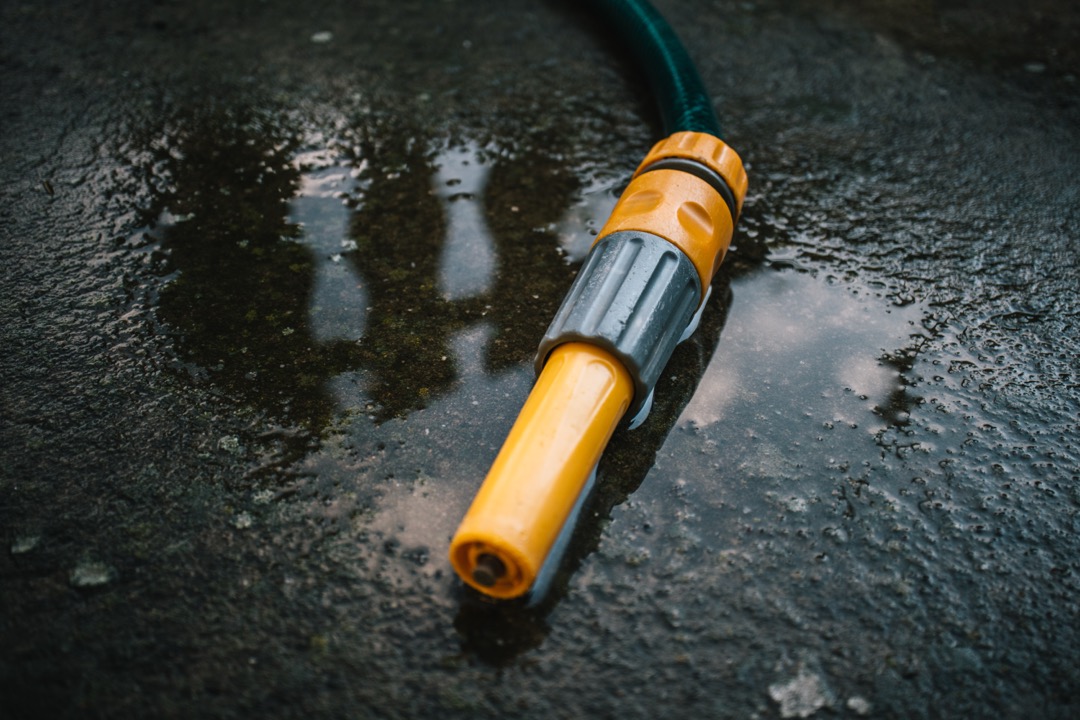
As a licensed general contractor, I treat a garden hose as a real working tool, not a seasonal afterthought. On my job sites a hose mixes the water for concrete, rinses mud off equipment, feeds the pressure washer, and washes down the driveway when we pack up. At home it waters the beds and fills the kids’ pool. Across all of that, I have watched cheap hoses fail the exact same way every time: a kink that chokes the flow, a fitting that corrodes and seizes onto the spigot, or a liner that splits after one cold night left charged in the garage.
This roundup covers the 7 best garden hoses for 2026, spanning hybrid polymer, stainless steel, and expandable designs from 50 to 100 feet. I evaluated each one on the things that actually decide whether a hose lasts — material, fitting quality, kink resistance, and weight — instead of the marketing on the package. If you plan to run any of these as a feed line, my best pressure washers for home use guide pairs directly with this one.
| Product | Price | Buy |
|---|---|---|
| Flexzilla Garden Hose 5/8 in. x 50 ft.Best Overall | $39.97 | View on Amazon |
| Bionic Steel 100 Ft Metal Garden HosePremium Pick | $47.99 | View on Amazon |
| zero-G 4001-50 Garden Hose, 50 ft.Runner-Up | $42.44 | View on Amazon |
| Flexi Hose Expandable Garden Hose 50 ftRunner-Up | $49.99 | View on Amazon |
| Pocket Hose Ballistic 50 FT ExpandableRunner-Up | $59.99 | View on Amazon |
| Giraffe Tools Garden Hose 5/8" Heavy Duty 100ftRunner-Up | $57.80 | View on Amazon |
| Bionic Steel 75 Ft Garden Hose 304 Stainless SteelRunner-Up | $35.99 | View on Amazon |
Find the Right Garden Hose for Your Yard
Hose choice comes down to two things: how far you need to reach and how you want to store it. Jump to your situation:
- Quick picks — our top hoses overall
- Best expandable garden hose
- Best 100 ft garden hose
- Best 50 ft garden hose
- Best metal (stainless steel) garden hose
Quick Picks
Best Overall: The Flexzilla 5/8 in. x 50 ft. hits the sweet spot of kink resistance, cold-weather flexibility, and a lifetime warranty backed by over 100,000 reviews — the hose I hand most homeowners.
Lightest 50-Footer: The zero-G 4001-50 is the lightest traditional 50-footer with crush-proof brass couplings, named The Spruce’s #1 hose after 40-plus were tested. Note that it is not the cheapest hose here: the Flexzilla currently costs slightly less.
Runner-Up: The Flexi Hose Expandable collapses to 17 feet for storage and uses solid brass fittings, the best of the expandables if shed space is tight.
Upgrade Pick: The Bionic Steel 100 Ft is physically impossible to kink, shrugs off dogs and mower wheels, and stays around 3 lbs across a full 100 feet of reach.
How I Chose These Garden Hoses
I evaluated more than a dozen hoses across hybrid polymer, stainless steel, reinforced vinyl, and expandable categories against the factors that decide real-world longevity: material behavior in heat and cold, fitting metal and corrosion resistance, kink and crush resistance, flow rate by diameter, and charged weight. The PSI rating on the package matters far less than whether the fitting survives a winter or the liner survives a kink.
Every model here has a substantial base of verified Amazon reviews, and I cross-referenced those against independent testing from outlets like The Spruce, contractor experience, and the failure modes I see most often on job sites. I deliberately included a range of lengths and materials, because a balcony gardener with a single planter has nothing in common with a homeowner watering a half-acre lot or feeding a pressure washer. If your watering is centered on raised beds, the hose needs to reach and soak every bed the day you fill it — figure out how much soil those beds take first with our free raised garden bed soil calculator, then size the hose to reach them all. Seeding a lawn is the other job where reach decides the outcome: new grass seed has to stay damp two or three times a day for two to three weeks, and if the seedbed dries out once after the seed swells those seedlings are gone, so measure the run to the far corner before you buy. Our free grass seed calculator sizes the seed for the same square footage you are about to water. The same goes for a lawn renovation: fresh topsoil wants a deep soak the day it goes down or it crusts over, so check the yardage with our free topsoil calculator and make sure the hose reaches the far corner before the delivery shows up.
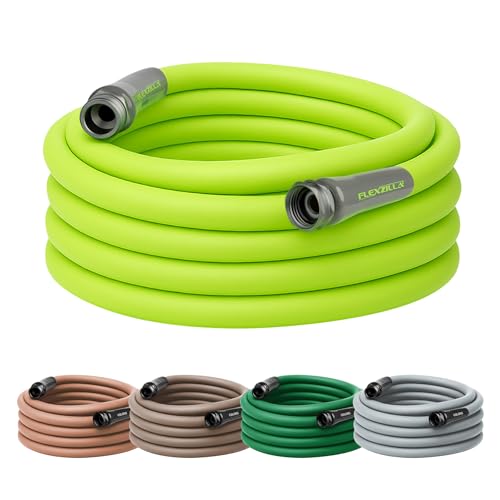
Flexzilla Garden Hose 5/8 in. x 50 ft. — Best Overall
The Flexzilla is the hose I reach for first and the one I recommend to almost everyone. Its hybrid polymer construction is the thing that sets it apart: where a rubber or vinyl hose stiffens into an uncooperative coil the moment temperatures drop, the Flexzilla stays soft and flexible. It lays flat on the ground and drags behind you instead of springing back into loops. On a cold spring morning when I am rinsing equipment, that difference is the gap between a tool that works and one I am fighting.
It is also effectively kink-free in normal use. No hose with an inner liner is literally impossible to kink the way stainless is, but the Flexzilla’s material resists the memory loops that cause standard hoses to crimp and cut off your flow at the worst possible moment. The SwivelGrip silicone handles on each end are a genuinely smart touch — they let you crank a fitting onto a spigot or nozzle without the twisting force traveling back down the hose and knotting it behind you.
The honest caveats are weight and fittings. At 7.8 lbs dry, a 50-foot Flexzilla full of water has real heft on a large lot, so if you are watering a big property look hard at the lighter stainless options below. And the anodized aluminum fittings, while solid out of the box, can stress-crack after years of being cranked onto a brass spigot — a known long-term wear point worth keeping an eye on. Even so, with over 100,000 reviews and a lifetime warranty behind it, the Flexzilla has earned the top pick.
Flexzilla Garden Hose 5/8 in. x 50 ft.
by Flexzilla
The best garden hose for most homeowners — Flexzilla's hybrid polymer stays flexible in the cold, refuses to kink, and is backed by over 100,000 reviews and a lifetime warranty.
Pros
- Hybrid polymer construction stays genuinely flexible in cold weather where rubber and vinyl hoses stiffen into uncoilable coils — it lays flat and drags behind you instead of fighting back
- Effectively kink-free in real use — the material resists the memory loops that cause standard hoses to crimp and cut off flow at the worst moment
- SwivelGrip silicone handles on both ends let you thread fittings onto a spigot or nozzle without the connection twisting the hose into a knot behind you
- Lifetime warranty backed by more than 102,000 reviews — an unmatched body of real-world reliability data across every climate
Cons
- Heavier than expandable models when full of water — at 7.8 lbs dry, a charged 50-foot run has real heft when you drag it across a large yard
- Anodized aluminum fittings can stress-crack after several years of cranking them onto brass spigots — a known long-term failure point
- Only available in the bright zilla green, which some homeowners find loud against landscaping
Bionic Steel 100 Ft Metal Garden Hose — Upgrade Pick
If you have a big lot, dogs, or a habit of running the mower over your hose, the Bionic Steel 100 Ft is the upgrade that ends the cycle of replacing cheap hoses every couple of seasons. Its segmented 304 stainless steel construction has no inner liner to crimp, which means it is physically impossible to kink. You can fold it, run it around a sharp corner, step on it, and the flow never chokes off. After years of dealing with kink points that eventually split, a hose that simply cannot kink feels like cheating.
The other revelation is the weight. A 100-foot run of conventional rubber hose is a genuine two-arm chore, often weighing well over 15 lbs dry. The Bionic Steel comes in around 3 lbs for the same length, so dragging it to the far end of the yard is almost effortless. It is also puncture-proof and chew-proof — dogs, gravel, lawnmower wheels, and the sharp deck-board edges that shred ordinary hoses do not faze it. With no liner to dry-rot or split, the service life is close to permanent.
Two things keep it in the upgrade slot rather than the top pick. The metal exterior gets hot in direct sun and can be uncomfortable to grab on a summer afternoon, and the included nozzle is throwaway plastic — budget for a metal trigger nozzle on day one. The stainless fittings can also oxidize at the connections over time in humid climates. For a long-reach hose you will not replace for a decade, those are easy trade-offs to accept.

Bionic Steel 100 Ft Metal Garden Hose
by Bionic Steel
The upgrade pick for big lots — Bionic Steel's segmented stainless construction is impossible to kink, shrugs off dogs and mower wheels, and stays remarkably light at 100 feet.
Pros
- Segmented 304 stainless steel construction is physically impossible to kink — there is no inner liner to crimp, so flow never gets choked off mid-job
- Ultra-light for a 100-foot hose at roughly 3 lbs, which is a fraction of what a comparable rubber hose of that length would weigh
- Puncture-proof and chew-proof — it shrugs off dogs, lawnmower wheels, gravel, and the sharp edges that shred conventional hoses
- Near-permanent service life with no liner to dry-rot or split, backed by roughly 38,700 pooled reviews and Amazon's Choice status
Cons
- The metal exterior gets hot in direct sun and can be uncomfortable to grab on a summer afternoon
- Included nozzle is cheap plastic and worth replacing with a metal trigger nozzle on day one
- Stainless steel fittings (not brass) can oxidize and bind at the connections over time in humid conditions
zero-G 4001-50 Garden Hose, 50 ft. — Lightest 50-Footer
The zero-G earns its spot by being the lightest traditional 50-foot hose I have handled and the easiest to live with day to day. At under 4 lbs dry, coiling it back onto a reel or wall hook after watering is genuinely effortless — there is no wrestling, no fighting the coil memory that makes heavier hoses such a chore to put away. The Spruce named it their #1 hose after testing more than 40 models, and that tracks with how it handles.
The standout feature at this price is the crush-proof brass couplings. Most inexpensive hoses ship with thin stamped fittings that flatten the first time a vehicle rolls over them or someone steps on the connection, after which they simply will not thread onto the spigot anymore. The zero-G’s brass couplings survive that abuse and keep threading cleanly, which is exactly the kind of detail that separates a hose that lasts five years from one that fails in one. It is backed by a 5-year warranty and roughly 2,900 reviews.
The one real limitation is cold. The reinforced vinyl is not rated below 35°F and can crack if left charged in freezing temperatures, so this is a hose you must drain and store before winter — a discipline I cover in detail below and in my home winterization guide. It is also not meant for hot water or as a high-pressure pressure-washer feed line. Respect those limits and the zero-G is an easy hose to live with. One caveat on price: it currently sits a shade above the Flexzilla, so pick it for the low weight rather than to save money.

zero-G 4001-50 Garden Hose, 50 ft.
by zero-G
The lightest traditional 50-footer here, with crush-proof brass couplings and a 5-year warranty, as long as you drain it before the first freeze.
Pros
- Lightest traditional 50-foot hose I have handled — under 4 lbs dry, so coiling it up after watering is genuinely effortless
- Crush-proof brass couplings survive being run over by a vehicle or stepped on, where stamped fittings flatten and stop threading onto the spigot
- Coils easily without fighting back, which makes hanging it on a reel or wall hook fast at the end of a job
- Named The Spruce's #1 hose after testing 40-plus models, backed by a 5-year warranty and roughly 2,900 reviews
Cons
- Not rated below 35°F — the reinforced vinyl can crack if left charged in freezing temperatures, so it must be drained and stored for winter
- Vinyl construction feels less premium than hybrid polymer or stainless, even if it performs well
- Not intended for hot water or as a high-pressure pressure-washer feed line
Flexi Hose Expandable Garden Hose 50 ft — Runner-Up
The Flexi Hose is the answer to one specific, real problem: storage. If you garden on a balcony, work out of a cramped shed, or just hate wrestling a rigid hose onto a hook, an expandable that collapses from 50 feet down to roughly 17 feet is genuinely liberating. It also weighs under 3 lbs, so you can carry it one-handed across the yard or up a flight of stairs to a rooftop garden without a second thought.
What earns the Flexi Hose the runner-up spot over the field of cheap expandables is its fittings. Most budget expandables fail first at the plastic connectors, which strip and crack within weeks. The Flexi Hose uses solid brass fittings that actually hold up to repeated connection cycles, and the 3/4-inch diameter moves more volume than the typical expandable. It carries a lifetime guarantee and roughly 5,200 reviews behind it.
The honest truth about every expandable, this one included, is that the inner latex tube is a consumable. Under heavy use it typically fails within 12 to 24 months — you are buying convenience and storage, not a buy-once-cry-once hose. Pressure also drops noticeably when your supply runs high, since the hose is working to stay expanded. Keep it off abrasive concrete and gravel, drain it after each use, and treat it as the lightweight convenience tool it is rather than your primary workhorse.

Flexi Hose Expandable Garden Hose 50 ft
by Flexi Hose
The best expandable hose for storage-constrained gardeners — Flexi Hose collapses to 17 feet, uses solid brass fittings, and weighs under 3 lbs, with the usual expandable caveat on liner life.
Pros
- Collapses from 50 feet down to roughly 17 feet for storage, taking up a fraction of the space of a rigid hose on a hook or in a bin
- Solid brass fittings instead of the cheap plastic ends that fail first on most budget expandables — the connections actually hold up
- Under 3 lbs makes it light enough to carry one-handed across a yard or up to a balcony garden
- Lifetime guarantee plus a 3/4-inch diameter for higher volume than most expandables, backed by roughly 5,200 reviews
Cons
- The inner latex tube typically fails within 12 to 24 months under heavy use — expandables are a consumable, not a buy-once hose
- Pressure noticeably drops at high water pressure as the hose works to stay expanded
- Not built for dragging across abrasive concrete or gravel, which abrades the outer fabric sleeve
Pocket Hose Ballistic 50 FT Expandable — Strong Expandable Alternative
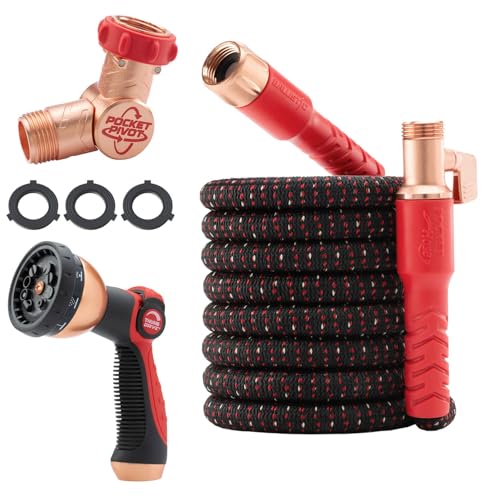
The Pocket Hose Ballistic is the second expandable worth your attention, and its signature feature solves a failure mode I see constantly: spigot stress. The Pocket Pivot swivel at the connection end lets the hose rotate freely instead of transmitting twisting force into the spigot threads. That matters because the most common way a spigot dies is from years of a stiff hose levering against it every time you move around the yard — the swivel takes that load off entirely.
Performance-wise, the 3/4-inch high-volume core delivers strong flow for an expandable, which makes filling buckets, watering cans, and the kids’ pool noticeably faster than a narrower hose. At roughly 2 lbs and collapsing small enough to stash in a bucket or deck box, it is the most portable hose in this entire roundup. Its 4,300-plus reviews confirm it is a proven design rather than a gimmick.
The trade-offs are price and the inherent expandable caveat. The Pocket Hose costs more than most competing expandables for broadly similar real-world durability, and like all of them, its long-term liner life is a question mark next to a stainless or hybrid hose. It is also a touch bulkier when collapsed than the Flexi Hose, so the Flexi edges it on pure compactness. If spigot protection and high flow are your priorities, though, this is the expandable to get.
Pocket Hose Ballistic 50 FT Expandable
by Pocket Hose
A strong expandable runner-up — the Pocket Pivot swivel protects your spigot and the 3/4-inch core moves real volume, though it costs more than competing expandables.
Pros
- Pocket Pivot swivel at the spigot end prevents the connection stress that snaps fittings and strips spigot threads over time
- 3/4-inch high-volume design delivers strong flow for an expandable, good for filling buckets and watering cans quickly
- Ultra-compact at roughly 2 lbs and collapses small enough to store in a bucket or deck box
- Backed by more than 4,300 reviews — a proven design among expandables rather than another As-Seen-On-TV one-season hose
Cons
- Pricier than most other expandable hoses for similar real-world durability
- Like all expandables, the long-term liner durability is a question mark compared to hybrid or stainless hoses
- Bulkier when collapsed than the Flexi Hose, so it is the less compact of the two expandables here
Giraffe Tools Garden Hose 5/8” Heavy Duty 100ft — Lightweight Long-Reach Polymer
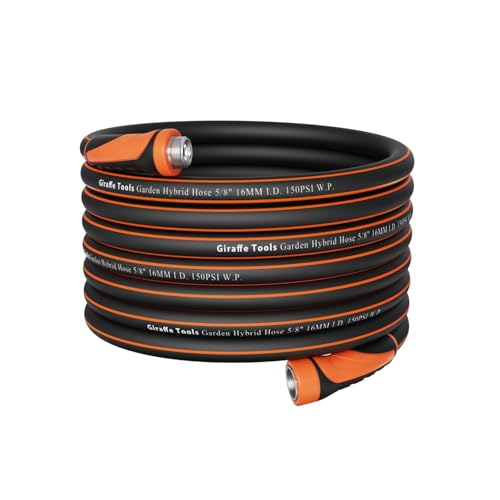
If you need 100 feet of reach but do not want to deal with the hot-metal and oxidation quirks of stainless, the Giraffe Tools hybrid polymer hose is the alternative. At just over 7 lbs for a full 100 feet, it is exceptionally light for that length — not as featherweight as the Bionic Steel, but far easier to drag than any rubber hose of comparable reach. The swivel handles on both ends let you connect and reposition without twisting the hose into knots behind you, the same problem the Flexzilla solves on shorter runs.
Where this hose distinguishes itself is sun and corrosion resistance. The polymer holds up to prolonged UV exposure better than most, resisting the surface degradation that fades and cracks cheaper hoses left out all season. The nickel-plated brass fittings resist corrosion at the connections far better than bare aluminum, which is exactly the galvanic-corrosion problem I warn about below. The Spruce ran it for a full year of hands-on testing, and it is backed by roughly 9,000 reviews.
Two caveats keep it out of the top tier. Being a lined polymer hose, it can kink if you yank it sharply around a tight corner, unlike the truly kink-proof stainless options. The swivel collar also tends to migrate down toward the middle of the hose during use and needs occasional repositioning. And the 1-year warranty is short next to the lifetime guarantees elsewhere in this roundup. For a light, long, sun-tough polymer hose, though, it is a strong choice.
Giraffe Tools Garden Hose 5/8" Heavy Duty 100ft
by Giraffe Tools
A lightweight 100-foot hybrid hose with corrosion-resistant nickel-plated brass fittings and dual swivel handles — the long-reach polymer alternative to going stainless.
Pros
- Just over 7 lbs for a full 100-foot hose — exceptionally light for that length and far easier to drag than a rubber equivalent
- Swivel handles on both ends let you connect and reposition without twisting the hose into knots behind you
- Holds up to UV and sun exposure better than most polymer hoses, resisting the surface degradation that fades and cracks cheaper hoses
- Nickel-plated brass fittings resist corrosion at the connections, backed by The Spruce's 1-year hands-on testing and roughly 9,000 reviews
Cons
- Can kink if pulled sharply around a tight corner, unlike the truly kink-proof stainless options
- The swivel collar tends to slide down toward the middle of the hose during use and needs occasional repositioning
- 1-year warranty is short compared to the lifetime guarantees on several competitors here
Bionic Steel 75 Ft Garden Hose 304 Stainless Steel — Best Mid-Length Stainless
The 75-foot Bionic Steel takes everything that makes the 100-foot version great and packages it at a lower price in a more manageable length for medium-sized yards. It is the same kink-proof segmented 304 stainless steel design — no inner liner, so it physically cannot crimp — which means the same dog-proof, mower-proof, crush-resistant toughness in a hose that suits the majority of suburban lots without the excess coil of a full 100 feet.
The weight is the headline. At under 2.5 lbs for 75 feet, it is the lightest hose of its length you can buy, and that makes carrying and repositioning it around the yard effortless. The 500 PSI burst rating and crush-resistant stainless fittings hold up to mower wheels, foot traffic, and the rough handling a hose actually gets in real life. It is one of the best-selling hoses on the entire platform, with 4,000-plus sold monthly and roughly 39,884 pooled reviews behind the design.
The trade-offs mirror the 100-foot model: the metal exterior heats up in direct sun, and the included nozzle is a basic plastic unit worth swapping for something metal right away. Seventy-five feet is also inherently a compromise length — a bit short for a true large lot, a bit long for a small one. But if your yard sits in that middle range and you want a kink-proof hose that will last for years, this is the value pick of the stainless category.

Bionic Steel 75 Ft Garden Hose 304 Stainless Steel
by Bionic Steel
The stainless kink-proof design in a more affordable 75-foot length — under 2.5 lbs, dog-proof and mower-proof, and one of the best-selling hoses on the platform.
Pros
- Same kink-proof segmented stainless steel design as the 100-foot model at a lower price and a more manageable length for medium yards
- Under 2.5 lbs makes it the lightest 75-foot hose you can buy and effortless to carry and reposition
- 500 PSI burst rating and crush-resistant stainless fittings hold up to mower wheels, foot traffic, and rough handling
- Among the most-bought hoses on Amazon with 4,000-plus sold monthly and roughly 39,884 pooled reviews
Cons
- Metal exterior heats up in direct sun like the 100-foot version
- Ships with a basic plastic nozzle worth upgrading immediately
- 75 feet is a compromise length — short for large lots, longer than needed for small ones
Best Expandable Garden Hose
Expandable hoses shrink to a third of their working length for storage — the right call for a balcony, a small shed, or anyone tired of coiling a heavy rubber hose. The trade-off is durability: the cheap ones burst at the fabric seam within a season. These two are the exceptions I trust.
| Product | Price | Buy |
|---|---|---|
| Flexi Hose Expandable Garden Hose 50 ftBest expandable overall Flexi Hose — a double-latex core in a tough woven jacket with solid brass fittings, the expandable that holds up season to season | $49.99 | View on Amazon |
| Pocket Hose Ballistic 50 FT ExpandableBest heavy-duty expandable Pocket Hose Ballistic — a heavier woven shell built to resist abrasion on rough patios and gravel, for expandable users who drag the hose across hard surfaces | $59.99 | View on Amazon |
Best 100 ft Garden Hose
A 100-foot hose reaches the back of a deep lot or a detached garage without coupling two hoses together — but length adds weight and pressure loss, so the material matters more than at 50 feet. Metal resists kinks and drags flat; polymer stays lighter to haul.
| Product | Price | Buy |
|---|---|---|
| Bionic Steel 100 Ft Metal Garden HoseBest 100 ft metal Bionic Steel 100 ft — a 304 stainless jacket that will not kink, puncture, or hold coil-memory the way rubber does over a long run | $47.99 | View on Amazon |
| Giraffe Tools Garden Hose 5/8" Heavy Duty 100ftBest 100 ft lightweight Giraffe Tools 100 ft — a lighter polymer hose that is far easier to walk across a big yard, with brass fittings and a heavy-duty core | $57.80 | View on Amazon |
| Bionic Steel 75 Ft Garden Hose 304 Stainless SteelBest 75 ft alternative Bionic Steel 75 ft — the same stainless build a size down, for reaches between 50 and 100 feet where a full 100 ft is overkill | $35.99 | View on Amazon |
Best 50 ft Garden Hose
Fifty feet is the length most yards actually need — enough to reach the garden beds and wash a car without hauling extra weight. This is where you get the widest choice of materials, so pick by how much the hose weighs and how it stores.
| Product | Price | Buy |
|---|---|---|
| Flexzilla Garden Hose 5/8 in. x 50 ft.Best 50 ft overall Flexzilla 50 ft — the kink-free hybrid-polymer hose that stays flexible in cold weather, the everyday default | $39.97 | View on Amazon |
| zero-G 4001-50 Garden Hose, 50 ft.Best lightweight 50 ft zero-G 50 ft — a genuinely light woven hose that is easy to maneuver and carry, the pick when weight matters most | $42.44 | View on Amazon |
| Flexi Hose Expandable Garden Hose 50 ftBest storable 50 ft Flexi Hose 50 ft — shrinks down for storage if shed or hook space is tight | $49.99 | View on Amazon |
Best Metal (Stainless Steel) Garden Hose
Stainless-steel-jacketed hoses solved the two worst hose problems at once: they will not kink and dogs cannot chew through them. The trade-off is that they do not lie perfectly flat and the outer coil can feel stiff — but for kink-free durability, nothing else comes close.
| Product | Price | Buy |
|---|---|---|
| Bionic Steel 100 Ft Metal Garden HoseBest long metal hose Bionic Steel 100 ft — the full-length 304 stainless option for reaching a detached garage or back fence without a single kink | $47.99 | View on Amazon |
| Bionic Steel 75 Ft Garden Hose 304 Stainless SteelBest mid-length metal hose Bionic Steel 75 ft — the same puncture- and kink-proof build in a more manageable 75 ft for mid-size yards | $35.99 | View on Amazon |
Why Brass-on-Brass Fittings Matter
The single most common way a garden hose dies is not the hose body — it is the fitting seizing onto the spigot. The culprit is galvanic corrosion, and it is pure metallurgy. When you thread an aluminum fitting onto a brass spigot, you have created an electrochemical cell: two dissimilar metals in contact, with water as the electrolyte. The aluminum corrodes preferentially, the connection fills with white aluminum-oxide powder, and the two pieces effectively weld themselves together. After one wet winter in a humid climate, you may need a wrench and real force to break that connection — and you will often round off or snap the fitting trying.
Brass-on-brass eliminates the problem. Brass against brass is a galvanically compatible pairing, so the connection threads on and off cleanly for years. This is exactly why I spec solid brass fittings on every hose I recommend for serious use, and why the crush-proof brass on the zero-G and the solid brass on the Flexi Hose carry real weight in my evaluation. Nickel-plated brass, like the Giraffe Tools uses, is the next best thing — the plating shields the brass while staying compatible.
One more detail that separates contractor-grade fittings from consumer junk: hex or wrench-flat shoulders. A fitting with flat sides gives you a place to put a wrench when a connection is stubborn. A smooth, round fitting leaves you nothing to grip, so you end up crushing it with pliers. When you are shopping, look at the shape of the collar — flats are a sign someone designed it to be serviced, not just sold.
5/8 vs 3/4 Inch: The Flow Rate Math
Hose diameter confuses a lot of buyers, so here is the math in plain terms. The fraction on the package is the inner diameter, and it sets how much water the hose can physically move. A 5/8-inch hose flows roughly 9 gallons per minute. A 3/4-inch hose flows closer to 13 gallons per minute. That sounds like a big jump, but for almost everything a homeowner does, 9 GPM is already more than enough — watering beds, washing the car, rinsing the patio, and filling a watering can do not benefit from the extra volume.
So when does 3/4 inch actually earn its extra weight, cost, and stiffness? Three cases: filling a pool or large tank where raw volume saves you real time, feeding a pressure washer that demands high inlet flow to keep its pump fed, and running very long distances where you want to offset pressure loss. That last point is the one people forget — you lose roughly 1 PSI for every 10 feet of hose run, so a 100-foot hose has measurably less pressure at the nozzle than a 25-foot one. A larger diameter helps claw some of that back over distance.
For the vast majority of homes, 5/8 inch is the correct default and the size I recommend without hesitation. Step up to 3/4 inch only if you have one of those specific high-volume jobs. If you are sizing a hose specifically to feed a pressure washer, check the inlet requirements in my electric pressure washers guide first, since some compact units are happy with 5/8 inch while higher-flow machines want 3/4.
Winterizing a Garden Hose So It Lasts
More hoses die from one cold night than from years of use, and it is entirely preventable. The physics are simple: water expands roughly 9 percent when it freezes. If a hose is left full and charged when a hard freeze hits, that expansion has nowhere to go and ruptures the inner liner from the inside out. A vinyl hose like the zero-G is especially vulnerable, but even premium hoses can split if you leave them full in subfreezing temperatures.
The routine takes five minutes. Disconnect the hose from the spigot, remove the nozzle so water can escape from both ends, and drain it completely — the easiest way is to stretch it downhill or coil it on a slope and let gravity pull the water out. If you have a compressor, blowing the hose out with compressed air clears the last of it and guarantees nothing is left to freeze. Then store it loosely coiled somewhere above freezing, like a garage shelf or basement, rather than tight kinks that stress the material.
This same drain-and-store discipline protects your spigots and outdoor plumbing, which is why I fold hose winterization into the broader seasonal routine in my home winterization guide. A hose is cheap to replace, but the habit of draining everything before the first freeze is the same habit that keeps a burst pipe from flooding your basement. Build the routine once and it protects everything outside.
Buyer's Guide
I have dragged hoses across job sites for over 15 years — mixing concrete, washing equipment, feeding pressure washers, and watering the landscaping after the crew goes home. A hose is the cheapest tool on the truck that fails the most often, almost always at the fitting or the kink. Here are the six factors I check before recommending one to a homeowner.
Material
Material determines almost everything about how a hose behaves. Reinforced vinyl is the cheapest and lightest but stiffens in the cold and cracks if frozen while charged. Rubber is durable and handles hot water but is heavy and prone to memory kinks. Hybrid polymer, like the Flexzilla, is the modern sweet spot — it stays flexible in the cold, resists kinking, and lays flat without fighting back. Stainless steel, like the Bionic Steel, is the most puncture- and kink-proof of all because there is no inner liner to crimp, though the metal heats up in the sun. Expandable fabric-and-latex hoses win on storage but are a 12-to-24-month consumable. Match the material to your climate and how rough your use is.
Length
Buy the shortest hose that reaches the far corner of your work area and no longer. Every extra foot adds weight, drag, and one more thing to coil at the end of the job, and it costs you pressure — you lose roughly 1 PSI for every 10 feet of run. A 50-foot hose covers most suburban yards and is the easiest length to live with. Step up to 75 or 100 feet only if you genuinely have the distance, and when you do, prioritize a lightweight material like stainless or hybrid polymer so the long run does not become a wrestling match. If you need to reach two distant areas, two shorter hoses you can join often beat one unwieldy long one.
Diameter
Inner diameter controls flow rate. A 5/8-inch hose moves roughly 9 gallons per minute, which is more than enough for watering, car washing, and general yard work — this is the right size for the vast majority of homeowners. A 3/4-inch hose moves closer to 13 gallons per minute and only earns its extra weight and cost when you are filling a pool quickly, feeding a high-demand pressure washer, or running long distances where you want to claw back pressure lost to the length. A 1/2-inch hose is fine for light container watering but chokes flow on anything bigger. When in doubt, 5/8 inch is the default that serves almost every home use.
Fittings (Brass vs Aluminum)
The fitting is where most hoses die, so it is worth more attention than the hose body. Solid brass is what I spec — it is corrosion-resistant, threads smoothly, and survives years of cranking onto a brass spigot. Crucially, brass-on-brass avoids galvanic corrosion. When you thread an aluminum fitting onto a brass spigot, the two dissimilar metals react in the presence of water and corrode and seize together, often after a single wet winter. Look for fittings with hex or wrench-flat shoulders so you can break a stuck connection with a wrench instead of rounding it off. Stamped or thin aluminum fittings flatten if stepped on and then will not thread at all — crush-proof brass or octagonal brass couplings are the upgrade that pays for itself.
Kink Resistance
A kink is not just an annoyance — it cuts off your flow at the worst moment and, over time, the repeated crimping at the same spot weakens the hose until it splits there. Stainless steel hoses are the gold standard because they have no inner liner to fold over; they physically cannot kink. Hybrid polymer hoses like the Flexzilla are the next best thing, resisting the coil memory that makes cheap rubber and vinyl hoses crimp. Cheaper hoses kink most often right at the spigot, so a swivel fitting at the connection end helps. If you find yourself constantly walking back to un-kink your hose, that lost time is exactly what a better material buys back.
Weight and Portability
Weight is the spec people underestimate until they are dragging a charged 100-foot hose across a yard for the tenth time. A hose's dry weight roughly doubles when full of water, so a heavy hose becomes a genuine workout on a large property. Stainless steel hoses are dramatically lighter than rubber for their length — a 100-foot Bionic Steel weighs about 3 lbs versus the 15-plus pounds of a comparable rubber hose. Expandables are the lightest of all when empty. If you have a big lot, an elderly user, or you simply want to reach for the hose without dreading it, weight should weigh heavily in your decision. Pair the right weight with a wall-mounted reel or hanger and the whole chore gets easier.
Final Verdict
For most homeowners, the Flexzilla 5/8 in. x 50 ft. is the best garden hose you can buy right now. Its hybrid polymer stays flexible in the cold, resists the kinks that kill cheaper hoses, and the SwivelGrip handles make connecting it genuinely pleasant. Backed by over 100,000 reviews and a lifetime warranty, it is the hose I hand to the widest range of people with the most confidence.
If low weight is your main concern, the zero-G 4001-50 is the lightest traditional 50-footer with crush-proof brass couplings, as long as you respect its one rule and drain it before the first freeze. It is priced within a dollar of the Flexzilla, so choose it for the handling rather than the savings. For big lots, dogs, or anyone tired of replacing kinked hoses every season, the Bionic Steel 100 Ft stainless hose is the buy-once upgrade that simply cannot kink and stays remarkably light across a full 100 feet of reach.
Whichever you choose, remember that the fitting is where most hoses die and the freeze is what kills the rest. Spec brass-on-brass connections, drain the hose before winter, and store it loosely coiled out of the sun — do that, and the right hose will keep working long after the cheap ones in your neighbors’ garages have split.
Frequently Asked Questions
What is the best garden hose that won't kink?
Is it safe to drink from a garden hose?
What's the difference between a 5/8 and 3/4 inch garden hose?
Are expandable garden hoses worth buying?
How do I store a garden hose so it lasts longer?
Related Articles
About the Reviewer

Jake Morrison, Licensed General Contractor
B.S. Construction Management, Purdue University
Jake Morrison has spent 14 years in residential construction and home renovation before founding DIYRated in 2026. After helping hundreds of homeowners choose the right tools and materials for their projects, he started writing the product guides he wished existed when he was starting out. Jake tests every major product recommendation in his workshop in Indianapolis and focuses on real-world performance over spec-sheet marketing.