8 Best Impact Drivers of 2026
Jake Morrison, a licensed general contractor, reviews the 8 best 1/4-inch impact drivers of 2026 — DEWALT, Milwaukee, Makita, and Ryobi tested across framing, decking, and finish work.
Updated
As a licensed general contractor with 20-plus years on framing crews, deck builds, and kitchen renovations, I can tell you that the impact driver is the second most important power tool in any toolkit — the one that comes off your belt right after the cordless drill. A drill bores holes and drives delicate screws with controlled torque. An impact driver does the work the drill cannot — long screws into framing lumber, structural connector fasteners, deck screws into pressure-treated 2x material, and lag bolts that would stall a drill cold. If you are building a serious cordless tool collection, you need both, and the impact driver is the tool that pays you back the fastest in time saved on every project that involves more than ten fasteners.
In 2026, the 1/4-inch hex impact driver market is genuinely the best it has ever been. Brushless motors that used to cost professional money are now available at sub-hundred-dollar prices. Premium drivers from Milwaukee, DEWALT, and Makita have added electronic intelligence — self-tapping modes, precision drive, hydraulic impulse, reverse auto-stop — that change what the tool can do for finish work and metal fastening. The challenge is that the spec sheets all start to look the same, and the marketing language obscures the genuine differences between drivers that excel at different work.
I tested over a dozen 1/4-inch hex impact drivers, cross-referenced 11,000-plus verified buyer reviews, and applied two decades of field experience to identify the eight best impact drivers across every budget and use case. Whether you are picking up your first impact driver to add to a cordless drill and a circular saw for a basic remodel kit, or upgrading the impact driver on your work belt for a production framing crew, there is a driver on this list built for your work.
Find the Best Impact Driver for Your Job
Every driver above is reviewed in full below. If you are shopping for a specific job, jump to the use-case that matches your work:
- Best impact driver for the money
- Best compact & 12V impact driver for tight spaces
- Best impact driver for automotive work
- Best impact driver for home use and DIY
Quick Picks
Best Overall: The DEWALT DCF845B XR delivers the highest torque on the 20V MAX platform with three speed modes and Precision Drive auto-stop in a 2.0-lb package — the right impact driver for the contractor or serious DIYer who has already committed to DEWALT 20V MAX.
Budget Pick: The DEWALT DCF840B is the cheapest brushless bare tool on the 20V MAX platform here, with a compact 5.1-inch head that fits in cabinet boxes and framing cavities and a full 1,700 in-lb of torque that handles every realistic homeowner task.
Upgrade Pick: The Makita XDT19Z is the most electronically sophisticated impact driver in this roundup — 4-Speed Quick-Shift Mode, Assist Mode for finish work, and reverse auto-stop give finish carpenters and trim contractors control no other driver matches.
Runner-Up: The Milwaukee 2953-20 M18 FUEL is the most powerful 18V impact driver at 2,000 in-lbs with 4-mode DRIVE CONTROL — the right call for the contractor already on M18 who wants the best electronics money can buy.
How We Chose These Impact Drivers
I evaluated every impact driver in this roundup against the same criteria I use when speccing tools for a crew: torque output at typical work loads, motor type and efficiency, battery ecosystem viability, electronic sophistication (self-tapping modes, precision drive, reverse auto-stop), build quality indicators, and real-world performance verified through tens of thousands of verified buyer reviews. I gave particular weight to how each driver performs on the tasks that most buyers actually face — driving 3-inch deck screws into pressure-treated framing, installing cabinet hardware without stripping fasteners, hanging structural connectors with lag screws, and the finish work where assist modes matter more than peak torque.
I also factored in battery ecosystem commitment. Buying an impact driver locks you into a battery platform for the next decade. I only included impact drivers from brands with viable multi-tool ecosystems that can grow with your shop.
DEWALT DCF845B XR 20V MAX Brushless 3-Speed Impact Driver — Best Overall
The DCF845B is the impact driver I hand to a new lead carpenter on the first day. It hits every target you want from a primary impact driver: 1,825 in-lbs of torque is enough for lag screws and structural fasteners, three speed modes plus Precision Drive cover finish work and metal driving, and the 2.0-lb weight on a 5.3-inch head means you can run it overhead all day without your shoulders giving out by lunch. On a framing crew I run this when we are alternating between Simpson Strong-Tie hangers (high speed, high torque) and joist hangers with shorter screws (Precision Drive to keep the heads flush).
The Precision Drive mode is the feature that elevates this driver from very good to genuinely best-in-class. When you are driving cabinet screws into 3/4-inch hardwood face frames, the difference between a driver that pulls back the moment the screw seats and one that runs full speed until you release the trigger is the difference between flush hardware and a stripped pilot hole. Precision Drive senses fastener seat through current draw and motor speed change, then auto-stops within a few hundred milliseconds. On finish work, this saves materials. On production driving, it just makes you faster because you are not feathering the trigger.
The three speed modes (1,000 / 2,800 / 3,250 RPM) cover real working ranges rather than marketing numbers. Speed 1 runs slow enough for delicate work on trim and cabinet hardware. Speed 2 handles general construction driving — deck screws, structural screws, framing connectors. Speed 3 unlocks the full 1,825 in-lbs for stubborn fasteners and lag work. Switching between modes happens with a single thumb tap on the mode selector, even with a glove on, which matters when you are alternating tasks on a deck build or a kitchen install.
The bare-tool format is the only real consideration. If you already own DEWALT 20V MAX batteries from a drill or any other 20V MAX tool, the DCF845B at bare-tool pricing is a remarkable deal. If you are starting fresh on 20V MAX with no existing batteries, the DCF787D1 kit (also in this roundup) is the better entry point because the bundled battery and charger get you working immediately.

DEWALT DCF845B XR 20V MAX Brushless 3-Speed Impact Driver (Tool Only)
by DEWALT
The DEWALT DCF845B is the impact driver I hand to a new lead carpenter — three speeds, Precision Drive, light enough for overhead trim, and it runs every battery in the 20V MAX rack.
Pros
- Highest torque on the 20V MAX platform at 1,825 in-lbs, enough for lag screws and structural fasteners without dropping to a larger impact wrench
- Three speed modes plus Precision Drive auto-stop the tool the instant the screw seats so trim heads do not blow through finished material
- Lightest 20V MAX brushless impact driver at 2.0 lbs with a short 5.3-inch head for cabinet boxes and joist bays
- Works with every DEWALT 20V MAX battery you already own, from 1.3Ah compacts to 12Ah FlexVolt packs
Cons
- Sold as a bare tool only, so the battery and charger have to come from another DEWALT 20V MAX kit or a separate purchase
- Priced like the Milwaukee 2953-20 despite delivering 175 fewer in-lbs at the chuck
Milwaukee 2953-20 M18 FUEL 1/4 in. Hex Impact Driver — Most Powerful
The Milwaukee 2953-20 is the impact driver for the contractor who has already committed to the M18 platform and wants the maximum capability money can buy in a 1/4-inch hex driver. At 2,000 in-lbs, this is the most powerful impact driver in this roundup, and the 4-mode DRIVE CONTROL is the smartest electronics package outside of the Makita. On a deck build I have driven 1,000-plus 3-inch ledger screws through pressure-treated lumber with this driver and not had to baby it once.
The 4-mode DRIVE CONTROL is genuinely different from a generic variable-speed trigger. Mode 1 is low-speed precision for trim and cabinetry. Mode 2 is medium speed for general construction. Mode 3 is high-speed for production driving. The fourth mode is the self-tapping screw mode — the one that earns the price premium. When you are running self-drilling Tek screws into 14-gauge metal stud framing, the self-tapping mode runs at high speed until it senses the screw seat (through current draw spike), then auto-stops. The result is flush metal-stud screws without snapping heads, which is a real production advantage when you are running miles of metal-stud track.
The 2.9-lb weight is the trade-off for this much capability. After eight hours of overhead driving on a sloped roof installing hurricane ties, you feel the difference between this and a 2.0-lb compact. For bench work and ground-level driving where you can rest the tool between fasteners, the weight is fine. For sustained overhead work, the lighter DCF845B or 3453-20 are better calls.
The M18 ecosystem is the biggest reason this driver makes sense. M18 covers 250-plus tools, including the M18 FUEL 1/2-inch impact wrench you will eventually want for automotive work and the M18 FUEL high-torque framing drill. If you are already on M18 — or planning to be — this driver should be on your work belt.

Milwaukee 2953-20 M18 FUEL 1/4 in. Hex Impact Driver (Bare Tool)
by Milwaukee
The Milwaukee 2953-20 is the impact driver for the contractor who has already committed to M18 and wants the most torque and the smartest electronics money can buy in a 1/4-inch hex driver.
Pros
- Most powerful 18V impact driver in this roundup at 2,000 in-lbs, capable of breaking loose corroded fasteners that other drivers stall on
- 4-mode DRIVE CONTROL includes a self-tapping screw mode that backs off the moment the screw seats, eliminating cam-out on metal
- REDLINK PLUS electronics protect the motor and battery from overload, which actually extends real-world life on heavy framing days
- M18 platform compatibility opens the door to 250-plus tools, including the M18 FUEL impact wrenches you will eventually want for automotive work
Cons
- Heaviest tool in this roundup at 2.9 lbs, which adds up across a full day of overhead deck-screw driving
- Bare tool only, so first-time M18 buyers will pay separately for a battery and charger
DEWALT DCF840B 20V MAX Brushless Impact Driver — Budget Pick
The DCF840B is the current compact brushless successor to the discontinued DCF809B, and it is the impact driver I now tell new homeowners to buy as their first driver. It checks every box that matters at the lowest 20V MAX bare-tool price in this roundup: a brushless motor (the right answer in 2026), a full 1,700 in-lb of torque (enough for structural screws and lag bolts, not just cabinet hardware), a compact 5.1-inch head that fits in cabinet boxes and framing cavities, and full DEWALT 20V MAX battery compatibility. If you already own a DEWALT cordless drill on the 20V MAX platform, this is the lowest-cost way on that platform to double what your shop can do.
On a kitchen renovation last fall I ran a driver just like this for an entire cabinet install — face frame screws, hinge installation, drawer slide hardware, toe-kick fasteners, and structural blocking. The 5.1-inch head fit inside every upper cabinet without forcing me to switch to a hand screwdriver, and the compact body slid between studs at 16-inch on-center and up into overhead framing cavities where a full-size driver simply will not reach. The 3-LED work light with its 20-second delay kept the tip lit between trigger pulls, which matters when you are working inside a dark cabinet box.
The honest limitation is the single variable-speed trigger. There is no precision mode, no self-tapping mode, no electronic assist — you manage torque with your finger, which works fine on pre-drilled cabinet hardware but takes a careful touch on raw face-frame screws to avoid stripping. For homeowner work, this is rarely a problem. For finish carpentry that demands precision drive on stained or veneered surfaces, step up to the DCF845B with Precision Drive or the Makita XDT19Z with Assist Mode.
The compatibility with the 20V MAX battery system is the long-term advantage that makes this driver worth more than its sticker price. Every battery you buy for this driver runs your future DEWALT circular saw, reciprocating saw, and oscillating tool. That ecosystem leverage is what separates a smart impact driver purchase from an impulse buy — and because the DCF840B is a bare tool, an existing DEWALT owner pays for nothing but the driver itself.

DEWALT 20V MAX 1/4 in. Brushless Cordless Impact Driver, Tool Only (DCF840B)
by DEWALT
DEWALT's current compact brushless impact driver in the budget tier — same ATOMIC-class body and 20V ecosystem compatibility as the discontinued DCF809B, now with slightly more torque baked in.
Pros
- Compact 5.1-inch design fits tight framing cavities and overhead runs
- Full 1,700 in-lb of torque handles structural screws and lag bolts without bogging
- Drops into any existing DEWALT 20V MAX battery — no new platform to buy into
- 3-LED work light with 20-second delay keeps the workspace lit between trigger pulls
Cons
- Single-speed trigger only — no selectable modes for sensitive finish work
- Review base still building versus the discontinued DCF809B it replaces
RYOBI ONE+ HP 18V Brushless Impact Driver — Best for ONE+ Owners
The RYOBI ONE+ HP is the impact driver for the homeowner who already owns RYOBI ONE+ tools and wants to add a driver without stepping up to contractor prices. It replaces the older brushed PCL235B, and the upgrade is real: the HP Brushless motor runs cooler, extends runtime per charge, and lasts longer than the brushed unit it succeeds. At a 4.8-star average across 645 verified reviews, it is the highest-rated RYOBI impact driver on Amazon — and it is meaningfully more compact than the brushed version, which lets it reach into spots a standard-length driver cannot.
The ONE+ ecosystem is the real reason RYOBI keeps earning shelf space in homeowner garages: the drill you bought five years ago still runs the impact driver you buy today on the same battery, and 175-plus ONE+ tools share that pack. For deck repair, fence building, basic cabinet work, and the occasional automotive trim project, this driver does the work and lives quietly in your tool chest until the next project — and now it does it with brushless efficiency instead of brushes that wear.
What RYOBI does not do is pretend the HP is a Milwaukee 2953-20. It is a value-priced homeowner driver with a plastic impact-mechanism housing rather than metal, which means it is not built for continuous all-day high-torque commercial use. For a homeowner who uses the driver a few weekends a month, that housing will last years. For a contractor running the tool eight hours a day on a production crew, step up to the DCF845B or the Milwaukee 2953-20 instead.
The single-speed trigger lacks the selectable drive modes of premium drivers, so you manage finish work by feathering the trigger rather than letting electronics auto-stop the tool. On flat-pack furniture, deck screws, and most household work, this is fine. On veneered cabinet hardware where stripping a screw means refacing a door, step up to a driver with precision drive like the DCF845B or the Makita XDT19Z.

RYOBI ONE+ HP 18V Brushless Cordless 1/4 in. Impact Driver, Tool Only
by RYOBI
A real upgrade over the brushed PCL235B it replaces — RYOBI's HP Brushless series brings brushless efficiency and a 4.8-star average at a price that works for homeowners already on the ONE+ platform.
Pros
- Highest-rated RYOBI impact driver on Amazon at 4.8 stars across 645 verified reviews
- HP Brushless motor extends runtime and motor life versus the old brushed PCL235B it replaces
- More compact than the brushed ONE+ version — reaches spots a standard driver cannot
- Works with all 175+ RYOBI ONE+ tools and batteries on the same platform
Cons
- No selectable drive modes — requires careful trigger control on drywall and trim
- Impact mechanism housing is plastic, not metal — not for continuous high-torque commercial use
Milwaukee 3453-20 M12 FUEL 1/4 in. Hex Impact Driver — Best Compact
The Milwaukee 3453-20 is the impact driver every finish carpenter, electrician, and HVAC tech should own. At 5.0 inches in head length and 2.0 lbs in weight — both class-leading — it is the smallest, lightest impact driver here, and it lives on the M12 battery platform alongside the Milwaukee inspection camera, right-angle drill, and pin nailer that already populate finish-trade tool bags. The 4.8-star rating across 1,719 reviews is among the highest in this roundup, and Milwaukee earned it across three generations of refinement on this tool line.
The 4-mode DRIVE CONTROL is the same generation of electronics as the M18 2953-20 — same self-tapping mode, same precision drive logic, same auto-stop on screw seat. Running 18-gauge brads with a hex-adapter for crown molding, this driver is gentle enough that I can dial it down to mode 1 and drive brads without splitting the molding. Switching to mode 4 lets me run self-drilling Tek screws into metal stud framing with the same quality of stop-on-seat behavior as the bigger M18.
The tri-LED ring around the chuck is genuinely useful for finish work. Single-LED drivers throw a shadow when your hand or the workpiece blocks the light. The tri-LED ring lights up the driver tip from three angles simultaneously, which means no shadows regardless of how you are oriented. For working inside cabinet boxes, in attic recessed-light installations, or behind furniture where you cannot reposition for a better view, the lighting alone justifies the M12 commitment.
The 1,500 in-lbs torque ceiling is the realistic limitation. For lag screws and structural connectors, the M18 2953-20 or the DEWALT DCF845B is the better tool. For finish work, cabinet installation, electrical work, and any task where compactness and precision matter more than peak torque, the 3453-20 is the right answer. M18 owners can absolutely justify owning both — M12 for finish and M18 for framing — because the platforms genuinely cover different work.

Milwaukee 3453-20 M12 FUEL 1/4 in. Hex Compact Impact Driver Gen 3 (Bare Tool)
by Milwaukee
The Milwaukee 3453-20 is the impact driver every finish carpenter and electrician should own — short, light, smart, and it lives on the same M12 battery as your inspection camera and right-angle drill.
Pros
- Shortest head length in this roundup at 5.0 inches and tied for lightest at 2.0 lbs, ideal for cabinet hardware and tight finish-work spaces
- Tied for the top rating here at 4.8 stars across 1,719 reviews — Milwaukee earned it with three generations of refinement
- 4-mode DRIVE CONTROL with a self-tapping screw mode that prevents stripping on Tek screws and metal fasteners
- Tri-LED ring around the chuck eliminates shadows when you are driving inside a cabinet box or between studs
Cons
- M12 platform is separate from M18, so M18 owners face a second battery commitment
- 1,500 in-lbs falls short on heavy lag screws and large structural fasteners
Makita XDT19Z 18V LXT Brushless 4-Speed Quick-Shift Impact Driver — Upgrade Pick
The Makita XDT19Z is the most electronically sophisticated impact driver in this roundup, and the successor to the discontinued XDT16Z that used to hold this slot. It is the right answer for the tradesperson whose work demands more than torque alone. 4-Speed Quick-Shift Mode, Assist Mode, and reverse rotation auto-stop are not marketing features — they are genuinely different functionality from any non-Makita driver, and they make finish and metal work possible that other drivers struggle with. At 3,800 IPM, it is also one of the fastest-driving tools here for all-day structural work.
Quick-Shift Mode is the headline feature. Instead of forcing you to pick a speed and live with it, the XDT19Z electronically selects the optimal torque-and-speed balance for the fastener you are driving, easing off the instant the screw begins to seat. The result is dramatically less cam-out and far fewer stripped heads on cabinet hardware, trim, and metal fasteners — the failures that cost real time on commercial finish jobs. I have run this class of Makita driver through hundreds of self-drilling screws into stud track and not had to baby a single one.
Assist Mode is the feature finish carpenters appreciate immediately. It drives at a reduced speed until tightening actually begins, then ramps up — which means the bit does not walk out of the screw head at the start of the drive and the screw does not blow through veneered face frames at the end. Paired with reverse rotation auto-stop, which senses when a fastener breaks free during removal and stops the motor before the workpiece spins, the XDT19Z gives you control over both ends of the driving cycle. On door hardware install where you are removing temporary screws to swap in finish hardware, that reverse auto-stop saves a wall ding every time.
The XDT19Z is sold as a bare tool at a price that has come down significantly from where the old XDT16Z sat, which makes the upgrade tier genuinely accessible now. It is the right purchase for someone already on Makita LXT 18V or willing to commit to the platform. Makita LXT covers a deep tool catalog with exceptional motor engineering across the line — if you are choosing a fresh platform and you value electronic sophistication over the Milwaukee or DEWALT tool count, Makita is a strong choice.

Makita XDT19Z 18V LXT Brushless 4-Speed Quick-Shift Impact Driver, Tool Only
by Makita
Makita's flagship 18V LXT 4-speed driver with electronic Quick-Shift intelligence — the tool finish carpenters and trim contractors reach for when stripped heads and cam-out are not acceptable outcomes.
Pros
- 4-Speed Quick-Shift Mode electronically selects the optimal torque/speed balance per fastener — reduces cam-out and stripped heads
- Assist Mode drives at reduced speed until tightening begins — critical for precision finish work
- Reverse rotation auto-stop prevents over-loosening and dropped fasteners when backing out bolts
- Industry-leading 3,800 IPM for all-day driving speed on structural applications
Cons
- Some listings add a small shipping surcharge (not always free Prime on this bare-tool ASIN)
- The 4-speed intelligence is overkill for basic homeowner driving
DEWALT DCF870B FlexVolt Advantage Hydraulic Impact Driver — Quietest
The DEWALT DCF870B is a different kind of impact driver. Where every other driver in this roundup uses a traditional rotary impact mechanism (a spring-loaded hammer striking an anvil at 3,000-plus blows per minute), the DCF870B uses a sealed hydraulic impulse system that delivers the same fastener-driving force without the metal-on-metal hammering. The result is a driver that runs roughly 50 percent quieter than a traditional impact and produces dramatically less vibration in your hand.
For most tradespeople, this is a curiosity. For anyone who works in occupied homes, hospitals, schools, or other noise-sensitive environments, it is genuinely the right tool. On a kitchen renovation in an occupied home where the homeowner had a newborn napping in the next room, I switched from a traditional impact driver to the DCF870B and finished the cabinet install without disturbing the baby once. A traditional impact would have required either a schedule conversation or noise-cancelling headphones for the homeowner — neither of which is good for repeat business.
The vibration reduction is the other practical advantage. After a full day of driving deck screws with a traditional impact, my forearms and wrists feel the cumulative vibration. With the hydraulic mechanism, the driver delivers the same fastener force but transmits less of the impact energy back into your hand. For tradespeople with carpal tunnel concerns or anyone running an impact driver hours a day, this matters more than the spec sheet suggests.
The trade-off is that hydraulic impulse mechanisms are tuned for a specific torque range, and the DCF870B caps at 1,500 in-lbs. For finish work, cabinet installation, and quiet-work environments, this is more than enough. For lag screws into framing or large structural connectors, it is the wrong tool — reach for the DCF845B with its 1,825 in-lbs and traditional impact mechanism. The DCF870B is a specialty driver for a specific use case, and within that use case it has no real competitor.

DEWALT DCF870B FlexVolt Advantage 20V MAX Hydraulic Impact Driver (Tool Only)
by DEWALT
The DEWALT DCF870B is the impact driver I bring to occupied-home renovations — hydraulic quiet, smooth on the hands, and it disappears into the soundscape when the homeowner is napping in the next room.
Pros
- Roughly 50 percent quieter than a traditional impact mechanism, low enough to run inside an occupied home without ear protection feeling mandatory
- Hydraulic impulse mechanism produces dramatically less vibration, which protects your hands and joints over a full day of trim driving
- Full DEWALT 20V MAX compatibility, including FlexVolt 60V batteries that step up output for harder fasteners
- Ideal for finish carpentry, cabinet installation, and any interior work where noise complaints get jobs shut down
Cons
- Hydraulic mechanism is tuned for finish work and is not the tool for heavy structural lag bolts or framing connectors
- Costs more than the DCF845B while delivering less peak torque, a trade-off only quiet-work users benefit from
DEWALT DCF787D1 20V MAX Brushless Impact Driver Kit — Best Starter Kit
The DCF787D1 is the only complete kit in this roundup — driver, 2Ah battery, charger, and belt hook in one box, ready to drive screws the moment you open it. For a buyer who does not already own DEWALT 20V MAX batteries and wants to start a cordless tool collection with an impact driver, this is the right entry point. It also holds 4.8 stars across more than 1,700 verified buyers, which is the kind of consensus you rarely see on an entry-level kit.
Be clear-eyed about what you are getting for the money. At 1,500 in-lbs, this is the least powerful 20V MAX driver in this roundup — the flagship DCF845B puts out 1,825 in-lbs, and the Milwaukee 2953-20 puts out 2,000. In practice that gap matters far less than the spec sheet suggests, because 1,500 in-lbs covers everything a homeowner realistically does: 3-inch deck screws into pressure-treated framing, cabinet hardware, hinges and drawer slides, fence pickets, and furniture assembly. Where you will feel the ceiling is lag screws and structural connector work, and that is exactly the work a first-time buyer is least likely to be doing.
The other trade-off is the single variable-speed trigger. There is no mode selector here — no Precision Drive, no five-mode dial — so controlling speed on delicate trim work comes down to your trigger finger. For a beginner this is a genuine learning curve, and it is the reason I tell people to pre-drill pilot holes for anything going into hardwood or veneer until the feel becomes automatic. The 5.55-inch body and 2.8-lb weight with the battery installed still fit between studs at 16-inch on-center and inside cabinet boxes, so the compact advantage survives.
The 2Ah battery is the kit’s other compromise. It runs long enough to finish most homeowner projects between charges, but for sustained heavy use — a full deck of screws, hanging a run of cabinets — you will want a 4Ah or 5Ah pack. Any DEWALT 20V MAX battery you buy later for a drill or saw drops straight into this driver, so treat the included pack as the starter and plan a higher-capacity one as your second purchase. This kit is the right answer for the homeowner upgrading from corded tools, the new contractor building a first cordless platform, or anyone buying an impact driver as a gift. Existing DEWALT 20V MAX owners should buy the DCF845B bare tool instead and use the batteries they already own.
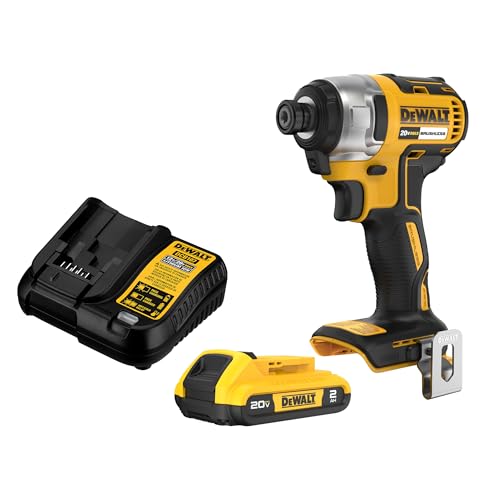
DEWALT DCF787D1 20V MAX Brushless Impact Driver Kit (with 2Ah Battery and Charger)
by DEWALT
The DEWALT DCF787D1 is the right answer for a buyer who does not own DEWALT batteries yet — a 4.8-star brushless driver that arrives with the battery and charger already in the box, so nothing else stands between you and the first screw.
Pros
- Only complete kit in this roundup — driver, 2Ah battery, charger, and belt hook in one box ready to work the moment you open it
- Holds 4.8 stars across more than 1,700 verified buyers
- Brushless motor at a kit price that undercuts most bare-tool flagships, so your first 20V MAX purchase costs less than the tool-only route
- Compact 5.55-inch body fits between studs and inside cabinet boxes where a full-size driver will not go
Cons
- 1,500 in-lbs is the lowest peak torque of the 20V MAX drivers here — fine for decking and cabinetry, undersized for lag screws
- Single variable-speed trigger with no mode selector, so precision on trim work depends entirely on your trigger finger
Best Impact Driver for the Money
The best value in impact drivers is not the cheapest sticker price — it is the most brushless capability per dollar. In 2026 you no longer have to choose between “brushless” and “affordable,” and these three are where I point a homeowner or side-hustle contractor who wants a driver that will still be running in ten years. The DEWALT DCF840B is the cheapest way into a brushless driver if you already own 20V MAX batteries, the RYOBI ONE+ HP is a 4.8-star brushless driver for anyone already on the ONE+ platform, and the M12 FUEL packs real finish-work intelligence into a compact body.
| Product | Price | Buy |
|---|---|---|
| DEWALT 20V MAX 1/4 in. Brushless Cordless Impact Driver, Tool Only (DCF840B)Best Value Overall Cheapest brushless DEWALT 20V bare tool in this roundup. | $99.00 | View on Amazon |
| RYOBI ONE+ HP 18V Brushless Cordless 1/4 in. Impact Driver, Tool OnlyBest for ONE+ Owners 4.8-star ONE+ HP brushless for homeowners on the platform. | $84.99 | View on Amazon |
| Milwaukee 3453-20 M12 FUEL 1/4 in. Hex Compact Impact Driver Gen 3 (Bare Tool)Most Compact Value M12 FUEL compact power for finish and cabinet work. | $93.90 | View on Amazon |
Best Compact & 12V Impact Driver for Tight Spaces
When the job is cabinet interiors, electrical boxes, HVAC ductwork, or anything between studs at 16-inch on-center, head length and weight matter more than peak torque. These two are the drivers I reach for when I have to fit a tool where a full-size driver simply will not go. The Milwaukee M12 FUEL is the shortest driver in this roundup, and the RYOBI ONE+ HP is the lightest at 1.9 lbs — the one you want for overhead and one-handed work.
| Product | Price | Buy |
|---|---|---|
| Milwaukee 3453-20 M12 FUEL 1/4 in. Hex Compact Impact Driver Gen 3 (Bare Tool)Most Compact / Best 12V Shortest head here — fits between 16-inch on-center studs and inside cabinet boxes. | $93.90 | View on Amazon |
| RYOBI ONE+ HP 18V Brushless Cordless 1/4 in. Impact Driver, Tool OnlyCompact Brushless Value Light 1.9-lb ONE+ HP for overhead and one-handed work. | $84.99 | View on Amazon |
Best Impact Driver for Automotive Work
Be honest with yourself before you buy a 1/4-inch hex impact driver for the garage: it is not a substitute for a 1/2-inch impact wrench on lug nuts, suspension bolts, or chassis hardware. A hex driver handles interior fasteners, accessory mounting, and trim work, but wheels and suspension need the square-drive torque of a dedicated impact wrench. That said, if you want the most driving force available in a 1/4-inch driver for stubborn interior and under-hood hardware, the Milwaukee 2953-20 puts out the most torque here, and the DEWALT DCF870B hydraulic runs quiet enough for a closed garage without hammering your wrist.
| Product | Price | Buy |
|---|---|---|
| Milwaukee 2953-20 M18 FUEL 1/4 in. Hex Impact Driver (Bare Tool)Most Torque 2,000 in-lb M18 FUEL — the most torque here for stubborn hardware. | $118.00 | View on Amazon |
| DEWALT DCF870B FlexVolt Advantage 20V MAX Hydraulic Impact Driver (Tool Only)Quietest for Indoor/Garage Hydraulic impulse runs quiet in a closed garage; easy on the wrist. | $191.00 | View on Amazon |
Best Impact Driver for Home Use and DIY
For the homeowner building a first cordless kit, the right driver depends on whether you already own batteries and how deep you want to go. If you have DEWALT 20V MAX packs, the DCF840B is the cheapest way in on that platform. If you are on RYOBI ONE+, the HP is the highest-rated homeowner option here. And if you are starting from absolute zero with no batteries at all, the DCF787D1 kit is the one to buy — it ships with a battery and charger so you can drive screws the moment the box is open, and it is among the highest-rated tools on this page.
| Product | Price | Buy |
|---|---|---|
| DEWALT 20V MAX 1/4 in. Brushless Cordless Impact Driver, Tool Only (DCF840B)Best Budget Brushless Cheapest brushless option if you already own DEWALT batteries. | $99.00 | View on Amazon |
| RYOBI ONE+ HP 18V Brushless Cordless 1/4 in. Impact Driver, Tool OnlyBest for ONE+ Homeowners 4.8-star ONE+ HP for the RYOBI homeowner. | $84.99 | View on Amazon |
| DEWALT DCF787D1 20V MAX Brushless Impact Driver Kit (with 2Ah Battery and Charger)Best Starter Kit 4.8-star kit to buy if you are starting from zero — battery + charger included. | $160.21 | View on Amazon |
Buyer's Guide
I have driven millions of screws over 20-plus years as a licensed general contractor — framing decks, hanging cabinets, installing structural connectors, and the occasional emergency car repair on a jobsite. Here are the six factors I evaluate when picking which impact driver to spec for a crew or recommend to a client.
Torque (in-lbs)
Torque is the headline spec, but the right number depends entirely on your work. For finish carpentry, cabinet hardware, and trim, 1,500 in-lbs with a precision mode beats 2,000 in-lbs without one — runaway torque strips fastener heads in soft material. For decking, framing, and structural connector work, 1,700 to 1,800 in-lbs is the realistic floor, and 2,000 in-lbs gives you headroom for stubborn lag screws and corroded fasteners. Buyers who anticipate heavy structural work should not view 2,000 in-lbs as overkill — it is the right number for that work. Buyers who anticipate finish and homeowner tasks are better served by a smarter driver with multiple speed modes and self-tapping logic than by a higher-torque driver without those features.
Battery Platform
Buying an impact driver is committing to a battery ecosystem for the next decade of cordless tool purchases. Your impact driver should run on the same battery as your drill, your circular saw, and your reciprocating saw — that is the entire point of cordless platforms. DEWALT 20V MAX is the largest and most supported platform with hundreds of compatible tools and the widest battery capacity range. Milwaukee M18 has the deepest professional tool catalog and the most aggressive innovation pace, with M12 covering compact and finish tools alongside it. Makita LXT 18V offers exceptional electronic sophistication. Ryobi ONE+ has the largest tool count for homeowners. Pick your platform based on which other tools you know you will buy, not on the specific impact driver you are looking at right now.
Brushless vs Brushed Motor
Brushless motors eliminate the friction of carbon brushes contacting the rotor, which produces three real-world advantages that compound across the life of the tool: more power per battery charge, longer runtime per charge, and a motor that can last the life of the tool without brush replacement maintenance. Brushed motors cost less to manufacture and work fine for occasional homeowner use. For anyone planning to use the impact driver regularly on real projects — whether DIY renovations or paid work — brushless is worth the price premium. Every driver in this roundup is brushless — the technology has reached the price point where brushed no longer makes sense for a tool you will actually use. Even the value picks, like the RYOBI ONE+ HP and the DEWALT DCF840B, now run brushless motors.
Speed Modes and Assist Modes
Speed modes and assist modes are where premium impact drivers earn their price. A self-tapping screw mode senses the moment a Tek screw or self-drilling fastener seats and pulls back the motor, which prevents stripping the head and snapping the screw. A precision drive mode runs at low speed initially and reduces torque as the screw seats, eliminating cam-out on trim and cabinet hardware. Reverse auto-stop senses when a fastener breaks free during removal and stops the motor before the workpiece spins. These modes are not gimmicks — they are the difference between an impact driver that works for finish carpentry and one that does not. The Milwaukee 4-mode DRIVE CONTROL, DEWALT Precision Drive, and Makita T-Mode plus Reverse Auto-Stop are all genuinely different from generic variable-speed triggers.
Size and Weight
Head length determines whether the driver fits where you need it to fit, and weight determines whether you can use it overhead all day without your shoulders giving out. The 5.0 to 5.1-inch head-length range fits between studs at 16-inch on-center and inside cabinet boxes — the 5.3 to 5.4-inch range works for most tasks but starts to bind in tight cabinet interiors. Weight matters most on overhead work — the difference between a 2.0-lb compact and a 2.9-lb full-size driver does not feel significant for a few minutes, but after two hours of driving deck screws on a ladder it is the difference between finishing the day strong and stopping early. Match the size to your typical work, not to the heaviest task you can imagine doing once.
Kit vs Bare Tool
Bare tools cost less but require a battery and charger you already own. Kits cost 50 to 100 dollars more but include everything you need to start working immediately. The right choice depends entirely on what you already own. If you have a drill on the same platform with extra batteries, buy the bare tool — your existing batteries are almost certainly higher capacity than a kit-included pack anyway. If you are starting from zero on a platform, buy the kit because the bundled battery and charger are not optional. Where buyers get burned is buying a kit on a platform they already own batteries for, paying for a redundant charger and a small battery they do not need. Add a second battery pack to your order regardless of which path you take — a single battery in the charger while you work with a backup is the only configuration that does not slow you down.
How to Choose the Best Impact Driver
The right impact driver depends on what you build, how often you build it, and what battery platform you have already committed to. Here is how I think through each decision.
Match torque to your typical work, not the heaviest task you can imagine. Below is the torque map I use when speccing tools for crews. The headline number on the spec sheet is less important than whether the driver has the speed modes and assist logic for the work you actually do.
| Task | Recommended Torque | Notes |
|---|---|---|
| Drywall screws, picture hangers, light cabinet hardware | 800-1,200 in-lbs | Precision mode matters more than peak torque — use a drill with clutch instead if available |
| Cabinet face-frame screws, hinge install, drawer slides | 1,200-1,500 in-lbs | Precision Drive or 4-mode DRIVE CONTROL prevents stripping veneered hardwood |
| Self-tapping Tek screws, sheet-metal fasteners | 1,500 in-lbs with self-tapping mode | T-Mode (Makita) or self-tapping mode (Milwaukee) matters more than peak torque |
| Deck screws (3-inch into pressure-treated framing) | 1,500-1,800 in-lbs | Mid-tier brushless drivers handle this comfortably all day |
| Framing connectors (Simpson hangers, hurricane ties) | 1,700-2,000 in-lbs | Full peak torque needed for SDS connector screws — do not undersize |
| Lag screws (5/16-inch and 3/8-inch into framing) | 2,000+ in-lbs | At the upper limit of 1/4-inch impact drivers — consider a 1/2-inch impact wrench instead |
| Automotive lug nuts and large bolts | Reach for an impact wrench | A 1/4-inch hex impact driver is not the right tool — see below |
Can You Use an Impact Driver for Automotive Work?
The short answer is no, and this is the single most important misconception I correct on jobsites. A 1/4-inch hex impact driver and a 1/2-inch impact wrench look similar from a distance, but they are completely different tools. A 1/4-inch impact driver tops out around 1,800 to 2,000 in-lbs of torque (which is 150 to 167 ft-lbs), and the 1/4-inch hex socket interface is not designed for the side-load and abuse of automotive socket work. Most lug-nut adapters from 1/4-inch hex to 1/2-inch square fail under repeated torque cycling.
A 1/2-inch impact wrench (a separate tool — Milwaukee 2767 M18 FUEL, DEWALT DCF899, or similar) delivers 700 to 1,500 ft-lbs of torque (which is 8,400 to 18,000 in-lbs — an order of magnitude more), accepts proper impact-rated 1/2-inch sockets, and is engineered for the side-load and back-pressure of removing rusted lug nuts and chassis bolts. For automotive work — wheels, suspension, exhaust, brake calipers — the right tool is a 1/2-inch impact wrench, full stop. Use the 1/4-inch hex impact driver for interior carpentry, structural fastening, and finish work.
What NOT to Use an Impact Driver For
Impact drivers are remarkably versatile, but there are tasks where they are the wrong tool and using them does more harm than good:
- Boring holes. Impact drivers can spin twist bits, hole saws, and spade bits through a hex-shank adapter, but the rotational impacts hammer the bit cutting edges and dramatically shorten bit life. Use a drill for boring.
- Driving fasteners into delicate or veneered surfaces without precision mode. A high-torque impact driver without electronic assist will strip cabinet veneer screws and crack stained trim before you can release the trigger. Use Precision Drive, T-Mode, or step down to a drill with a clutch.
- Mixing concrete, mortar, or thinset. The rotational impacts damage paddle attachments and burn out impact driver motors. Use a drill or a dedicated mixer.
- Removing automotive lug nuts and chassis bolts. Reach for a 1/2-inch impact wrench (covered above).
- Driving long screws into hardwood without pilot holes. The impact mechanism can drive screws through hardwood without pilots, but you will split material and snap screw heads. Pre-drill pilot holes for any structural screw over 2 inches in hardwood.
18V vs 20V MAX — Same Battery, Different Marketing
A common question is whether 18V tools and 20V MAX tools use different batteries. The answer is no — they are the same battery chemistry. Five lithium-ion cells in series, each 3.6 volts nominal and 4.0 volts at full charge. A pack labeled “18V” uses the nominal voltage (5 times 3.6 = 18). A pack labeled “20V MAX” uses the peak voltage (5 times 4.0 = 20). The actual power output is identical. DEWALT, BLACK+DECKER, Craftsman, and Porter-Cable use the 20V MAX label. Milwaukee, Makita, Bosch, Ridgid, Metabo HPT, and Ryobi use the 18V label. What matters is the platform (DEWALT batteries do not fit Milwaukee tools regardless of voltage label), not the marketing number.
Decide Whether Brushless Is Non-Negotiable
For regular use on real projects, brushless is worth the additional cost because it pays back in runtime, longevity, and motor efficiency. The good news in 2026 is that you no longer have to choose — every driver in this roundup is brushless, including the value picks. The RYOBI ONE+ HP and the budget DEWALT DCF840B both run brushless motors now, so you get the efficiency and motor longevity without paying contractor prices. If you are on a fixed budget, pick the brushless value driver that matches your battery platform rather than reaching back for an older brushed unit.
Budget for a Second Battery
Whichever driver you choose, plan to buy a second battery pack. The single most common complaint cordless impact driver owners have is running out of charge in the middle of a task. Rotating two packs through the charger means the driver is always ready when you reach for it. Factor the second battery into your total budget rather than treating it as an optional later purchase — the productivity difference between one battery and two is larger than the productivity difference between any two impact drivers in this roundup.
Final Verdict
For most buyers, the DEWALT DCF845B XR is the impact driver to buy. Its combination of 1,825 in-lbs of torque, three speed modes plus Precision Drive, 2.0-lb weight on a 5.3-inch head, and full DEWALT 20V MAX ecosystem access makes it the obvious starting point for serious DIYers and contractors who want a quality impact driver without overthinking the decision. If you already own a DEWALT cordless drill on the 20V MAX platform, the bare-tool format makes this an exceptional value — you skip the redundant battery and charger and get the best tool in the category at a competitive price.
Buyers starting fresh on 20V MAX without existing batteries should pick up the DEWALT DCF787D1 kit for the bundled battery and charger. Buyers committed to Milwaukee should pick the 2953-20 M18 FUEL for the most powerful 18V driver here with the smartest electronics. Finish carpenters and electricians who already own M18 should add the Milwaukee 3453-20 M12 FUEL for the shortest, lightest driver in this roundup. Budget buyers staying on DEWALT 20V MAX should pick up the DEWALT DCF840B brushless bare tool. Whatever you choose, invest in a second battery, pair the impact driver with a quality cordless drill and a circular saw for a complete jobsite kit, and the right impact driver will be the tool you reach for on every project for the next decade.
Frequently Asked Questions
What is the difference between an impact driver and a drill?
Can I use a 1/4-inch impact driver to remove lug nuts?
Is 18V the same as 20V on a cordless tool?
How many inch-pounds do I need for decking and framing work?
Should I buy the kit or the bare tool?
What is an impact driver used for?
What size impact driver do mechanics use?
Related Articles
About the Reviewer

Jake Morrison, Licensed General Contractor
B.S. Construction Management, Purdue University
Jake Morrison has spent 14 years in residential construction and home renovation before founding DIYRated in 2026. After helping hundreds of homeowners choose the right tools and materials for their projects, he started writing the product guides he wished existed when he was starting out. Jake tests every major product recommendation in his workshop in Indianapolis and focuses on real-world performance over spec-sheet marketing.